



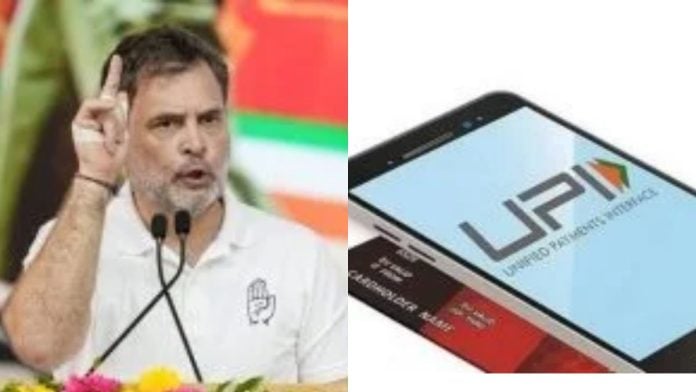
New Delhi: Leader of Opposition (LoP) in Lok Sabha Rahul Gandhi on Wednesday demanded that the government roll back the charges being introduced on certain commercial UPI transactions above Rs 2,000, alleging that the move would benefit the US.
Rahul went on to invoke former prime minister and his grandmother Indira Gandhi while attacking Prime Minister Narendra Modi over the issue.
“Once, Indira Gandhi ji was asked whether her inclination was towards the left or the right…? Her response was — neither towards the left nor the right; I keep my spine straight,” he said in a video posted on X.
“But Modi ji’s principle is different; he has decided to lie down flat in front of Donald Trump,” he said. “To provide massive profits to America, he has imposed charges on UPI and levied a tax on every single Indian.”
“Modi ji, keep your spine straight and roll back the UPI tax.”
Modi ji, roll back the UPI tax. Now. pic.twitter.com/IIt46zMgCG
— Rahul Gandhi (@RahulGandhi) September 16, 2026
The LoP had questioned the government’s assertion that customers would not be charged directly if a fee was imposed on merchants.
“The government says no fees will be charged to customers. But where will the fees imposed on shopkeepers ultimately come from? Added to prices, straight out of the customer’s pocket,” he had said on Tuesday.
Congress leader Jairam Ramesh also hit out at the Modi government, posting that the “U-turn Ustad owes an explanation for his somersault”.
Ramesh shared a 11 June, 2025 post from the Finance Ministry which said: “Speculation and claims that the MDR will be charged on UPI transactions are completely false, baseless, and misleading.”
Merchant Discount Rate (MDR) is the fee a business pays to process digital payments like credit cards, debit cards, or select high-value UPI transactions.
At a press conference on Wednesday afternoon, All India Congress Committee (AICC) social media and digital platforms chairperson Supriya Shrinate also questioned the decision to introduce MDR on certain UPI transactions.
“Running UPI costs Rs. 20,700 crore a year. Last year, the RBI transferred Rs. 2.87 lakh crore as surplus to the government. The government and RBI can cover the entire UPI cost by using just 7% of that surplus,” she said.
Shrinate also pointed to the Modi government’s moves on MDR in August and September.
“In August, the Modi government introduced the Taxation and Other Laws Amendment Bill to enable MDR on UPI. On 6 August, Finance Minister Nirmala Sitharaman told Parliament that no decision on MDR had been taken,” she said.
“On 14 September, a notification was issued late at night imposing MDR on commercial UPI transactions above Rs. 2,000,” she said, alleging that it was an attempt to weaken UPI and give American companies a larger share of its earnings.
“It has been done at America’s behest, with a compromised Prime Minister bending to Trump’s pressure,” she said.
What new framework says
The Finance Ministry’s 14 September notification did not itself set an MDR rate for UPI transactions above Rs 2,000. It specified that UPI transactions up to Rs 2,000 would be protected from direct or indirect charges by banks or system providers.
Subsequently, the Modi government announced the new MDR framework. From 15 October, a 0.4% MDR will apply to specified person-to-merchant UPI transactions above Rs 2,000, with a cap of Rs 300 for transactions of Rs 75,000 and above. Person-to-person transactions will remain free, while transactions covered by the zero-MDR framework for small merchants will also remain free.
Banks, it said, have been advised to ensure merchants do not pass the MDR on to customers, while UPI app providers cannot impose platform or hidden charges.The government estimates that around 96% of merchant UPI transactions will remain unaffected by the new framework.
(Edited by Tony Rai)
Also Read: Congress takes aim at Modi govt over UPI notification. ‘Quietly opens door to charges,’ says Rahul