





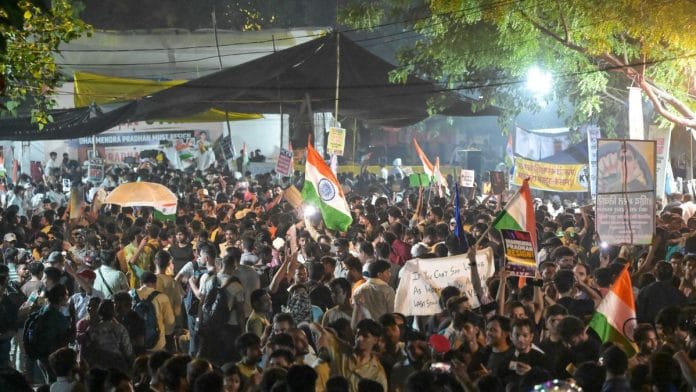



As a wave of student-led protests swept India last week, Satvik Soni spent hours buried on Instagram broadcasting protest locations, explaining detainees’ rights and calling on demonstrators to report police misconduct. His tersely worded posts quickly racked up tens of thousands of views.
Prime Minister Narendra Modi’s government struggled to catch up. As the movement gained steam, Modi’s allies took to X and WhatsApp, accusing the movement of being backed by foreign forces. They blocked the Cockroach Janta Party’s main account on X and cut internet access at gathering spots, following a playbook New Delhi has used to quash unrest in Kashmir and other hotspots.
It didn’t work. Fueled by tongue-in-cheek memes and viral reels of a police crackdown, India’s Gen-Z protesters outmaneuvered Modi online at virtually every turn, calling into question the Indian leader’s longstanding dominance of the country’s digital landscape — instrumental in propelling him to power 12 years ago, and in helping him maintain control since.
Using coordinated hashtags, synchronized posting times and pre-written scripts passed across WhatsApp groups, Modi’s Bharatiya Janata Party over years built a digital mass-communication machine that helped him win three national elections and cement his image as one of the world’s most digitally savvy politicians.
Yet Indian authorities struggled to keep pace with the protest movement, which instead flooded Instagram — the Meta Platforms Inc. service largely neglected by the BJP — with posts and reels, coordinating demonstrations and spreading viral content to Indian youths.
“I used Instagram because I have never really understood X, and I do not think this generation is there in the same way,” said Soni, a 25-year-old filmmaker from Mumbai. “Younger people rely largely on Instagram.”
The episode offers an early test of whether India’s most powerful political party can meet the country’s huge young electorate where it actually spends most of its time. A vast cohort of young first-time voters is set to cast ballots in state elections next year and in a national vote by 2029.
Demonstrators and digital experts say the movement’s online success stemmed in part from its irreverent, meme-able tone. Dressed in Instagram-ready costumes, protesters danced and waved signs with nods to Gen-Z slang or pop culture. One widely shared reel riffed on a popular video format in which a user invites viewers to “get ready with me” for the day — except the young woman opened with: “Get ready with me to witness the downfall of a government.”
Images and videos of the police crackdown also went viral, helping to stoke sympathy for the movement. In one widely shared video, a woman in a hoodie was filmed blocking a police bus with her hand. In other reels, demonstrators taunted police to unleash water cannons on them to help them cool down.
Several creators said they began amplifying the protests because they felt mainstream media wasn’t fully capturing events on the ground.
“People were on the lookout for creators specifically talking about these kinds of things on Instagram,” said Yashaswinee Raje Singh, a 28-year-old New Delhi-based lifestyle influencer. She posted to her 183,000 Instagram followers throughout the protests, saying short reels and “carousel” posts of numerous swipeable photos made the information “easily digestible.”
“The novelty was that these memes, these sound-bytes — people shared them themselves, and it’s an emotional outburst,” said Neelanjan Sircar, an associate professor at Ahmedabad University. “That is something the government can’t control very easily.”
A BJP official acknowledged that the government didn’t expect a Gen-Z protest movement to erupt on Instagram, saying the party’s strengths have long been WhatsApp and X, formerly Twitter. For voters 25 to 50 years old, WhatsApp is the key communications channel, with the party running chat groups from the national level all the way down to the village, the official said, asking not to be identified because the discussions are private.
The BJP has since realized it’s lagging behind in its outreach to younger citizens, the official said. As a result, the party is encouraging leaders to raise their Instagram profile by sharing more inspiring videos on the platform and highlighting Modi government programs.
A BJP spokesperson didn’t respond to a request for comment.
In one sign of the renewed effort, Modi took to Instagram in a late-night selfie video last week, where he called the leak of school exam questions — one of the main causes fueling the protests — “extremely painful.” BJP officials said the post drew more than 303 million views within 24 hours.
Several cabinet ministers have also boosted their Instagram activity. The BJP’s official account published a reel — “PM Modi is there for you” — to the opening tune of the sitcom “Friends.” The change in tone reached parliament this week, where Gen-Z slang like “delulu” and “FOMO” turned up during a debate on the government’s new education bill.
“The BJP is essentially from the WhatsApp generation,” said Chetna Kumar, a geoeconomics analyst at Bloomberg Economics. The party missed the protest movement, she said, because “it was not tracking the spaces where young people were talking to one another.”
Still, many young demonstrators aren’t yet moved by the government’s shift. To Soni, it was ordinary people who became the movement’s defining voices, rather than the politicians.
“Countless everyday leaders emerged during the protests,” he said. “Joy can itself be a form of resistance.”
Disclaimer: This report is auto generated from the Bloomberg news service. ThePrint holds no responsibility for its content.