




Thiruvananthapuram: In its first budget after coming to power, the Congress-led UDF government focused on investment and infrastructure, marking a significant departure from the previous LDF government’s interim budget, which centred more on welfare measures.
The revised 2026-27 Budget announced a Rs 400-crore Mission Samudra, a Congress pre-poll promise aimed at transforming Kerala into a ‘port city’ by leveraging its 600-km coastline.
It also proposed the Southern Kerala Economic Corridor linking Thiruvananthapuram, Kollam and Alappuzha, alongside a Rare Earth and Critical Minerals Corridor, to attract investment by capitalising on the region’s strengths in technology, minerals, ports and the coastal economy.
Another major announcement was Land Reforms 2.0, aimed at utilising surplus government land to attract more investments.
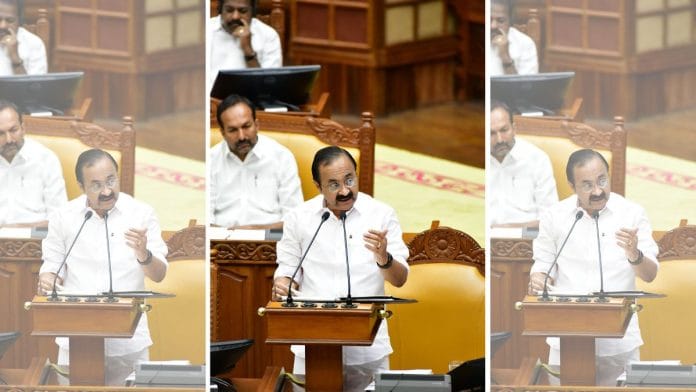
“My government is steadfastly committed to ushering in a ‘New Age Kerala’ (Puthuyuga Keralam), an era that harmonises economic growth driven by social justice with modern, environmentally responsible infrastructure development,” said Chief Minister V.D. Satheesan, who also handles the finance portfolio.
Satheesan began his speech by citing the White Paper published earlier this month. He stated the state had a debt burden of Rs 5.07 lakh crore, while salaries, pensions and interest payments account for a staggering 77 percent of total revenue receipts. Interest payments alone account for 20.9 percent of revenue receipts.
The White Paper also alleged that the previous LDF administration overestimated revenues by Rs 20,500 crore, resulting in a reduction of the annual plan outlay by Rs 5,000 crore compared with the interim budget announced by the LDF government in January.
However, the budget invited sharp criticism from the opposition LDF, which alleged that the UDF government’s first budget focused heavily on the privatisation of mining and the state’s coastline.
“In the last Union Budget, the central government had announced a rare earth corridor connecting Kerala, Andhra Pradesh and Odisha. The idea has been emulated by the UDF, which can be seen in several projects aimed at opening up the mining of rare earth minerals through the corridor,” said leader of opposition Pinarayi Vijayan, adding that the previous LDF government had envisaged the project with a focus on the public sector.
Mission Samudra and Land Reforms 2.0
In a budget focused on investment and infrastructure, the most significant announcements were Mission Samudra and Land Reforms 2.0.
The mission aims to integrate the state’s 600-km coastline, two international seaports, a container transshipment terminal, 17 non-major ports and other marine resources in a bid to place Kerala prominently on the global maritime map within the next five years.
The budget said that manufacturing zones, stuffing centres and dry ports will be established near the Vizhinjam and Kochi ports.
It added that Vizhinjam will become India’s primary port offering green bunkering services, alongside a shipbuilding and maintenance hub near the port, which the government said would boost employment opportunities for coastal communities.
Besides this project, the government will formulate a comprehensive Kerala Maritime Policy focusing on the development of the state’s four primary non-major ports — Vizhinjam-Kovalam, Kollam, Beypore and Azhikkal — by promoting seaborne freight transport, port-led industries, logistics and allied shipping activities.
The policy will also seek to develop the remaining 13 non-major ports to promote maritime tourism, logistics, maritime industries, maritime legal education and the establishment of a maritime museum through public-private partnerships.
The budget proposes a Southern Kerala Economic Corridor linking Thiruvananthapuram, Kollam and Alappuzha into a unified economic zone, leveraging the region’s port infrastructure, critical mineral resources, technology institutions and coastal economy to attract private investment.
Under the plan, Thiruvananthapuram will be developed as a knowledge and space technology hub, Kollam as a centre for mineral processing and rare earth industries, and Alappuzha as the country’s blue economy capital.
The government has earmarked Rs 100 crore for the Rare Earth and Critical Minerals Corridor and Rs 50 crore for the Southern Kerala Economic Corridor, while a detailed project report will be prepared to identify infrastructure needs and policy interventions.
Another major announcement proposes developing Kerala into South India’s leading aviation and logistics hub by leveraging its four international airports.
The budget also allocated Rs 200 crore for preliminary activities under the plan, which includes strengthening the aircraft Maintenance, Repair and Overhaul (MRO) sector, establishing simulator-based pilot training and aviation maintenance institutes, and creating airport-centric economic zones through Aeropark and Aerocity projects integrating IT, GCCs, hospitality and aviation-related services. A new aviation policy will be formulated to support these initiatives.
The budget says the government will also develop integrated packhouses, pharmaceutical cargo facilities, logistics parks and Free Trade Warehouse Zones to boost exports. A world-class Global Convention Centre has also been announced near Cochin International Airport.
A specialised single-window investment facilitation mechanism named ‘Invest Keralam’ has been announced to improve Kerala’s investment climate by addressing longstanding bottlenecks such as land acquisition delays, high costs and regulatory hurdles. An Investment Advisory Council chaired by the chief minister will oversee major projects.
Another significant proposal is Land Reforms 2.0, aimed at overhauling outdated land laws to speed up land conversion for commercial projects.
The move has been announced as part of a Land Management Policy to address land scarcity and ease industrial development. The announcement assumes significance as the state was considered a pioneer in land reform in the 1960s and 1970s, which dismantled large feudal landholdings and granted ownership rights to tenants and agricultural workers.
Education and infrastructure
The budget outlines major infrastructure projects in the transport, education and sports sectors, including the construction of an international-standard football stadium in the Malabar region to identify and train football talent and host major international matches. An allocation of Rs 50 crore has been made for the project.
Similarly, light metro projects have been announced for Thiruvananthapuram and Kozhikode, with an allocation of Rs 20 crore and Rs 100 crore for renewable and alternative energy initiatives.
The budget proposes a Wayanad Tribal University and Indigenous Knowledge Zone as a centre for higher education, research and socio-economic development, promoting indigenous studies, tribal entrepreneurship and biodiversity conservation. A total of Rs 50 crore has been allocated for the project.
The budget further proposes a Global Job Watch Tower, another promise in the Congress manifesto, to track emerging employment trends and future skill requirements in India and abroad. It aims to align education and skill development programmes with evolving job markets and has been allocated Rs 2 crore initially.
Kerala Knowledge Valley, a world-class higher education hub, has been proposed to reduce student migration from the state. The project will bring together advanced academic programmes, research parks, centres of excellence and leading national and international universities, while strengthening industry-academia collaboration.
The government has allocated Rs 100 crore for the initiative and plans amendments to the Private University Bill to support its implementation.
In addition, Rs 100 crore has been allocated to establish Kerala Health and Life Sciences City, an integrated healthcare hub combining multi-speciality hospitals, medical colleges, research centres, diagnostic facilities and rehabilitation services within a single ecosystem.
The budget also proposes a Rs 50-crore Gen-Z initiative aimed at harnessing the technological skills and creativity of young people to drive innovation, startups, research and smart industries in Kerala.
The programme will focus on emerging technologies such as AI, robotics, data science, IoT and virtual reality, while also promoting digital ethics, privacy protection and cybersecurity, with the goal of making Gen Z a key driver of Kerala’s future economy.
Welfare measures
The revised budget also outlines several welfare measures.
It proposes a ‘One Kerala Karuthal Mission’, a technology-driven platform to provide direct assistance for medical treatment and education to people facing severe financial hardship using donations from CSR funds, NGOs, institutions and individuals.
The budget states that the government will bear all administrative costs to ensure donations reach beneficiaries, with transparent digital verification, beneficiary identification and real-time public disclosure systems. An allocation of Rs 1 crore has been made for the project.
The budget also proposes the development of a Silver Economy centred on Kerala’s ageing population, with a focus on eldercare services, retirement infrastructure, geriatric healthcare innovation and senior entrepreneurship.
For this, a comprehensive Silver Economy Policy and a statewide survey of senior citizens will be undertaken, with funds earmarked for the Department of Elderly Welfare.
Besides this, the rubber support price has been increased from Rs 200 to Rs 250 per kg. The budget also announced a package for the fisher community, including an increase in kerosene subsidy, wage compensation during weather-related fishing bans, land titles for coastal residents without pattayam, and a dedicated housing scheme.
(Edited by Sugita Katyal)
Also Read: Congress govt to implement PM-SHRI in Kerala, with riders. It’s reignited a political row