





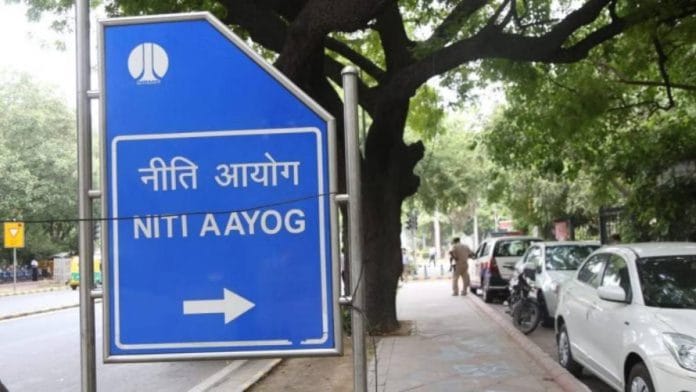


New Delhi: India’s ambition to position itself as a global supplier of skilled workers is being held back by weak migration support structures and poor alignment between state-level skilling programmes and international labour demand, according to a new NITI Aayog working paper released on Wednesday.
The working paper, ‘States Framework: Advancing International Mobility for Skilled Workers’, argues that while countries across Europe, the Gulf, North America and East Asia are grappling with acute labour shortages, India risks missing the opportunity unless states build structured systems for overseas mobility.
The report points to persistent weaknesses in India’s overseas skilling ecosystem. Citing the PRAYAS International Migration and Mobility Mapping Report (2026), NITI’s working paper states, “Access to formal skilling pathways for overseas employment remains uneven across regions and worker categories.”
The paper notes that India’s migration ecosystem remains heavily dependent on informal networks and private recruitment agencies, especially for low and semi-skilled workers, limiting formal skilling necessary for overseas jobs.
“International mobility emerges as an outcome of strong skill ecosystems, rather than a parallel or informal pathway,” the report says.
The report comes at a time when India has the world’s largest overseas migrant population of 18.5 million people and received $137.67 billion in remittances in 2024, accounting for 3.5 percent of Gross Domestic Product. The paper underlines that India’s demographic advantage is time-bound. Citing United Nations estimates, it says India’s working-age population will peak around 2030, after which it will begin tapering off.
At the same time, advanced economies are facing labour shortages due to ageing populations, shrinking workforces and skills mismatches.
According to the paper, Europe currently has around 1.05 crore job vacancies, followed by the United States with 72 lakh vacancies and Gulf countries with nearly 27 lakh.
According to the working paper, a structured and standards-aligned mobility system for skilled Indian workers offers dual benefits—supporting international labour markets facing shortages while reducing pressure on India’s labour market by expanding overseas employment avenues.
However, the NITI paper warns that global migration systems are becoming increasingly selective. “Destination countries actively curate their labour markets based on sectoral demand, skill levels, and perceived social compatibility,” the paper says, adding that many countries now prioritise “economic utility while minimising long-term social or political responsibility”.
The working paper also highlights sharp regional disparities in migration trends in India. While Kerala, Tamil Nadu and Andhra Pradesh are increasingly sending nurses and technical professionals to Europe and North America, states such as Uttar Pradesh and Bihar remain concentrated in low-wage Gulf migration.
Even though Uttar Pradesh and Bihar account for high emigration clearances, their remittance contribution remains comparatively low because workers are concentrated in lower-paying jobs.
The paper also pushes for a “circular mobility” model, where workers gain skills and overseas experience before returning to India and re-entering global labour markets.
According to the report, such a model would allow India to use migration not just as an employment strategy but as a long-term economic and human capital tool. “When framed as a mutually beneficial compact, circular mobility transforms temporary migration into a regenerative economic mechanism,” it says.
Also Read: India’s school system is failing the test. NITI Aayog flags dropouts, weak learning outcomes
NITI recommendations
The federal think tank lays out a framework for states to build structured overseas employment ecosystems. The working paper recommends that states identify sectors with strong international demand and align local skilling programmes accordingly.
The NITI Aayog has suggested district-level assessments of migration trends, training capacity and diaspora networks to identify high-mobility districts.
The paper also calls for the creation of state migration dashboards integrated with the Centre’s eMigrate and National Career Service platforms.
Another recommendation is specialised “finishing schools” within the state skilling ecosystem. It calls for upgrading ITIs, polytechnics and skill centres to prepare workers for foreign labour markets. These institutions would provide training on language, cultural orientation, soft skills and internationally benchmarked technical needs.
It also recommends bilateral agreements with destination countries and employers for mutual recognition of qualifications, curriculum alignment and predictable recruitment pipelines. “These agreements should establish well-defined frameworks for worker recruitment, deployment, employment conditions, and dispute resolution while ensuring compliance with international labour standards and human rights conventions,” it says.
The paper additionally recommends stronger language and cultural preparation for workers before departure, arguing that psychosocial readiness is becoming critical in increasingly competitive migration markets.
The NITI paper positions overseas mobility as part of India’s broader economic strategy. “With a structured, scalable, and inclusive approach, States can unlock the full potential of international mobility,” it says, helping India emerge as the world’s “Global Skills Capital”.
(Edited by Nardeep Singh Dahiya)