





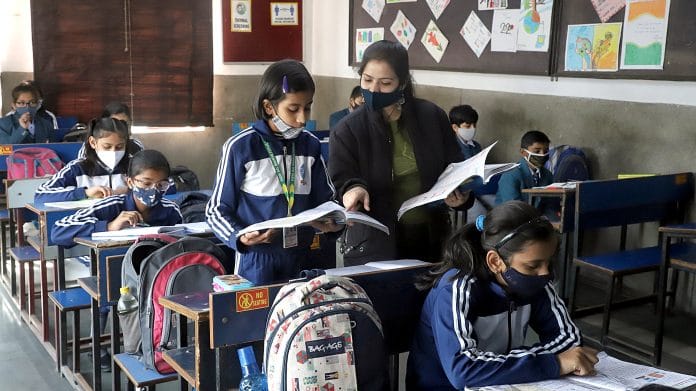


New Delhi: India has nearly achieved universal enrolment at the primary level, but its school education system continues to grapple with deep structural problems – from over one lakh single-teacher schools and massive teacher shortages to sharp dropout rates after Class 10, and weak learning outcomes despite rising private school enrolment.
These findings are part of a new NITI Aayog report, ‘School Education System in India: Temporal Analysis and Policy Roadmap for Quality Enhancement’, released Thursday. The report says India currently has 14.71 lakh schools serving 24.69 crore students, but warns that access alone has not translated into quality learning or continuity in education.
The report draws on data from the Unified District Information System for Education (UDISE), PARAKH Rashtriya Sarvekshan 2024, National Achievement Survey (NAS) 2017 and 2021, and the Annual Status of Education Report (ASER) 2024.
One of the strongest concerns raised is the fragmented structure of India’s school system. While the country has 7.3 lakh primary schools (Classes 1-5), the number drops sharply to just 1.42 lakh for secondary schools (Classes 9-10). “Only ~5% of schools in India offer continuous schooling from Grades 1 to 12,” the report states.
As a result, students are often forced to change schools after the fifth, eighth, or tenth grade. These transitions contribute to poor retention and lower progression to higher classes.
The transition from secondary to higher secondary (Classes 11-12) remains a major weak point. Although the national transition rate improved from 67.7 percent in 2014-15 to 75.1 percent in 2024-25, the report says this stage “remains a critical point of attrition in the school cycle”.
The Gross Enrolment Ratio (GER) at the higher secondary level stands at just 58.4 percent nationally. Bihar (38.1 percent), Meghalaya (39.7 percent), Nagaland (39.8 percent) and Assam (43.5 percent) are among the worst-performing states.
Dropout rates rise sharply after elementary education. While primary-level dropout has fallen to 0.3 percent nationally, it increases to 3.5 percent at upper primary, and jumps to 11.5 percent at the secondary stage.
The report notes that “financial constraints, early entry into the workforce, and social pressures continue to impede progression” after Grade 10.
Teacher shortages remain another major concern. India has around 1.01 crore teachers, but “significant shortfalls in teacher availability continue to affect the delivery of quality education, particularly in rural and underserved regions,” the report says.
Bihar alone has more than 2.08 lakh vacancies at the elementary level, besides 36,035 vacancies in secondary schools and 33,035 in senior secondary schools. Jharkhand, Madhya Pradesh and Karnataka also report large shortages.
The report notes that around 1.04 lakh schools — over 7 percent of all schools — operate with just one teacher. These teachers are expected to handle multiple grades while also managing administrative duties and mid-day meals. Nearly 14 percent of planned teaching days are lost to non-academic work such as elections and surveys.
NITI Aayog has also flagged the growing number of extremely small schools. More than one-third of schools in India have fewer than 50 students, with many functioning with minimal infrastructure and staff.
“The small size of these schools has made their operation economically inefficient and administratively challenging, particularly with respect to teacher deployment and the provision of essential physical infrastructure,” the report states.
The report also points to weak teacher preparation. Data from NITI Aayog’s SATH-E (Sustainable Action for Transforming Human Capital-Education) programme found that “many teachers score below 60-70 percent in subject papers of the grades they teach”, indicating gaps in foundational knowledge in Mathematics, Science, English and Hindi.
Only 10-15 percent of candidates appearing for the Central Teacher Eligibility Test (CTET) and State TETs score above the 60 percent qualifying threshold. Average marks in primary level mathematics hover around just 46 percent.
The report further highlights the growing shift toward private schools, driven by parents’ perceptions that they offer better discipline, English-medium instruction and employability. Government school enrolment has fallen from 71 percent in 2005 to 49.24 percent in 2024-25, while private schools now account for 44.01 percent of all secondary institutions.
But the report suggests that private schools are not necessarily delivering better outcomes. It found that 35 percent of class 5 students in low-fee private schools cannot read a class 2 textbook, while 60 percent are unable to solve a basic division problem.
It also criticises the weak regulation of private schools, saying many low-fee institutions lack proper infrastructure, trained teachers and oversight. Parents, it says, often choose schools based on “proxies like English-medium instruction or digital boards” rather than actual learning outcomes.
NITI’s recommendations
To address these issues, NITI Aayog has proposed a series of reforms covering governance, pedagogy, infrastructure and technology.
Among its biggest recommendations is moving away from the current pyramidal school structure toward a “cylindrical” model built around composite schools offering education from Grades 1 to 12.
“A cylindrical structure enables students to move through primary, upper-primary, secondary and higher secondary stages within coherent institutional arrangements, reducing unnecessary transitions and supporting smoother academic progression,” the report states.
The report also calls for a shift from “textbook completion to foundational mastery”, recommending that children be taught at their actual learning level rather than strictly by grade.
Interestingly, NITI Aayog also advocates integrating Artificial Intelligence into classrooms, while cautioning against overuse. It says AI should assist teachers rather than replace them and recommends introducing AI literacy from upper primary onwards.
“In light of emerging research on the cognitive effects of AI overuse, balanced digital exposure and age-appropriate safeguards should be incorporated to sustain learners’ attention, creativity, and independent thinking abilities,” the report says.
Regarding classroom teaching, the report recommends that professional development move beyond “occasional, lecture-based sessions” toward sustained, practice-centred learning, including structured career pathways for teachers – from senior to master to mentor-teacher roles. It also asks that teachers be freed from non-teaching duties.
Framing the reforms as part of a proposed “Sushikshit Bharat Abhiyaan”, the NITI Aayog report says that piecemeal reforms will no longer be enough. “Incremental change will not be sufficient; meeting the aspirations of a resurgent India will demand a system-wide transformation of school education,” it adds.
Also read: UGC’s draft mental health norms call for standardised student-counselor ratio, well-being centres
One of the impediments in good learning process is the insufficient fund allocated for education by the central government and the governments of the states. The central government allocates less than 0.5 percent of our GDP. It should spend atleast 1 percent of the GDP for education.
Most of the state governments spend around 2 percent of their respective GSDP. Each state government should spend atleast 3 percent of its GSDP for education.
Nehru messed up when it came to building the education system. He took a top to bottom approach which is why have good public universities but horrendous public schools.
This is something which the govt needs to focus on immediately. Reforming the education system whether it’s in the bottom or the top is needed. We don’t learn things, we have been taught to memorize them. We have been taught not to challenge teachers.