



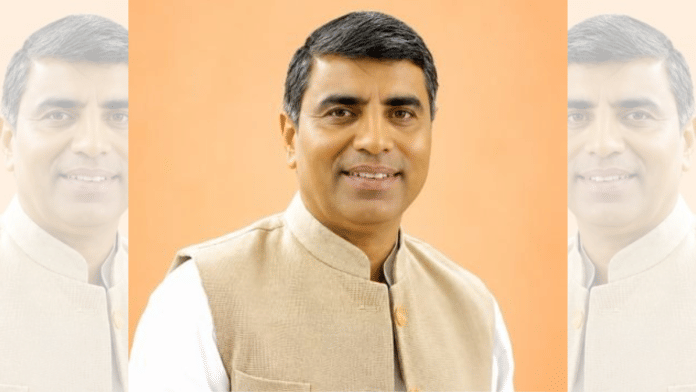

Gurugram: Haryana Education Minister Mahipal Dhanda has issued a standing order laying down exactly which officer in his department gets to decide what — from posting a Group A officer to writing off a lost government typewriter worth a few thousand rupees.
The 12 August order issued under Rules 18 and 19 of the Rules of Business of the Government of Haryana, 1977—framed under Article 166 of the Constitution—was circulated on 19 August by the Superintendent Administration on behalf of the Principal Secretary, School Education Department, Chandigarh.
Copies went to the governor’s office, the Chief Minister’s office, the Chief Secretary, and every branch officer and superintendent in the Directorates of Secondary and Elementary Education.
A senior officer in the School Education Department, requesting anonymity, told ThePrint that the order was meant to remove any confusion over who has the authority to decide what.
“Files may sometimes get held up when officials are not sure at what level a case should be cleared. This order settles that — every category of case now has one officer clearly marked against it, so there’s no scope for confusion or delay,” the officer said.
At the heart of the order are five annexures, each a checklist of decisions related to the department by a rung of the bureaucracy.
Annexure A is the chief minister’s list—education department subjects on which the decision has to be taken by the chief minister. These include appointments, promotions, dismissals and prosecution sanctions of Group A officers, framing of new service rules, and any case involving a “major question of policy”.
It also keeps some business at the top: annual confidential reports of administrative secretaries and directors general, and cases where the minister-in-charge and his administrative secretary simply disagree.
Annexure B belongs to the minister-in-charge himself: transfers of Group B, C and D staff, administrative approval for building works and equipment purchases above Rs 10 lakh, and permission for officers to write books.
Tucked into the same list are decisions with more public resonance — taking over privately managed educational institutions, declaring government girls’ schools co-educational, and naming government or aided institutions after defence and paramilitary martyrs, freedom fighters or “eminent personalities.”
The list closes with a catch-all line: “generally, all matters related to educational institutions of the Government.”
Below that lies Annexure C, for the Additional Chief Secretary, Principal Secretary or Commissioner-cum-Secretary — financial irregularities up to Rs 10 lakh, extension of service beyond 55 years for senior officers, sanction for foreign travel by Class-I and Class-II officers, and references to the Haryana Public Service Commission.
Annexure D goes to the Secretary or Special Secretary — medical reimbursements up to Rs 3 lakh at hospitals outside the approved list, appeals against penalties imposed by field officers, permission for non-gazetted officers to travel abroad on personal visits, and NOCs for passports for Group A and B officers.
The smallest cases fall to the Joint Secretary or Additional Secretary under Annexure E — write-offs of lost government money or stores up to Rs 25,000, casual leave for the Under Secretary, and even requests from non-gazetted staff to change their name or date of birth in service records.
The order also builds in a fallback chain for urgent matters when the minister is out of Chandigarh — such cases can be cleared by the Additional Chief Secretary or Principal Secretary, and if that officer too is away, by the Secretary or Special Secretary concerned, with the file shown to the minister on his return “for information and orders as he may deem fit.”
A clause in the order states that no decision can later be challenged in a representation, enquiry or court merely on the ground that the file did not receive approval from the prescribed authority — a provision meant to insulate routine departmental orders from procedural challenges.
The order explicitly supersedes every previous delegation order issued in the department “from time to time,” and states that any conflicting rules stand overridden by virtue of the powers vested in the minister under Article 166.
(Edited by Ajeet Tiwari)
Also read: Only 1 of 10 Haryana tehsildars clears Criminal Law paper as departmental exam sees mass failures