



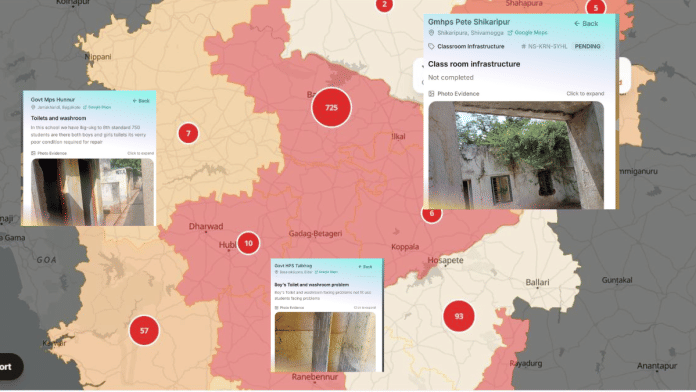
Bengaluru: Over 1,300 complaints of broken toilets and crumbling infrastructure in government schools were registered in about a month, yet none have been resolved so far by Karnataka’s education department.
That’s the status of complaints registered on nammashale.in (Kannada for my school), a privately developed portal through which anyone can identify problems in a public school, geotag them, and bring them directly to the attention of the authorities.
“We have been getting reports from every district since we launched the portal in August. We have tried to get the education department to take notice of these complaints and fix these schools but there is no response from authorities,” Dhruv Jatti, the 27-year-old founder of the portal, told ThePrint.
The portal attempts to replace the older system of manual representations to government offices with location-tied, automated 30-day escalation to senior department officials and community verified fixes.
The portal has mapped 48,000 government schools in Karnataka. Any individual near a government school can upload pictures of broken toilets, crumbling infrastructure and other problems which then get uploaded to the site and shared with senior officials of the education department.
Portals like nammashale are part of a growing number of startups and privately-developed technological interventions that offer solutions for pressing problems.
In Bengaluru alone, there have been technological offerings to report uncleared garbage, detect potholes, report bribes, and several others trying to get the authorities’ attention to act on overlooked problems.
Although the Karnataka government has called on innovators and startups to develop technology-driven solutions for real world problems, authorities have resisted deploying these solutions.
Tech aversion?
Senior government officials said that only commissioned interventions would be accepted.
“We have a system of emails, letters, petitions and other forms of receiving grievances. The Praja Seva portal (launched by Chief Minister D.K. Shivakumar as part of his 100 days in office) has been aggregating all grievances which the government will take forward,” a senior government official said.
However, developers argue that despite the absence of such interventions, the government shows little interest in implementing solutions that would not only save time and money but possibly trigger a far more effective, public-driven response mechanism that enhances the visibility of grievances and their redressal.
Currently, public shaming of authorities on social media appears to be the most effective way to get the government’s attention, if not any ensuing action.
In September, the Greater Bengaluru Authority (GBA), the city’s civic body, said it was developing Sahaaya 3.0 to “fix one of the biggest frustrations with Bengaluru’s civic complaint system: complaints getting closed while the actual problem is still there.” However, the GBA is still taking feedback on the technology itself, and not the problem.
Interestingly, several other state governments have been quick to reach out to startups developing such tech interventions for their respective regions.
Gaurav Sen developed Pothole Reporter, an app which detects potholes while driving, pulls up details of the contractor who laid the road, dates and even the agency responsible for the road’s upkeep.
It was an attempt for citizens to bring these issues to the government’s attention and help rid Bengaluru of its taint of becoming synonymous with potholes and crumbling public infrastructure.
Sen garnered interest from political leaders in West Bengal, the Chennai city corporation, and even Andhra Pradesh Deputy Chief Minister Pawan Kalyan, but none from Bengaluru’s civic authorities, except one tech-savvy IAS officer from the Bangalore Development Authority.
Nammashale is in a similar position. The portal has already been noticed and its developers have interacted with the Tamil Nadu education department but there’s no action in Karnataka yet.
“We have no dearth of reporting mechanisms and Karnataka is way ahead of its counterparts when e-governance is concerned,” the government official cited above said.
However, innovators and civic groups argue that privately-developed tech interventions would not be necessary if the government system functions efficiently. Another senior government official said that regulatory reasons add to delays in adoption and implementation of such partnerships.
Earlier this month, Karnataka IT Minister Priyank Kharge launched the first call under its ‘Government First’ initiative, inviting local startups to develop and deploy solutions to on ground challenges identified by the authorities. But the government is yet to even consider—let alone adopt—any such interventions that it has not commissioned–free or otherwise.
(Edited by Nardeep Singh Dahiya)