



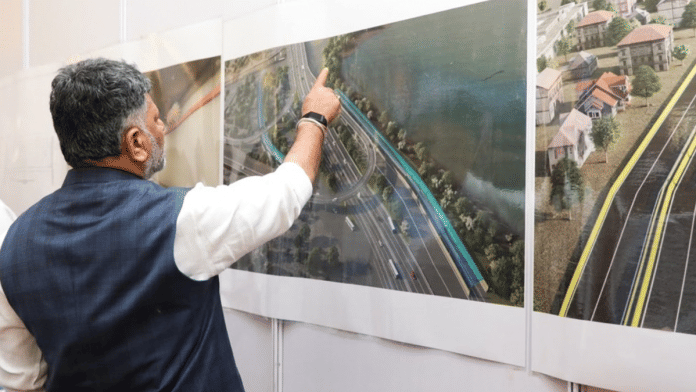
Bengaluru: Decongesting Bengaluru road, or just shifting traffic bottlenecks! The argument has divided policymakers, academia and activists in Bengaluru over the proposed 2.2-km Hebbal short tunnel road.
Policymakers argue that the proposed tunnel will ease traffic congestion at one of the busiest junctions in Bengaluru, while mobility experts and critics say it will bring short-term relief but cause irreversible damage in the long term.
They flag several issues related to the project including the felling of 1,128 trees, and draining of the Hebbal lake to build the tunnel.
However, Bangalore Development Authority (BDA) chairman N.A. Harris, a senior Congress legislator, said the tunnel is a “targeted intervention to address the existing bottleneck at the Hebbal Junction”.
“The project has been assessed in the context of the surrounding road network and approaches, with appropriate traffic-management measures planned,” he told ThePrint.
The D.K. Shivakumar-led Congress government approved the Hebbal–Mekhri Circle project in December 2025. The 2.2-km tunnel is estimated to cost Rs 1,385.28 crore, according to the Detailed Project Report.
The proposed tunnel—about 60 feet below the surface with six lanes measuring around 3.5 metres each–will run between Hebbal Junction and the University of Agricultural Sciences (UAS) Staff Quarters, according to the BDA’s project proposal.
Chief Minister D.K. Shivakumar laid the foundation stone for the Hebbal short tunnel project on 28 June 28. The construction has begun, with preliminary works and excavation underway at the site.
The government claims that the project is crucial to ease congestion between Mekhri Circle and Hebbal Junction. Hebbal Junction further connects Bengaluru city to its northern localities as well as the Kempegowda International Airport Bengaluru
However, academics have flagged the project as a mere shifting of bottlenecks—an Indian Institute of Science study says congestion could shift to the tunnel’s entry and exit points, particularly around the Veterinary Hospital and Esteem Mall, with queues potentially extending towards Mekhri Circle.
The critics have also argued it will increase dependency on private mobility.
Also read: Chennai vs Bengaluru—where did the Great Trigonometrical Survey of India begin?
‘Functional connectivity’
Ashish Verma, the convener of Indian Institute of Science’s (IISs’s) Sustainable Transportation Lab which studied the tunnel project, told ThePrint that the short-tunnel is unlikely to fix the problem.
“The Hebbal Short Tunnel will not even provide immediate relief, as the traffic congestion will not be eliminated; rather it will be pushed to bottleneck points after the entry/exit points of the tunnel,” he said.
Citizen groups are also pushing the government to rethink the proposed project.
On Sunday, hundreds of Bengaluru residents formed human chains around trees to protest the proposed felling of over 1,128 trees for the Hebbal Short-Tunnel project while demanding dialogue with stakeholders.
Of these, 56 are proposed to be felled and 1,072 for transplanted, subject to approval from the Tree Committee.
Satya Arikuthram, former chief technical adviser to Karnataka’s Directorate of Urban Land Transport (DULT) who is now an independent mobility consultant, said in an X post that two laws—Karnataka Tank Conservation & Development Act, BMLTA Rule 24—were amended to get the project “pre-approved” status.
“Wonder why the Govt did not amend the Tree Act to get away with tree cutting without explaining?” he said.
Apart from the felling of trees, the tunnel is also expected to take over 3.5 acres of Hebbal lake—one of the few waterbodies that was well-maintained until a partial draining out carried out between early and mid-February 2026 by the BDA to make way for the project.
The BDA also told ThePrint that it had commissioned a feasibility and impact study through IIT-Bombay to examine the project.
According to the BDA, the study examined the proposed elevated corridor—the proposed 1.8-km four-lane elevated corridor connecting Mekhri Circle to Veterinary College/Hebbal which is being planned alongside the tunnel as part of the same traffic solution—and the underpass as complementary interventions that could work together as part of the overall road network.
Responding to the concerns raised in the IISc study, the BDA told Verma in a letter on 16 September that the tunnel and elevated corridor were “functionally connected” and were meant to work as an integrated traffic solution.
The BDA said the combined impact of the two projects should be assessed based on congestion reduction, travel-time savings, uninterrupted traffic movement and changes in traffic distribution.
Verma and the others question how this would be possible since there are over 1.3 crore registered vehicles in Bengaluru with nearly 2,000 new ones added each day.
Several activists and opposition leaders have asked the government to instead focus on enhancing mass mobility solutions, including completing the long-delayed metro rail stretches on congested roads.
Velamarthi Venkatachalam is an alumni of TPSJ and is currently interning with ThePrint
(Edited by Ajeet Tiwari)
Also read: Tunnel vision or silver bullet? Why Bengaluru’s Rs 17,700 cr underground road project is facing oppn