



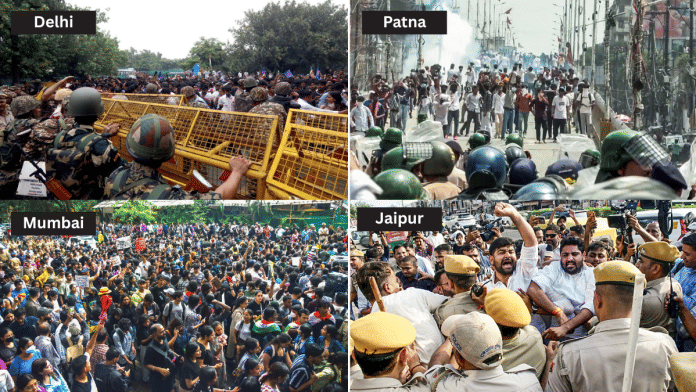

New Delhi: Even as several states and Union Territories, including Delhi, Assam, West Bengal and Bihar, have issued directions to review or withdraw cases against protesters who attended Cockroach Janta Party (CJP)-led demonstrations, FIRs cannot be closed overnight merely on the basis of government orders.
In line with the government’s acceptance of the CJP’s demand that protesters should not face criminal cases, the police may move to file closure reports. However, legal experts say such closures would not be on the ground of “lack of evidence” but instead rely on the Supreme Court’s 28 July order restraining coercive action against peaceful protesters without criminal antecedents, or on subsequent government directions.
The final decision rests with the court. Any closure report filed by the investigating agency must be examined and approved by the court, which is free to accept or reject it, multiple experts told ThePrint.
“Once an FIR is registered, it is the property of the court. There is no provision that allows for withdrawal of an FIR. A closure has to be filed or the High court has to be approached for quashing. This can only be done through the prescribed legal process and is not something that takes effect merely because the government has issued an order,” a senior police officer explained.
Any decision by the government not to pursue prosecution is routed through the public prosecutor. Referring to the government’s direction, the prosecutor may move the court stating that the state does not wish to continue with the prosecution.
Legally, there is a provision for withdrawal from prosecution under Section 360 of the Bharatiya Nagarik Suraksha Sanhita (BNSS). It allows a Public Prosecutor or Assistant Public Prosecutor to withdraw from the prosecution of an accused at any time before the judgment is pronounced, but only with the consent of the court. If the withdrawal is sought before charges are framed, the accused is discharged. If it is sought after charges have been framed, it results in an acquittal.
Senior advocate Maninder Singh told ThePrint that a political announcement to withdraw cases does not automatically terminate the criminal proceedings.
“It merely empowers the prosecution, the public prosecutor, who appears on behalf of the state, to move an application before the court seeking withdrawal from prosecution. Thereafter, the magistrate has to follow the procedure prescribed under law.”
He added that once such an application is considered by the court, the Delhi Police may rely on the government’s executive order while seeking closure of the case. The court has to follow the procedure as per law and call the victim in the case to accept the withdrawal or give objections.
Singh said that where victims oppose the withdrawal, they may file a protest petition before the court. In such cases, the court may reject the request, direct investigation depending on the facts of the case. “There can, therefore, be no blanket withdrawal of cases.”
“The criminal justice system is not executive-driven alone. Once the criminal law has been set in motion, its course is regulated by statute and supervised by the judiciary. A press statement may indicate the Government’s intention, but it is not a substitute for the statutory process prescribed under the BNSS.”
Advocate Vijay Aggarwal told ThePrint, “There is a provision to withdraw from prosecution, and it is invoked quite often. Several cases have been withdrawn in states such as Uttar Pradesh. But even then, there is a prescribed legal process. The withdrawal can take place only with the consent of the court,” he said.
An officer reiterated saying that the legal proceedings come to an end only when the court passes an order accepting the closure. “Until then, the government’s directions are an indication that the state does not intend to actively pursue prosecution, offering relief to the accused.”
A second officer said that ordinarily, when the state seeks to withdraw a prosecution, the magistrate considers the nature of the case. In matters where the state itself is the primary victim—for instance, cases involving damage to public property, rioting or injuries to police personnel, the court may be more inclined to consider the state’s request, the officer explained.
However, where there are private victims, the court is likely to hear them before taking a decision on withdrawal, this officer said.
Former Supreme Court judge Abhay S. Oka said that the Union government can give assurance regarding closure of criminal cases registered by the Delhi Police as it is under the control of the Union government. “However, in the case of other states, the police are under the control of the state authorities. In any case, once an FIR is registered, it cannot be cancelled or deregistered,” he added.
Also Read: Delhi govt says no adverse action against CJP protesters, orders review of arrests in all 13 cases
‘Orders not uniform’
Interestingly, the directions issued by different states are not uniform. While Delhi’s order makes no explicit mention of “withdrawing” FIRs, it merely reiterates the Supreme Court’s 28 July directions, asking police to exercise restraint against peaceful student protesters while making it clear that the protection does not extend to those with criminal antecedents.
In contrast, states such as Bihar have gone a step further by specifically directing the withdrawal of cases against peaceful protesters. Maharashtra, on the other hand, is yet to issue any written order on the matter, even as discussions on the issue continue.
The process will require scrutiny of each case on its own merits. “The Delhi government’s order has been carefully worded. It does not direct blanket withdrawal of cases,” the officer quoted above said. “Instead, it provides for a review of arrests and cases and largely reiterates the Supreme Court’s 28 July directions to exercise restraint against peaceful protesters.”
Further, where the police want to file a closure report, it is likely to rely on the Supreme Court’s order and the government’s review direction rather than citing a lack of evidence. “The police in its report would not talk on the probe but instead cite the SC order and government’s direction to file a closure.”
In Delhi’s order, even the provision relating to arrests speaks only of a “review of arrests” and release. It does not mandate that all accused persons be released or that every case be withdrawn.
“It merely says that arrests already made will be reviewed and releases considered accordingly. This leaves it to the police to decide whether a person should continue to remain in custody,” the officer said.
The Bihar government’s order goes a step further by expressly referring to the withdrawal of cases against peaceful protesters.
“In Bihar, the investigating officer is likely to file a closure report citing the government’s order and stating that no further investigation is required. The public prosecutor will support this before the court, which will then decide whether to accept or reject the report,” the officer said.
The officer added that FIRs registered against “unknown persons”, where no accused has been identified, could be closed relatively quickly. However, cases in which individuals have been specifically named or identified will require a far more detailed legal process before they can be withdrawn, making any blanket, overnight closure of all FIRs “virtually impossible”
While the Bihar Police recorded 64 FIRs, Maharashtra has registered 17 cases, at least seven cases have been filed by Kolkata and 13 FIRs have been registered by Delhi under sections of rioting, vandalism, attempt to murder and obstructing public servant on duty.
(Edited by Tony Rai)