



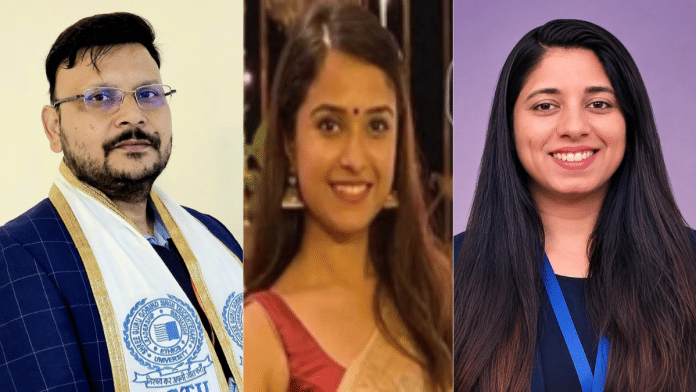
Gurugram: Long before the Bombay High Court’s order questioned how Disha Salian’s front teeth could have broken in a fall that left the rest of her face without a mark, a professor in Gurugram had already put the same question on paper.
Advocate Nilesh Ojha, who represents Disha Salian’s father Satish Salian, engaged Dr Bhoopesh Kumar Sharma, a professor of forensic science at SGT University, Gurugram, in March 2025 to examine two photographs of the deceased alongside her postmortem report.
Sharma, who has worked as a forensic and questioned-document expert for close to two decades, went through the photographs feature by feature.
His report notes the right eyebrow and eye orbit clear of any injury or mark, the eye partially open, the forehead clear, the nose intact and undamaged, and the right cheek showing no evidential injury in either image. In neither photograph, he recorded, was there any sign of bleeding from the face.
ThePrint has accessed a copy of the report prepared and signed by Sharma and another expert, Megha Walia, an associate professor of Forensic Sciences at the same university where Sharma works, on 3 April 2025.
“Advocate Nilesh Ojha contacted me in March 2025 for a report based on two digital photographs and the postmortem report of the deceased, Disha Salian. I worked on it along with my colleague, Megha Walia, and almost in a week’s time, I submitted the report to him for his case before the Bombay High Court,” Sharma told ThePrint.
In his report, Sharma also flagged a detail from the postmortem report that the pictures could not explain. The body, according to point 7 of the postmortem record, was found nude. In his report, Sharma laid out the range of scenarios under which that could happen, from a suicide committed in that state, to a possible sexual assault before the fall, a staged suicide, a bathroom accident, or a threatened or forced fall, and said the clothing itself, its location and condition, needed to be examined as evidence to rule out any of these.
He also flagged point 13 of the postmortem report, which records the facial features as “injured” with the eyes and mouth semi-closed, and noted that this general description of an “injury” did not match what was visible in the photographs, nor did it specify the type or location of any injury.
The sharpest point in his report concerned the postmortem’s finding that the front teeth had fallen out. Sharma wrote that a fall from that height should be expected to distribute impact force across multiple parts of the body, and that the face, being heavily vascular, should show bleeding, abrasions or fractures even from a minor impact, not just broken teeth with no other injury or marks around it.
Front teeth breaking, he wrote, would ordinarily indicate direct impact on the mouth or jaw, which should leave cuts, bruising or swelling on the lips or gums. With none of that visible, he said, one possibility forensic experts would put forth is that damage to the teeth could have occurred separately from the fall, including after death.
“It is scientifically implausible that only frontal teeth would break while the entire face remains uninjured,” he wrote, and called for “a thorough re-investigation by the police or relevant authorities, with the assistance of qualified forensic experts”.
His report’s conclusion held that, prima facie, the circumstances did not align with a death caused by a fall, and that the discrepancies between the postmortem report and the photographs raised serious concerns requiring a fresh probe.
One of the questions the bench raised, while going through the postmortem report, was how a fall from the 12th floor of the building could have left the deceased’s front teeth broken while “not a single facial bone was fractured”, and neither the jaw nor the delicate nasal bone showed any injury. “We find this difficult to accept,” the bench noted.
The nude body was among the circumstances the bench found unexplained. The order records that the police had seized and identified the deceased’s clothes separately, through a panchnama, yet still wrote to the postmortem doctor asking why the body was nude when it reached him, a discrepancy the court said “has remained unexplained”. That is the same detail Sharma’s report had asked to be examined as evidence in its own right, more than a year before the bench raised it.
Ojha has since spoken about the report in a media interview, saying that Sharma’s report formed part of the material placed before the court to argue that the police inquiry had never seriously tested the suicide theory.
Sharma’s report was filed more than a year before the case reached its current turning point. The Central Bureau of Investigation registered an FIR on 14 September into Disha Salian’s death, two days after Satish Salian recorded his statement before the agency. The FIR names no one as accused, in keeping with the Bombay High Court’s direction that nobody be treated as one until the investigation itself throws up grounds for suspicion.
In his statement, Satish Salian named a long list of people whose roles he wanted the CBI to examine: Actor Sooraj Pancholi, bodyguards of Aditya Thackeray, Rhea Chakraborty’s brother Showik Chakraborty, Rohan Rai, in whose flat Disha Salian died, former Maharashtra chief minister Uddhav Thackeray, former home minister Anil Deshmukh, former Mumbai police commissioner Param Bir Singh, former police officer Sachin Vaze, a serving DCP, officers of the Malvani police station, the special investigation team that later probed the case, the doctors who conducted the delayed postmortem, and staff of the forensic science laboratory.
Shiv Sena (UBT) MP Sanjay Raut called the FIR a “political conspiracy” aimed at the Thackeray family. The CBI has not commented beyond registering the case and writing to the Malvani police for all records related to the death.
The FIR follows a 2 September order of a Bombay High Court bench of Justices Sarang V. Kotwal and Ranjitsinha Raja Bhonsale, which found that the Mumbai police’s six-year inquiry under Section 174 of the Cr.P.C. was “inadequate and insufficient” and had left more questions than answers.
The court ordered the CBI to appoint a senior officer, register an FIR, record Satish Salian’s statement and investigate the death without being influenced by the court’s own observations.
With postmortem doctors and forensic lab staff now on Satish Salian’s list to the CBI, the questions Sharma’s report raised sit squarely within what the agency has been asked to examine.
(Edited by Viny Mishra)
Also read: Disha Salian death: Uddhav, Aaditya, Dino Morea, Rhea Chakraborty should be probed, says CBI FIR