



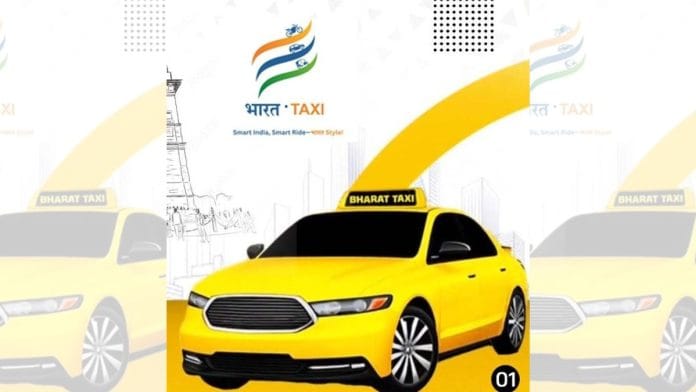
New Delhi: Bharat Taxi, the government-backed cooperative ride-hailing platform, has seen a multi-fold increase in bookings in Chandigarh and Ahmedabad, with driver acceptance rates crossing 80 per cent in both cities, a senior company official told ThePrint.
A driver acceptance rate is the percentage of ride requests a driver accepts out of the total requests offered by a ride-hailing platform.
The platform, launched as a cooperative alternative to private ride-hailing companies, has seen stronger growth in Chandigarh and the cities of Gujarat over the past couple of months, with acceptance rates upwards of 80 per cent, compared with 40-60 percent in other markets.
“We are seeing good traction in Tier-1 cities, with bookings in Chandigarh and Ahmedabad witnessing multi-fold increase in rides. In other cities, the average is between 40-60 per cent, which is also healthy,” the official said.
The higher acceptance rate has been attributed to pricing aligned with rates prescribed by state transport authorities. The company believes this has helped make the platform more attractive to drivers, particularly as it does not rely on the high incentives offered by private aggregators to retain drivers.
Under the cooperative model, Bharat Taxi aims to reduce the commissions paid by drivers to aggregators by enabling direct transactions between drivers and passengers. The longer-term objective is to give drivers an ownership stake in the platform and allow them to participate in its profits.
Bharat Taxi was launched in February by Union Home and Cooperation Minister Amit Shah. Beginning with operations in the Delhi-NCR region, it has since expanded to around 30 cities; 100 cities are targeted by the end of the current financial year.
The platform has so far onboarded more than 10 lakh drivers and 60 lakh commuters, according to the company official.
Also Read: Bharat Taxi sees stronger traction in smaller cities than metros, major expansion on the cards
Hyderabad next, wallet system in works
Bharat Taxi is now preparing to expand into southern India, with driver onboarding already underway in Hyderabad. Commercial operations in the city are expected to begin in November.
The platform is also set to commence operations in Guwahati, Assam, in the coming days.
Beyond intra-city cab services, the cooperative has started inter-city operations on routes including Mumbai-Pune, Delhi-Agra, Delhi-Dehradun, Ahmedabad-Rajkot and Delhi-Jaipur. More routes are expected to be added as the network expands.
The company, however, continues to face competition from established private aggregators who offer drivers higher incentives to encourage ride acceptance.
Bharat Taxi does not intend to replicate that model, the official said, arguing that sustained dependence on incentives would not be viable in the long run. Instead, the platform is seeking to compete through its cooperative structure, pricing and lower dependence on commissions.
To address concerns raised by drivers, the company has also begun holding weekly interactions with its driver partners across cities. These driver samvads are held on Saturdays to gather feedback and address operational issues.
One of the key demands raised by drivers has been the introduction of a digital wallet, a feature commonly available on private ride-hailing platforms.
Bharat Taxi is currently finalising its wallet system and plans to launch it within the current year. The wallet is expected to allow drivers to make payments for expenses such as airport parking and tolls through the platform, while also enabling applicable incentives and other adjustments to be settled digitally.
At present, drivers using Bharat Taxi have to bear expenses such as airport parking charges directly, unlike on some private platforms where such payments can be managed through an in-app wallet.
The cooperative company expects the new system to reduce cash transactions and address one of the operational concerns raised by drivers as Bharat Taxi expands its footprint across the country.
(Edited by Nardeep Singh Dahiya)