


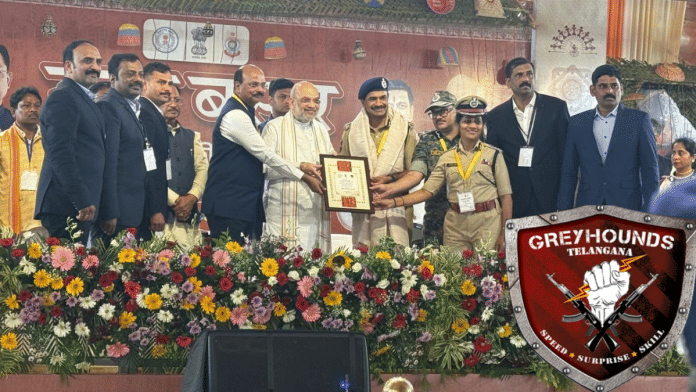
Hyderabad: When Union Home Minister Amit Shah declared in May that India was now Naxal-free, speculation rose about what would happen to the country’s elite forces that battled them in affected states.
In Telangana, Director General of Police (DGP) C.V. Anand announced last month a reorganisation of the state’s anti-Naxal unit, the Greyhounds, the Organisation for Counter Terrorist Operations (OCTOPUS), and the Special Intelligence Branch (SIB) to address evolving security challenges.
Anand said the state’s policing requirements have evolved from the days when tackling Left-Wing Extremism (LWE) and terrorism were the biggest challenges.
Now, new issues such as traffic management and road safety, drugs control, cybercrime, online betting, investment fraud, and food adulteration were major concerns that need addressing, he said.
In line with the new priorities, Greyhounds, OCTOPUS and SIB personnel are being given new responsibilities. Anand, however, emphasised that Greyhounds and OCTOPUS still have sufficient strength for operations, maintenance and training.
Under the reorganisation, 513 staff from Greyhounds, OCTOPUS and SIB—five inspectors, 22 sub-inspectors, 14 assistant sub-inspectors, 84 head constables and 388 constables—have been reassigned to eight departments.
Held the Staff officers ‘ meeting and discussed very important issues facing the department . The SRC report and withdrawal of superfluous security in the name of maosim leading to saving of almost 400 manpower and a fleet of BP cars , the manpower and vehicles audit and the… pic.twitter.com/uN8M62NEIb
— DGP TELANGANA POLICE (@TelanganaDGP) July 21, 2026
Of these, 224 have been allocated to traffic and road safety, 80 to food adulteration and drug control, 79 to vigilance and enforcement, 28 to civil supplies, 27 to the DGP Office-T-SPARK, the technology and artificial intelligence wing of the Telangana Police, and 25 each to the Anti-Corruption Bureau (ACB), Criminal Investigation Department (CID) and Cyber Security Bureau.
Although all details of the redeployment cannot be made public, a “chunk” of the force will be diverted to other wings over time, a senior official told ThePrint.
Also read: The Maoists are gone, but India should still be wary of a new red insurgency
LWE-free India
Speculation that the strength and composition of elite anti-insurgency forces may undergo some change grew after the home minister’s announcement.
Talk of restructuring began in Telangana too, which led the fight against the LWE challenge in the country with its famed Greyhounds and the SIB. Both took shape in united Andhra Pradesh, and now Telangana and residual Andhra Pradesh have their own units.
Following a sustained decline in Maoist activity in the state, along with the rest of the country, then Telangana Director General of Police (DGP) B. Shivadhar Reddy declared the state “totally free of Maoist armed formations”.
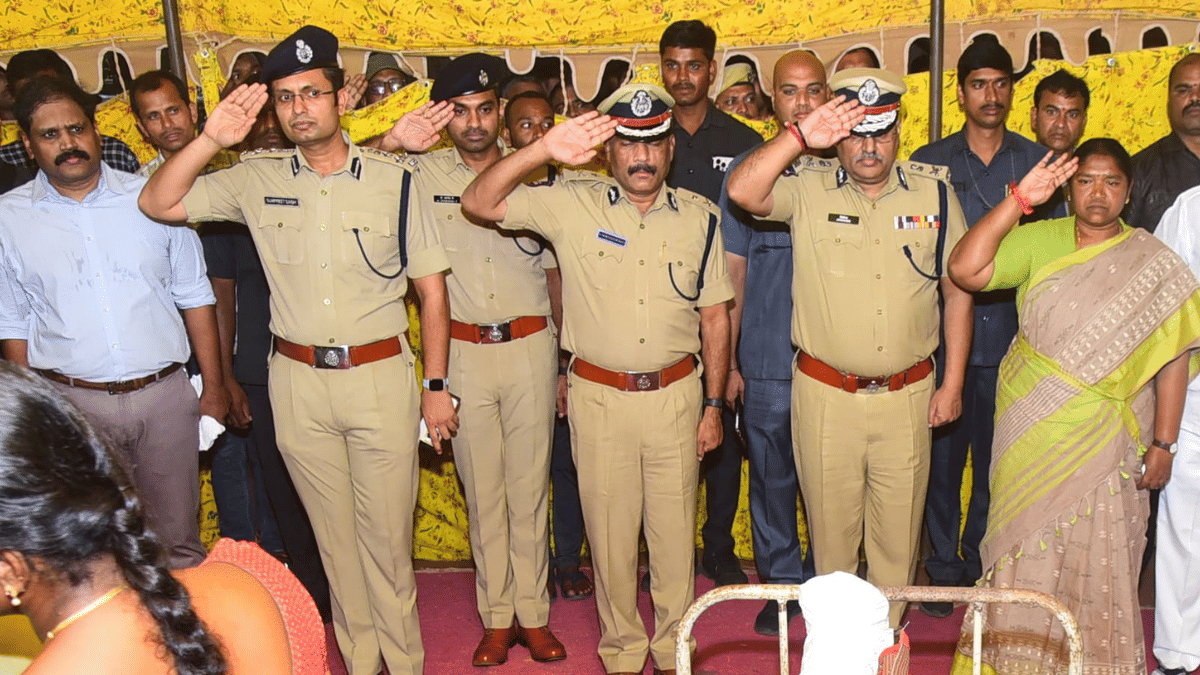
Anand, who took over from Reddy as the state’s DGP in May, signalled the need for change, noting that “the evolution of crime demands a corresponding evolution in policing”.
The call first came from the very top of the state’s administrative hierarchy.
Speaking at the Telangana Police Retreat 2026 event in March, 2026, Chief Minister A. Revanth Reddy hinted that senior police officials should consider scaling down the Greyhounds staff.
“If there are sanctioned posts for a particular purpose and when that purpose is resolved, what is the use of continuing the staff in that department?” Reddy had asked.
A pioneering force
The Greyhounds was set up in 1989 by the late Indian Police Service (IPS) officer K.S. Vyas under then Andhra Pradesh chief minister NT Rama Rao to combat the Maoist menace in the state.
Launched after a spate of high-profile killings by Maoists in the state, its training programme was conceived by Vyas. The IPS officer himself was brutally killed by the insurgents a few years later.
Envisioned as a force with elite combat and assault skills and well-versed in guerrilla and jungle warfare, the Greyhounds became the model for anti-Maoist forces in many other parts of the country.
They include Odisha’s Special Operations Group, Maharashtra’s C-60, West Bengal’s Counter-Insurgency Force and Chhattisgarh’s District Reserve Guard (DRG).
The Central Reserve Police Force’s (CRPF) elite Commando Battalion for Resolute Action (CoBRA) is also modelled on the Greyhounds.
“The AP government recognised that regular law and order police were neither equipped nor trained for anti-Naxal operations, which involve a different set of skills,” a former Greyhounds chief told ThePrint. “Jungle warfare is a completely different ball game. Keeping this in mind, the Greyhounds were raised as a highly specialised force.”
What makes Greyhounds different?
According to the former chief, there are three main differences between the Greyhounds and other forces.
“First, the tactical training is very different, catering to the needs of a very different theatre of warfare. Second, the physical demands of sustaining oneself in the jungle are humongous and not something that can be compared with usual law-and-order duties. It requires a specialised training regimen,” he said.
“Finally, the nature of anti-Naxal operations and jungle warfare means that every bullet fired has to count in an often do-or-die situation. Hence, firearms training has to be impeccable. All of the above are only possible in a separate, committed force,” he added.
The SIB also emerged out of a similarly specific need.
“Intelligence gathering has different wings. So did the intelligence department of AP Police. But when the Naxal threat emerged, there was nothing specifically earmarked to counter that. Thus, the need for a separate outfit was felt,” the former chief explained.
“While the Intelligence Bureau (IB) had a dedicated wing for the same, state police forces did not. It was in this context that both the SIB and Greyhounds were raised,” he added.
In its early years, the Greyhounds only had a base in Hyderabad, the state capital.
“The personnel would be sent to the districts per requirement, and once inside a district, the respective Superintendent of Police (SP) would direct the force,” the former officer explained.
But later, the Greyhounds chief controlled the force even in the districts, leading to a closer watch over operations and follow-ups, he said.
“By 2005, we had considerable control over much of Andhra Pradesh, but the Odisha border continued to be a region of concern. So, a second base was opened there. The proposal for a third base, in Rayalaseema, did not materialise,” he added.
Today, the Greyhounds have two centres in Hyderabad: one for training and one as a base. Visakhapatnam also has one centre which includes both a training centre and a base.
“Thus, even after the bifurcation of Andhra Pradesh in 2014, both Telangana and residual Andhra Pradesh continue to have a Greyhounds force each, along with an equally split SIB,” the former officer explained.
‘Toughest posting’
Former Greyhounds commandos say it was one of the most challenging assignments.
“The Greyhounds attachment is probably the toughest posting in the country. We pay both physically and mentally,” a former Greyhounds commando told ThePrint.
He recalled being part of units that did two to four operations every fortnight, each lasting two to five days. “In the jungle, we survived on a dry ration consisting of just nuts, dry fruits and the like. But if the operation lasted for long, we would run out of even that,” the former commando said.
He added that he ended up with a damaged kidney because of the unfiltered water his team would have to consume during operations in the forests.
“We are a one-of-a-kind force,” another former commando told ThePrint. “Other forces in the country look up to us and try to emulate us. The Greyhounds are thoroughly professional, with no hierarchy. Everyone looks out for one another,” he added.
The former Greyhounds chief echoed these views. “As far as operations are concerned, there is only one rank for all members of the unit. Even in training, there is only trainer and trainee, no hierarchy. An assistant commandant can be trained by a constable. No one wears a rank. It’s a rank-free force,” he said.
The Greyhounds are renowned for their operations that dealt a major blow to Maoist insurgency in the region over three decades.
Why restructuring
The former Greyhounds chief said the Maoist threat, while not completely eliminated, had reduced considerably, and the question now is whether such a big force is still needed.
“Telangana is seeing an emergence of new-age threats relating to narcotics, excise and cybercrime. With their exceptional skills and training, the Greyhounds can be absorbed for most duties,” he said.
“The job is very strenuous on the body and takes a severe toll. As a result, one cannot serve in the force for more than six years. In this scenario, and given that it is not always possible for the government to recruit new hands, it is sensible to deploy the Greyhounds in the new roles,” the former officer added.
“Depending on the requirements thereafter, the forces can be trained and deployed accordingly.”
He suggested Greyhounds personnel could perhaps be redeployed in OCTOPUS.
“The tactical training differs from what the Greyhounds undergo. But they have similar training in firearms. With the threat of terrorism only growing, it would not be such a bad idea to redeploy some of the Greyhounds personnel to the OCTOPUS force,” he said.
However, the former officer does not see Greyhounds personnel being diverted to day-to-day law-and-order duties. “Given the force’s training and expertise, the government would like to use them for special operations.”
Downsizing, not discontinuing
Security experts said that though the Naxal threat has reduced almost entirely, the unit should not be completely disbanded.
“There is no dispute that the Naxal threat has come down rather considerably. Therefore, there is no point in keeping the entire force involved in counter-insurgency roles,” Kamal Kumar, a former Director of the Sardar Vallabhbhai Patel National Police Academy (SVPNPA), told ThePrint in May, when news of the proposed restructuring first came.
“At the same time, it is important to maintain a minimum strength, so that a remobilisation of the force is possible to counter any future threat,” he had added.
Kumar said restructuring meant downsizing, or scaling down, but not disbanding the force. According to him, while some personnel will be diverted to other units, a significant chunk would remain in the Greyhounds.
Kumar felt that restructuring was a well-thought-out move given the emerging challenges facing the police today.
“Today, forces such as OCTOPUS, EAGLE, and the Quick Response Teams (QRTs) have to meet the growing challenges in the state. The government cannot always sanction new posts for these forces’ growing demands,” he had said.
“If the Greyhounds are available, it is not a bad idea to divert some of them to those forces. Law-and-order problems are dynamic and priorities keep changing. It is always wise to restructure according to emerging requirements,” he had added.
The Greyhounds are not a permanent force. Instead, they functions as a deputation force, similar to the Special Protection Group (SPG) and the National Disaster Response Force (NDRF) battalions.
“The purpose of keeping a force fully deputational is to ensure the age profile of the force is always maintained at an optimum level,” said Kumar.
Greyhounds personnel are mostly recruited from the state armed police battalions or the districts’ armed police units. “After restructuring, the personnel can always go back to their parent forces, and make up for the shortages there,” he had added.
The likelihood of Maoist threat returning
Several officials in Telangana believe the LWE threat is over, and it is unlikely to return, but added that the government can’t let down its guard.
A senior state official pointed to the role played by units such as the Greyhounds and the SIB in eliminating the security threat, and also gave credit to the efforts of the state government in bringing Maoists into the mainstream.
Development works, governance measures, and “attractive rehabilitation packages” turned the tide in favour of the government, he explained.
Kumar said, “The state cannot afford to relax. Eternal vigilance is the price of peace. Anyway, one cannot say the threat is completely over. Yes, the threat profile is currently low, but that does not mean we drop our guard completely.”
Another former special director of the IB told ThePrint that while the current “war” may be won, as long as “the socio-economic realities of the country’s people are not addressed, resentment may resurface in a different form”.
It may or may not be in the form of an armed uprising, but “ideologically it could still be a force to reckon with”, he said.
(Edited by Sugita Katyal)
Also read: Left Wing Extremism crushed but PM Modi has a message for the country: Beware of ‘dimagi Naxals’