





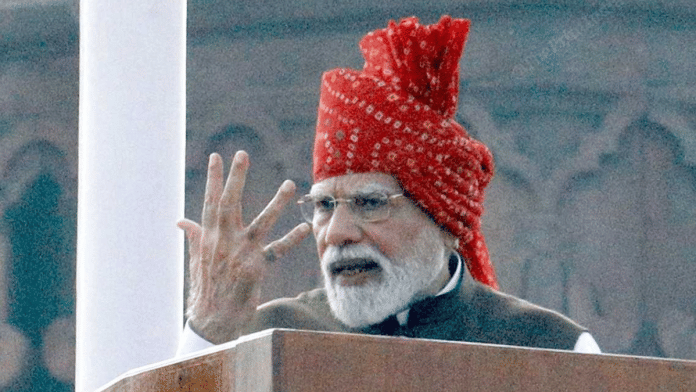


New Delhi: Months after the deadline was met to curb the Left Wing Extremism (LWE) in the country, Prime Minister Narendra Modi warned the people of ‘dimagi Naxals (ideological Naxals)’ who were looking for an opportunity to foster violence.
The country, he said Saturday, has to remain very aware of this challenge.
“For years, people with a Maoist mindset held positions in the corridors of power in the country. They served as advisors in government committees. This Maoist mindset influenced policies,” Modi said in his address to the country from Red Fort, as India celebrated the 80th Independence Day.
“We have succeeded in ending armed Naxals in the jungle and freeing the country from that crisis. However, while armed Naxals are gone, dimagi naxal (ideological Naxals) are looking for an opportunity. They are searching for paths to violence,” he said, adding that this group was trying various ways to drag the society down the wrong path.
“We must recognise these ideological Naxals. We need to isolate these ideological Naxals and connect the country’s young generation toward building a developed nation.”
In his address to the nation, PM Modi said that in the 21st century, decades-old problems need to be addressed and solved. “Naxalism and Maoism have destroyed the future of lakhs of youth. It has stolen young children from mothers. It has destroyed parents and the dreams they held,” he said.
Naxalism, he said, captured a significant region of the country at gunpoint for more than four decades. “It destroyed the essence of the Constitution.”
More than 3,500 security personnel have died, while trying to maintain law and order, he asserted. “This is more than those who die in a war. Naxalism has ultimately resulted in bloodshed.”
When the people gave the Modi government a chance in 2014, he said, a pledge was taken to eradicate Naxalism. “I am pleased to say that Naxalism and Maoist violence are breathing their last.”
He further said that the regions where Naxal bullets used to fly, and where people lived in fear, in those areas now, that have become Naxal-free, “The tricolour of vishwas, vikas, and prayas (trust, development, and effort) is flying high.”
The long road to LWE end
A government press note on 1 August states that the decade from 2004 to 2014 was among the most violent in LWE history. Violence peaked in 2010 with 1,936 incidents and 720 civilian deaths. The full decade recorded 17,542 violent incidents, 1,913 security personnel deaths, and 5,019 civilian deaths.
Naxal-related incidents declined sharply from 870 in 2014 to just 33 in 2026 (as on 29 July. During the same period, fatalities dropped from 310 to 11.
There was no consistent national policy previously with the states operating in silos, according to the Modi government. “Even then the government publicly acknowledged in 2009 that Naxalism was the biggest internal security challenge facing India, one that exceeded even Kashmir and the Northeast in geographic spread,” the press note said.
The first decisive action came in 2015 with the approval of the National Policy and Action Plan to address LWE. This replaced the earlier, ad hoc approach with a structured, whole-of-government framework, it said.
The plan deployed Central Armed Police Forces (CAPF), provided specialised training, and allocated funds through the Security Related Expenditure, Special Infrastructure Scheme, and Special Central Assistance (SCA) scheme, while addressing socio-economic root causes alongside security. Till now, approximately Rs 4,289.20 crore have been released since the inception of SCA scheme in 2017.
Under the Special Infrastructure Scheme (SIS), projects worth Rs. 1,761 crore have been sanctioned for LWE-affected states to strengthen special forces, special intelligence branches, district police and the construction of fortified police stations.
On 24 August 2024, the government of India set a target to make the country Naxal-free by 31 March, 2026. The target, the press note said, was achieved on schedule through intensified security operations, stronger coordination, infrastructure expansion, and accelerated development outreach.
A series of coordinated operations, including Black Forest, Octopus, Double Bull, Thunderstorm, Bhimbarg, and Chakrabandha, significantly “weakened” Maoist networks across affected regions, the government said.
Among them, Operation Black Forest emerged as a major breakthrough, dismantling a key Maoist stronghold, leading to the elimination of over 30 Maoists, and triggering a sharp rise in arrests and surrenders.
Operation Double Bull resulted in Gumla, Lohardaga, and Latehar districts becoming Naxal-free. Collectively, these operations restored state presence in long-affected areas, reduced extremist influence, and created conditions for improved security, governance, and development outreach.
A dedicated vertical was established within the National Investigation Agency (NIA) to investigate Naxal financing networks.
As of December 2025, the NIA had seized assets worth over Rs 40 crore.The Enforcement Directorate (ED) attached assets worth Rs. 12 crore, while state agencies confiscated an additional Rs 40 crore.
By December 2025, 111 LWE cases had been investigated and 98 charge sheets filed. As of June 2026, the total number of NIA cases reached 112, with 100 charge sheets filed, the government said.
In 2025 alone, 2,337 Naxalites laid down their arms, while 3,927 cadres surrendered between 2024 and March 2026.
The government backs its claims that the resolve to end Naxalism was about ensuring that every facility available in big cities reaches the poor tribals of the region, so their children, too, can have a bright future.
Their focus was on expanding infrastructure, connectivity, and governance outreach in remote regions to integrate previously underserved areas with mainstream development and governance systems.
A total of 15,189 km of roads have been constructed under the two LWE-specific schemes, the Road Requirement Plan (RRP) and the Road Connectivity Project for LWE Affected Areas (RCPLWEA), it said.
Meanwhile, 9,497 towers have been commissioned. In the areas that were most LWE affected, 96 percent of villages (44,728 out of 46592 villages) now have mobile connectivity, the government data shows.
“The government significantly expanded financial inclusion in LWE-affected districts over the last twelve years. During April 2015 to March 2026, 1,804 bank branches opened, 1,321 ATMs installed, 74,720 banking correspondents appointed, and 6,025 post offices established,” a government statement said.
During the last 12 years, 259 Eklavya Model Residential Schools have been sanctioned for tribal children in remote areas. Also, 179 EMRS have been made functional. Additionally, 47 Industrial Training Institutes (ITIs), and 49 Skill Development Centres (SDCs) were also developed in these areas, the statement added.
(Edited by Tony Rai)