








Fair-complexioned and grey-haired, the middle-aged police officer’s head had been hacked from his body and placed on a brass prayer-thaali: A young woman raised it before her comrades, and anointed her hands, feet and forehead with Gora Chand Sanyal’s blood. The bystanders who witnessed the execution on the streets of West Bengal’s Baranagar in the summer of 1971 knew a minor celebrity had been murdered.
A jemadar or junior officer in the British Indian Army, Sanyal had been assigned to serve at a prisoner-of-war camp in Singapore. There, he acquired two ceremonial swords purported to have belonged to the Indian National Army leader Subhash Chandra Bose. The prisoners told Sanyal—or so he later claimed—that Bose had escaped Singapore ahead of the British in a submarine.
Almost certainly, the death-squad had heard their leader Charu Mazumdar’s exhortation, “He who has not dipped his hands in the blood of class enemies can hardly be called a communist.” The strangely religious resonance of the inspector’s killing was obvious: The avenging god, the sacrificial animal, the liberation of living outside of all norms and taboos.
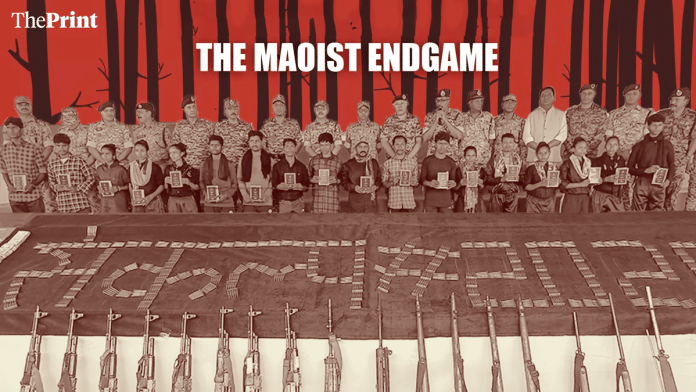
But 20 years after then Prime Minister Manmohan Singh warned that Maoists were India’s greatest internal security threat, the macabre cult of blood, which claimed over 12,000 lives since 2000 has finally disintegrated. The last known member of the 24-member Communist Party of India-Maoist’s politburo and central committee, Misir Besra, was finally arrested on 29 July. Telangana declared it was free of Maoists in April, and Maharashtra in May. Suresh Koda, the last surviving Maoist in Bihar, surrendered to authorities in February.
Even though the last Maoists are either dead or in prison, there are three reasons to worry that the next generation might be preparing for war. First, violent movements of the Left have shown an extraordinary ability to rise from the ashes of their funeral pyre. The Telangana insurgency ended in 1951, only to re-emerge in 1967. This second phase of insurgency was dismantled by 1972, but resurrected once again by 1980. Moreover, little effort has been made to address the social crisis that enabled the rise of Maoist insurgencies. Third, each counterinsurgency hollowed out civic norms and institutions, embedding violence at the heart of political life.
The revolution unchained
“The results of the Meerut case have proved to the hilt that there is no communist movement in this country,” read one newspaper editorial in 1928. For decades, the British Indian intelligence services had watched, with mounting concern, as Left-wing movements gained momentum in China, French Indochina, Burma and even Afghanistan. British intelligence officer David Petrie, writing in 1927, displayed contempt for the organisational abilities of Indian communist leaders such as Narendra Nath Bhattacharya, better known by his alias MN Roy. Following the 1928 textile strike—to which the communists were peripheral—four top Communist Party of India leaders were prosecuted for plotting revolution, and given lengthy sentences.
Led gently forward by Soviet agents such as publisher Philip Spratt and trade unionist Ben Bradley, the communist movement recovered from this early blow—only to make a mess again. A second prosecution followed, this time at Meerut. The Allahabad High Court, though, was sceptical of just how serious the threat was, noting that the revolutionary plot was “utterly puerile and could not be conceived to lead to any such serious consequences as the accused dreamt of.”
But the communist movement continued growing far from the gaze of imperial authorities and the CPI leadership.
Telangana communists had begun a guerrilla campaign against the landlords who held up the Hyderabad Nizam’s regime. Long before Independence, at least 300 villages in Nalagonda, Khammam and Warangal were under communist control, a mini-state the Nizam’s police and his Razakar militia proved unable to defeat.
Also Read: New tactics, solid intel & LWE postings—meet the IPS officers who helped turn tide against Maoists
The red earth
Five days were all the Indian Army needed to brush aside the Nizam’s moth-eaten military. Fearing, just as the Intelligence Bureau had, that peasant revolution could sweep across India, the Army was ordered to turn on the communist squads.
A grim war followed. From late 1949, thousands of Adivasis living deep in the forests were relocated into camps. The Hyderabad administration claimed these camps were meant to bring development to Adivasi communities, but most were simply open-air prisons. The Military Intelligence Directorate noted in mid-1951 that there was “a paucity of food grains, water and other bare necessities of life at centres where they have been concentrated.”
Even though the full weight of the armed forces bore down on the insurgents, the fighting stalemated by 1951.
“Experience has shown that the operations of the type which the Military have undertaken have produced no useful results and the terrorists have all the time managed to escape these operations,” the special commissioner for Telangana, V Nanjappa, observed in correspondence now stored in the National Archive. Local police, backed by units from Uttar Pradesh and Punjab, began operating alongside militia recruited from the Koya Adivasis.
These tactics, though, had serious consequences. From mid-1951, government reports show, extrajudicial executions mounted. 17 terrorists were claimed to have been killed between 13-19 May in 1951. The police, however, recorded that only a single breech-loading single barrel gun, a muzzle-loading gun, and one .303 rifle had been recovered from them.
There were also several cases of vigilantes being used to settle community disputes. Few prosecutions succeeded. In August, 1951, the Home Secretary of Hyderabad informed the Ministry of States that of 3,937 communist suspects arrested by authorities in 1949-1951, only 163 had been convicted.
Also Read: Surrender, eliminate, develop: Fall of the Red Corridor, ending 6 decades of Maoist insurgency
An unfinished rebellion
However, from 1967 onward, the resentment over evictions of tenants from agricultural land and the grinding burden of debt exploded into a rebellion in West Bengal’s Naxalbari. The leader of the rebellion, chronically ill communist Charu Mazumdar, saw this as an opportunity to resume the armed struggle called off in 1951.
The leading chronicler of the period, Sumanta Banerjee, has recorded that Mazumdar’s armed squads failed to either seize weapons or murder large numbers of opponents. The movement drew several young urban radicals, though, who then began a campaign of terror in Kolkata. The state hit back savagely: Kalyan Chaudhuri has documented dozens of mass executions in the city by police, which took place as the army was deployed across the countryside.
Even as these events unfolded, a new uprising began in Andhra Pradesh. Led by opponents of the decision to end armed struggle in 1951, the Srikakulam uprising centred on Adivasi regions in the district. Figures like the communist Vempatapu Satyanarayana sought to build a new Adivasi culture, persuading men to cut their hair and women to cover their breasts. Local courts were set up to adjudicate disputes within the community; just one case involving Adivasi litigants ended up in civil courts between 1962 and 1965.
The end was predictable: Like its sister rebellion in West Bengal, the Srikakulam could not survive in the face of sustained state pressure. The party disintegrated, but began to rise again from 1983-1984.
Each time, a new generation of radicals rose to replace older leaders pushed by age or fatigue to make their peace with defeat. The Maoist leadership that has now crumbled was all over the age of 60, many suffering from ailments and wounds acquired during long decades in the forests.
Long before the great rebellion of 1857, the Adivasis had waged a long war of attrition against the Raj: The Kol and Santhal rebelled in Bengal, Bihar and Jharkhand; the Muria went to war in Chhattisgarh, and there was a large-scale revolt in Odisha’s Kalahandi. These are the same territories where Maoism has risen, time and again. As former West Bengal police chief Arun Mukherjee has observed, India has means to fight insurgents, but flails when confronted with people who for generations “have been subjected to the worst kind of exploitation by everybody, starting with the Government.”
Ever since its birth as a nation-state, India has shown it can fight insurgents and insurrections. Ensuring they don’t arise again, though, has proved a whole lot harder.
Praveen Swami is Contributing Editor at ThePrint. His X handle is @praveenswami. Views are personal.
(Edited by Insha Jalil Waziri)