



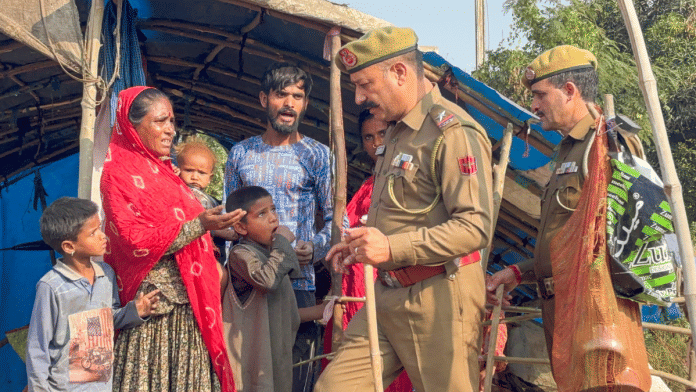
New Delhi: As four members of the High-Level Committee on Demographic Changes (HLCDC) visited Jammu on 10 August as part of their first field visit to study demographic changes in border and adjoining areas, officials presented them with fresh data on Rohingya and Bangladeshi settlements across 10 border districts in Jammu and six districts in the Kashmir Valley, ThePrint has learnt.
There are 6,737 Rohingyas and 46 Bangladeshis spread across 10 districts in Jammu, according to government data. In the Kashmir Valley, there are 919 Rohingyas and 458 Bangladeshis across six districts.
According to sources in the security establishment, although the number of Rohingya settlements has seen only a slight increase in the last two years, concerns persist over their alleged involvement in criminal activities, including organised crime, drug trafficking and human trafficking.
Official data presented to the committee showed that 101 cases involving 179 men and 21 women were registered against Rohingyas in Jammu. In the Kashmir Valley, 16 cases involving 41 women and four men have been registered, multiple sources confirmed.
“There was a detailed discussion on issues related to illegal immigration in border districts and the need to strengthen monitoring and surveillance. The committee also met civil society groups that work closely with people living in these camps,” one of the sources said.
The major districts where Rohinyas live in Jammu include Doda, Jammu, Kathua, Kishtwar, Poonch, Rajouri, Reasi, Samba, Udhampur, and Ramban. In Kashmir, the districts include Srinagar, Budgam, Ganderbal, Anantnag, Pulwama, Shipian, Kulgam, Baramulla, Bandipora, and Kupwara.
The Rohingyas are a predominantly Muslim ethnic group from Myanmar, mostly based in the Rakhine province. Classified either as resident foreigners or associate citizens, the Rohingyas arrived in large numbers in 2012 and then 2017 to escape sectarian violence and military crackdowns.
It was on 26 May that the Ministry of Home Affairs (MHA) constituted the committee to study demographic changes arising from illegal immigration and other reasons, and to suggest measures to deal with these changes.
The MHA notification said that the panel has to submit its report in the next one year along with recommending an organised and permanent operational system for legal- and time-bound detention, or deportation of immigrants residing in India.
‘Involvement in drugs, human trafficking’
A senior police officer told ThePrint that there is an interesting contrast in the political discourse surrounding the settlement of Rohingyas in Jammu and Kashmir.
“Rohingyas are predominantly Muslim, so one may expect that they would go to Kashmir Valley but an overwhelming majority of these Rohingyas are in Jammu and not in the valley. The Rohingyas in valley are very small in number,” the officer said
The officer added that a lot of these Rohingyas after coming from Myanmar went to Hyderabad, and many travelled to Jammu and settled there in 2012 and 2017.
The Rohingya settlement in Jammu is a matter of concern because of its proximity to border areas and the security challenges arising from the alleged involvement of some individuals in criminal activities, another officer said.
The officer added that investigations have found instances of Rohingya women being brought from Jammu to the Kashmir Valley by Kashmiri men and married under informal or exploitative arrangements.
“In certain cases, these women face coercion and sexual exploitation. Several such cases of human trafficking have come to light in recent years,” the source said. “Their involvement in cases of drugs is also a concern and there is a rise in such cases.”
(Edited by Tony Rai)