



New Delhi: What’s the difference between ice cream and frozen dessert? For the average person, probably not a lot: both are sweet and both are frozen.
But for some in the industry, they could be like chalk and cheese. Ice cream is made with dairy fat, while frozen desserts use edible vegetable oils. And for nearly three decades, this difference has been at the heart of a simmering debate in India’s frozen treats industry.
An announcement last month by Kwality Wall’s, one of India’s largest and most recognisable frozen dessert brands, that it would transition its entire portfolio to 100 percent milk-based ice cream by 2027, has reignited the debate. As part of the shift, products that have for decades been made using vegetable fats, including Magnum and Cornetto, will be re-formulated to use dairy fat instead.
But, the move isn’t just about a simple change in ingredients. It also puts the spotlight on the wider discourse over labelling, marketing and consumer perception about ice cream that the industry has battled for decades.
“We are not a frozen dessert company anywhere in the world—we are an ice cream company. In India, we changed everything. Everything,” said Peter ter Kulve, Global CEO, The Magnum Ice Cream Company. Kwality Wall’s is owned by The Magnum Ice Cream Company, the global ice cream business that was spun off from Unilever last year. In India, its portfolio includes brands such as Magnum, Cornetto, Feast and Paddle Pop, many of which have historically been sold as frozen desserts.
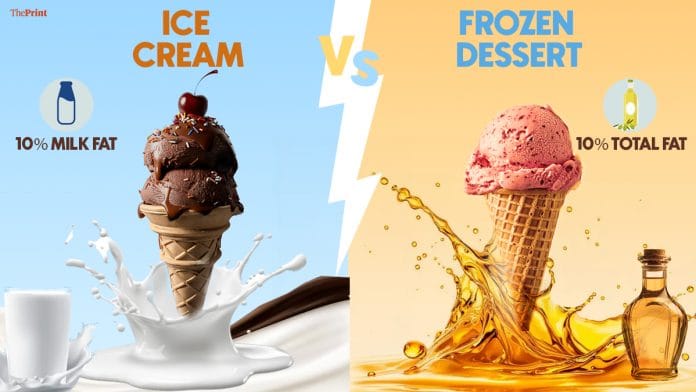
Under the Food Safety and Standards Authority of India (FSSAI) regulations, ice cream and frozen desserts are two distinct categories. Ice cream must be made with dairy fat, with a minimum of 10 percent milk fat, while frozen desserts use edible vegetable oils, such as palm oil or palmolein as the fat source. Both contain milk and milk solids. The fat source is the only regulatory difference between them.
The decision by Kwality Wall’s comes at a time when both categories have become major segments of India’s frozen treats market.
For decades, frozen desserts gained popularity partly because vegetable fats are cheaper than dairy fat, allowing manufacturers to offer products at lower prices. Yet, several industry sources say that consumer demand has increasingly shifted towards dairy-based offerings, prompting some companies to expand their ice cream portfolios.
India’s frozen treats industry—including both ice-creams and frozen desserts—is large and growing. According to industry estimates, the ice cream market in 2026 is pegged at roughly Rs 28,000-Rs 35,000 crore, while the frozen dessert market is even bigger at Rs 40,000-Rs 45,000 crore.
“Both segments are growing at a 6-8 percent compound annual growth rate,” said Anuvrat Pabrai, vice president of the Indian Ice Cream Manufacturers’ Association (IICMA) and founder of Kolkata-based Pabrai’s Fresh & Naturelle Ice Creams.
The scale of the Kwality Wall’s pivot may shift that balance significantly.
“The shift announced by Kwality Wall’s to ice creams from frozen desserts is going to have a major impact on the market, and I personally expect a shift from frozen desserts to ice cream in double-digit percentages,” Pabrai told ThePrint.
Another senior executive at a milk-based ice cream company, who did not wish to be identified, told ThePrint, “If other organisations are pivoting primarily towards dairy-based ice cream, it is good for the industry because consumers ultimately decide what they want.” He added that if demand is shifting, companies will naturally respond to the change.
Also Read: India’s dilemma with AI-driven IVF—law, data, and a regulatory vacuum
The decades-old debate
A few big companies control most of India’s frozen treats market, but some sell “ice cream”, while others sell “frozen desserts”. Some prominent milk-based ice cream brands in India include Amul, Mother Dairy, Havmor, and Arun. Most other significant national brands, including Cream Bell, Vadilal, and Dairy Day, straddle both categories, selling milk-based ice creams, alongside frozen desserts. Until last month’s announcement, Kwality Wall’s was in the frozen dessert category.
The price equation explains much of this market structure.
According to C.K. Bhardwaj, former vice president at the makers of Cream Bell ice cream, who currently runs Global Icecream Consulting, vegetable oil costs roughly Rs 150 to 200 per kg, while dairy fat costs over Rs 600 per kg.
The two categories are not, however, as different in composition, as popular perception suggests.
Both ice cream and frozen desserts are prepared from a pasteurised mix that includes milk and milk solids, sugar, stabilisers and flavouring.
The fat source is the single variable that separates them under FSSAI rules. Ice cream must contain at least 10 percent milk fat, whereas frozen desserts must contain a minimum of 10 percent total fat, which may be derived from vegetable oils, such as palm oil.
As a result, the two products can often be nearly indistinguishable in terms of taste, texture and appearance.
Palm oil is often viewed negatively because it is relatively high in saturated fat, which has traditionally been linked to increased levels of bad cholesterol and a higher risk of cardiovascular disease when consumed in excess.
However, the industry disputes the notion that frozen desserts are inherently less healthy than ice cream. The comparison on saturated fat is more complex than commonly perceived, industry representatives said.
Pabrai, who runs a frozen desserts brand with 40 outlets, 20 of which are in Kolkata, said that butter and cream contain about 66 percent saturated fat, compared with around 50 percent in palm oil and 40-42 percent in palmolein.
Only palm kernel oil, at roughly 80 percent, exceeds butter in saturated fat content.
“Palm oil has been unfairly vilified. I would continue using vegetable-fat blends in my frozen dessert brand even if they cost more than dairy fat because, in my view, vegetable fats carry flavours more effectively in frozen products, particularly delicate fruit flavours,” Pabrai told ThePrint.
However, dairy-based ice cream manufacturers disagree.
A senior executive at a milk-based ice cream company said that dairy fat delivers a richer and creamier mouthfeel that consumers value.
“A product which is made of milk allows you to unleash that sensual experience of creaminess much better than a frozen dessert,” the executive said.
R.G. Chandramogan, founder and chairman of Chennai-based Arun Icecreams, one of India’s largest private dairy companies and a major manufacturer of milk-based ice cream, told ThePrint that the market for milk-based ice creams is growing faster than the market for frozen desserts in India.
“Most players who make both products are also trying to increase the percentage of their sales coming from milk-based ice cream. The quality-conscious people tend to prefer milk-based offerings,” he added.
How frozen desserts entered India’s ice cream market
The origins of India’s frozen dessert industry lie as much in industrial policy as in consumer demand.
Bhardwaj explained that for decades after Independence, ice cream was reserved for small-scale industries under a government policy designed to protect small businesses. The rules effectively prevented large companies from setting up the kind of capital-intensive manufacturing operations needed to build a national ice cream business. That became a hurdle when multinational companies began exploring India’s frozen treats market in the early 1990s.
According to Bhardwaj, manufacturing conventional ice cream at scale was difficult under the prevailing regulatory framework. “When Unilever decided to get into the ice cream segment, it could not set up a plant with an investment of just Rs 2-3 crore, as required under the small-scale industry rules. Large companies were effectively barred from manufacturing ice cream. So they started a different category,” he told ThePrint.
That category was frozen desserts. Because the category fell outside the small-scale industry bracket, large companies could manufacture and scale it without the same restrictions.
This opened the door for Hindustan Unilever Ltd (HUL), then part of the Unilever group. In 1994, Brooke Bond Lipton India launched the Wall’s range of frozen desserts. By the end of that same year, it had already entered into a strategic alliance with the Kwality Ice Cream Group.
Over time, HUL consolidated several brands under the Wall’s umbrella and built one of the country’s largest frozen treats distribution networks.
Industry executives say economics also played a major role in the category’s growth. Vegetable fats were significantly cheaper than milk fat, allowing manufacturers to cater to India’s highly price-sensitive market. “That cost difference has historically made frozen desserts the commercially attractive choice for manufacturers, particularly for the Rs 10 to 20 per unit price points that drive the bulk of volumes in India,” Bhardwaj said.
According to Bhardwaj, frozen desserts currently account for roughly 55-60 percent of the total frozen treats market by volume, larger than the dairy ice cream segment because the lower price points make frozen desserts accessible to a wider consumer base, and most major players have built their portfolios around them.
Labelled, but not quite visible
The Food Safety and Standards Regulations, 2011 established the base product standards distinguishing ice cream from frozen dessert.
In 2017, the specific labelling requirement mandating a boxed declaration of vegetable fat content on frozen dessert packaging was also notified. However, the compliance deadline was extended repeatedly—from January 2019 to January 2020—while FSSAI’s own nomenclature review remained unresolved. After January 2020, FSSAI extended the deadline indefinitely, pending a final decision on nomenclature.
In December that year, FSSAI published new Food Safety and Standards (Labelling and Display) Regulations 2020, which superseded the 2011 Packaging and Labelling Regulations and came into force by July 2022.
Under these regulations, frozen dessert manufacturers are required to declare on-label that the product “is made with Edible Vegetable Oil/and Vegetable Fat”. The separate legal categories of “Ice Cream” and “Frozen Dessert/Frozen Confection” remained intact.
The ingredient list must name the vegetable oil used, and every package must carry a separate, clearly boxed declaration specifying the fat source. “All major brands are following the guidelines of FSSAI. They always declare: this contains vegetable oil,” said Bhardwaj, who has worked with multiple brands across both categories in his consulting practice.
The gap, however, is not in compliance, but in visibility. A consumer who opens a Cornetto at a pushcart in the evening is unlikely to pause and read the small-print declaration on the wrapper before the product melts. FSSAI’s labelling framework places the disclosure burden entirely on the packaging, with no requirement for front-of-pack prominence for the frozen dessert classification.
“Only the nature of the product is such that we purchase ice cream, just open it and try to eat it. It is really very difficult to read the small print,” said Bhardwaj.
Ashim Sanyal, chief operating officer and secretary of consumer rights group VOICE (Voluntary Organisation in Interest of Consumer Education), said that many consumers remain unaware of the distinction between ice cream and frozen dessert.
“What certain brands do is very clever. They basically hide the word ‘frozen dessert’ completely. You will not find the word next to the brand name,” he said. “When you buy ice cream, buy ice cream. The word ‘ice cream’ will be prominently mentioned next to brands like Amul and Mother Dairy. Look for that.”
The labelling debate extends beyond the distinction between ice cream and frozen dessert. Industry representatives on both sides argue that current regulations create another anomaly involving chocolate-coated products.
Sudhir Shah, president of the Indian Ice Cream Manufacturers’ Association (IICMA), said that while a typical chocolate coating contains around 50 percent palm oil or coconut oil, these components are excluded when determining whether a product qualifies as ice cream or frozen dessert.
Similarly, the chocolate spray used inside ice cream cones can contain around 50 percent palm oil, while the chocolate coatings in products such as choco bars may contain 50 percent or more palm oil or coconut oil.
Shah said that FSSAI has an anomaly in its regulation, whereby outer coatings and solid chocolate core is not considered for analysis of the product although the customer is ingesting the same.
Also Read: GLP-1 drugs cut sick days by half. Researchers now think it could save healthcare systems billions
Amul ‘pure’ ice cream advertisement that went to court
The industry’s long-running dispute spilled into the courts in 2017, when Amul launched a television advertising campaign contrasting its “real milk” ice cream with frozen desserts.
One of the advertisements showed two cups side by side, with milk being poured into one labelled “Amul”, and a thick semi-solid substance into another labelled “Frozen Desserts”. The voiceover urged consumers to choose “real milk” ice cream over frozen desserts made with “vanaspati”.
The campaign drew a legal challenge from Hindustan Unilever Ltd, the then market leader in frozen desserts. In June 2017, the Bombay High Court restrained Amul from airing the advertisements, holding that they amounted to generic disparagement of the frozen dessert category.
The court’s objection was not to the underlying fact that frozen desserts use vegetable fat. Rather, it found that the advertisements created a misleading impression.
“They had made two mistakes. One was that they had written the word vanaspati, which is not allowed to be used in frozen desserts,” Pabrai said. “The second was the comparison, which gave consumers the impression that Amul ice cream is made with milk and frozen desserts contained no milk at all and were made entirely from vanaspati, a term commonly associated by consumers with hydrogenated vegetable fat.”
ThePrint reached out to Amul for comment with a detailed set of questions. However, despite multiple follow-ups, the company did not respond.
The FSSAI tangle
The 2017 court battle between Amul and Hindustan Unilever Ltd did more than settle an advertising dispute. It also revived a long-running debate within FSSAI over what frozen desserts should be allowed to call themselves.
Following the Bombay High Court judgment, FSSAI convened a stakeholder consultation that brought together representatives from Amul, Mother Dairy, Kwality Wall’s, as well as other frozen dessert manufacturers and consumer groups.
According to Sanyal, who was a participant, frozen dessert companies argued that their products should be allowed to use the term “ice cream”, while dairy-based manufacturers opposed the move. The frozen dessert industry proposed that all frozen treats be classified as ice cream, with milk-fat products labelled specifically as “dairy ice cream”.
Industry representatives argued that such terminology is used in several international markets and would better reflect the nature of the products.
“As the only consumer group that joined that consultation, we argued that the product names should reflect their ingredients. You can’t get into a category where you don’t belong, because it is all about the ingredients,” Sanyal told ThePrint.
Pabrai said that the discussions later shifted to whether products containing non-dairy substitutes should instead be classified as “analogues”, a proposal that was also contested.
Ultimately, FSSAI retained the distinction between ice cream and frozen dessert, and the nomenclature change was not adopted.
Shah, president of IICMA, said the industry’s position has consistently been that consumers should be able to make informed choices. “Both categories are legal, have regulatory standards and specifications, and are subject to the same food safety, quality and hygiene standards,” he said. “Whatever terminology is finally adopted, transparency and avoidance of consumer confusion should remain the guiding principles.”
ThePrint reached out to Kwality Wall’s for a response, but the company declined to comment.
Is palm oil really the villain?
The debate is often framed as a simple choice between dairy fat and vegetable oil. Nutrition experts and industry representatives, however, say the reality is more nuanced.
According to Fatimah Zohra, a dietician at Fitelo, an online platform that offers expert consultations for diet management and weight loss, the nutritional differences between ice cream and frozen desserts are often overstated. Both products contain similar ingredients and are highly processed.
“Their nutritional composition is absolutely similar. There is not much difference. It all depends upon the composition of the product, the sugar content and other ingredients used,” she told ThePrint.
Dr Prajwal K. C., consultant of General Medicine at Fortis Network’s Gleneagles Hospital in Bengaluru, echoed this view. He said consumers should not assume one category is automatically healthier than the other simply because of the source of fat.
“A better way to compare is by looking into the overall nutritional profile, including the amount and type of fat, added sugar, calories and other nutrients,” he said, adding that both products can be enjoyed occasionally as part of a balanced diet.
However, Zohra was critical of palm oil, the vegetable fat most commonly used in frozen desserts in India. “Palm oil is not at all good. It has so much trans-fat and is so often recommended not to be consumed.”
Industry representatives push back on this framing.
Bhardwaj pointed out that Indians routinely use both butter, a dairy fat, and refined vegetable oil in everyday cooking, and the choice between them is treated as a matter of personal preference.
It is only when vegetable oil appears in a frozen treat, he argued, that it gets vilified. The same logic, he argued, should apply to ice cream and frozen dessert. “Ice cream has its own advantage, frozen dessert has its own advantage.”
Zohra said that consumers with lactose intolerance, dairy sensitivities or certain digestive conditions may sometimes prefer non-dairy alternatives. However, she stressed that consumers should look beyond a single ingredient and evaluate a product’s overall nutritional profile. “Sugar content, calories, stabilisers, emulsifiers and serving size are all important considerations. The overall health impact is covered when we read the nutritional label.”
Ultimately, both ice cream and frozen desserts are indulgence products. While the debate often centres on whether the fat comes from milk or vegetable oil, nutrition experts say consumers should pay equal attention to sugar content, calories and portion sizes. “Neither category should be viewed as a health food, and both must be consumed in moderation,” Zohra said.
This is an updated version of the report.
(Edited by Sugita Katyal)
Also Read: How a vaccine made from a patient’s own tumour can help keep skin cancer from returning