





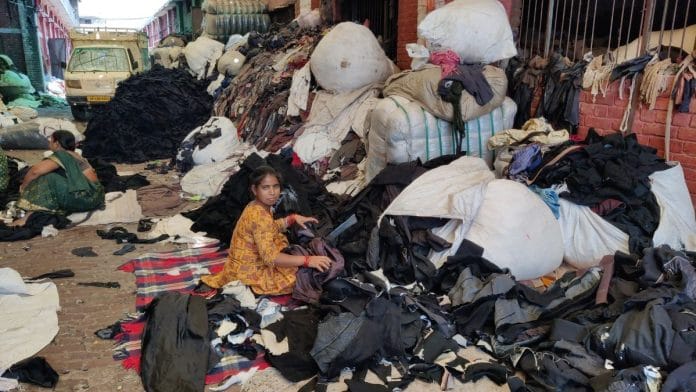


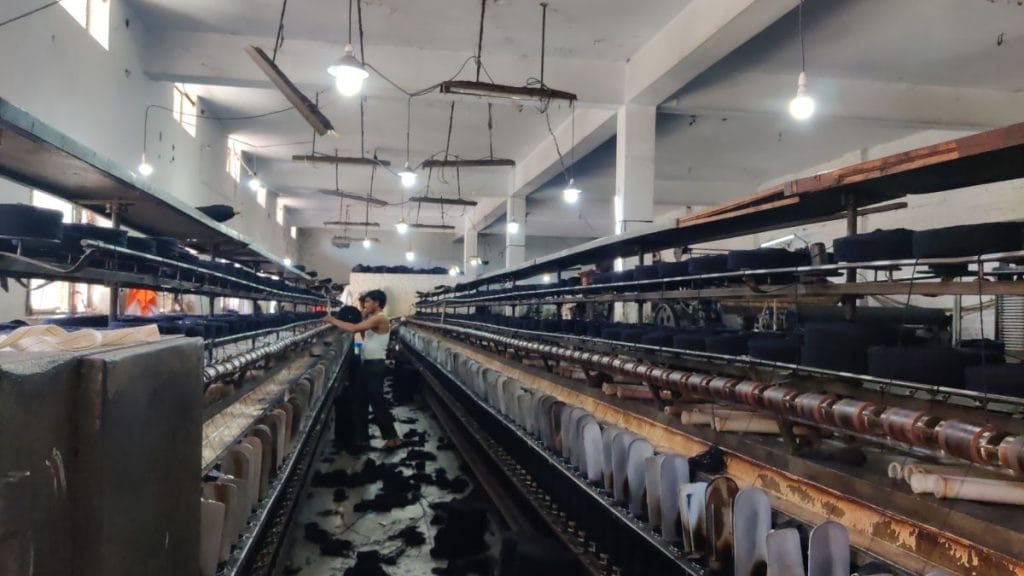
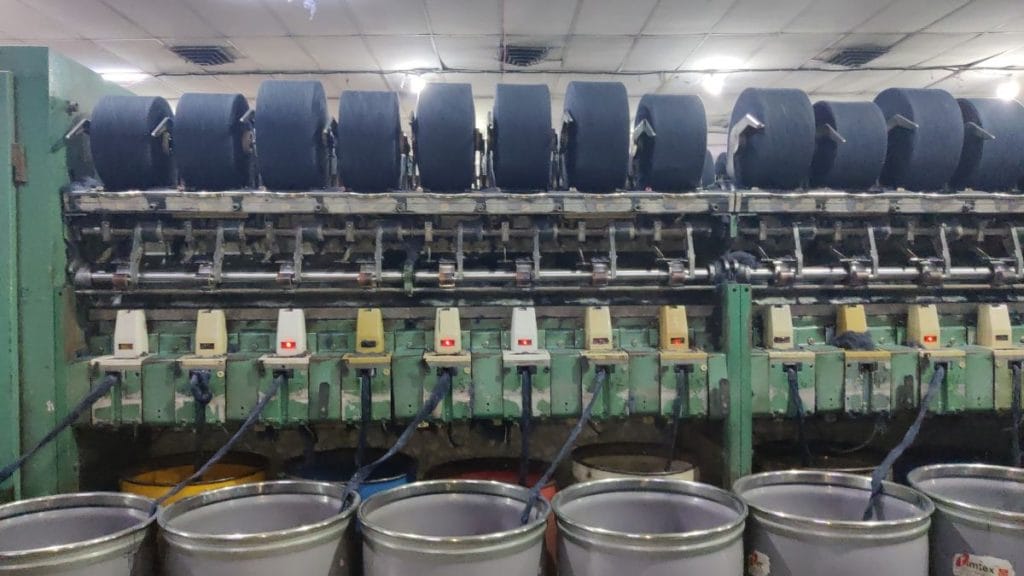
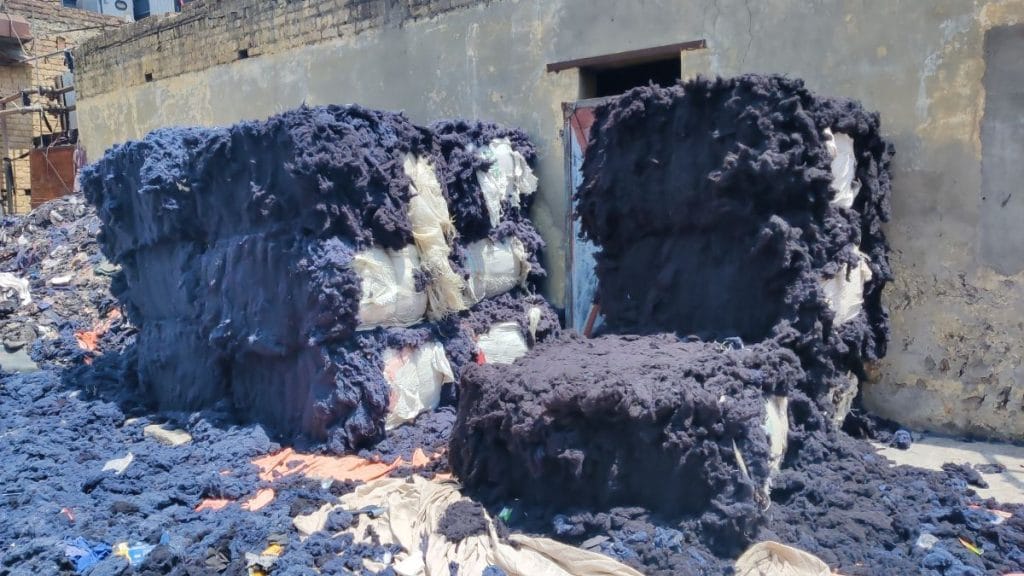
Panipat: Inside a textile recycling unit in Haryana’s Panipat, workers feed mountains of discarded clothing into giant cutters that roar without pause. Fine fibres float through the air like coloured smoke. By the end of a 12-hour shift, they cling to Uttam Kumar’s arms, legs and sweat-soaked T-shirt, coating his body in a layer of lint.
He no longer bothers brushing them off.
What looks like routine inside the factory is part of a much larger system that depends on this physically punishing, dust filled labour, turning the world’s discarded clothes into reusable fibre.
Panipat is the dark underbelly of the world’s fast fashion industry. The small city has become Asia’s largest textile recycling hub, processing nearly one million tonnes of discarded clothing every year. Garments thrown away in Europe, the United States and East Asia arrive here by the container-load to be sorted, shredded and transformed into blankets, carpets, yarn and new clothing which end up anywhere from Delhi’s Sarojini Nagar to Vietnam. In an age of climate-conscious consumption, Panipat is often celebrated as proof that circular fashion works.
But beneath the sustainability story lies a far more uncomfortable reality.
Workers spend years breathing fibre-laden dust inside poorly ventilated factories leading to serious health issues like tuberculosis, COPD, and even cancer. Residents complain of polluted drains, foul-smelling air and contaminated groundwater. Regulators struggle to monitor hundreds of recycling units scattered across industrial clusters. And while global brands increasingly market recycled clothing as an ethical solution to fashion waste, many of the environmental and human costs of that transition are concentrated in a single city.
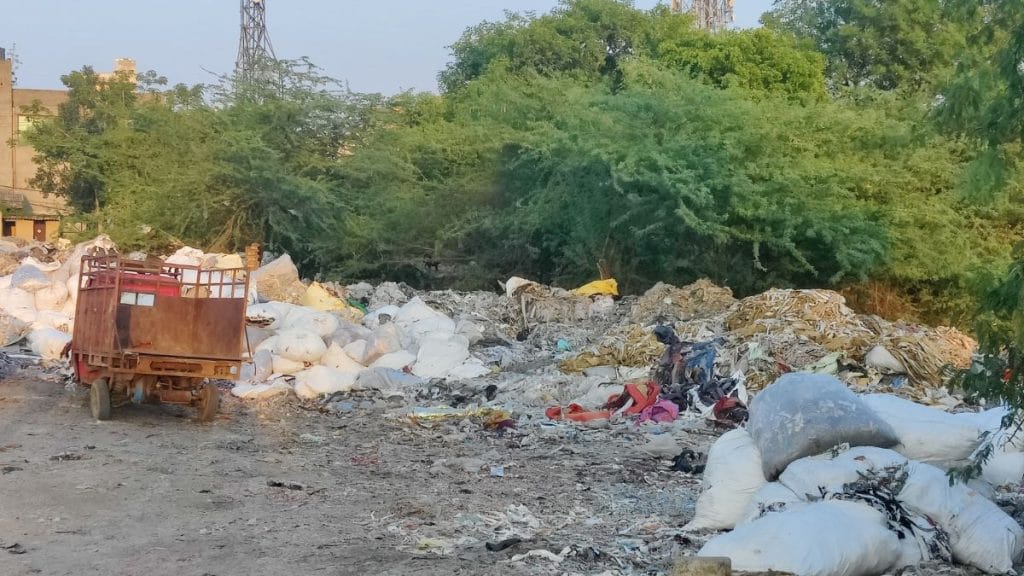
Every year, nearly one million tonnes of textile waste flow through Panipat’s recycling ecosystem, sustaining an industry worth an estimated Rs 7,000-8,000 crore and employing more than 200,000 people across MSMEs and informal supply chains. The industry, started in the 1980s, is omnipresent in the town. Even the roadside litter is dominated by scraps of clothes. The environmental benefits are undeniable. So are the costs.
Factory owners insist Panipat is being unfairly singled out. They say that although underground, illegal units of recycling may operate in the shadows of Panipat, they in no way represent the entire industry.
“Panipat’s industry does not even know the spelling of ‘sustainability and circularity’. India is the only major economy where recycled fibre is the third-largest fibre,” Parvinder Singh, founder of Global Alliance for Textile Sustainability Council (GATS), said. “You are solving the world’s problem, but you don’t even know it. Even our ministry doesn’t fully understand it.”
Where the world’s discarded clothes go
Long before a discarded T-shirt reaches a Panipat factory floor, it has already travelled thousands of kilometres.
Its journey may begin in a donation bin in London, a recycling centre in Germany, a charity collection drive in the United States or a sorting warehouse in East Asia. What starts as unwanted clothing in wealthy economies eventually converges on India’s western coast, entering one of the world’s largest textile recycling supply chains.
At the centre of that network is Gujarat’s Kandla and its Deendayal Port that handles the largest volume of this inflow.
Due to import restrictions, India does not allow the import of second-hand clothes for reuse, only recycling. Instead, they are routed through the Kandla Special Economic Zone, where they are “mutilated” — often just enough to make reuse difficult, but not fully destroyed.
From there, much of the material begins its journey north to Panipat to its 350-400 manufacturing units.
In many ways, Panipat has become the world’s textile dustbin as well as its repair shop.
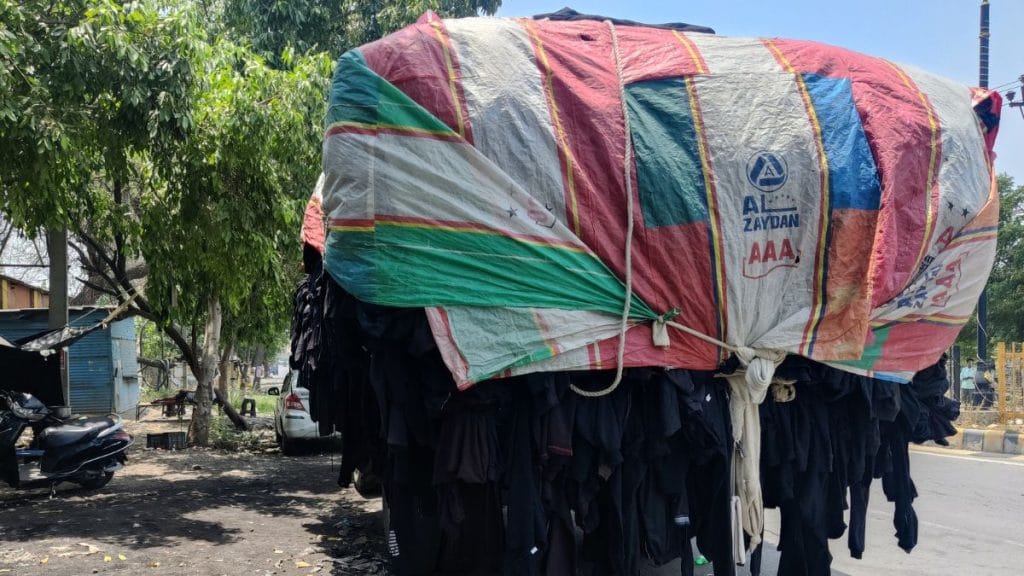
The tightly compressed bundles arriving from Kandla are first categorised into three classes — Grade A (minimal damage), B (some good, some bad) and C (largely unusable). The best-quality garments, often with only minor defects or signs of wear, rarely enter the recycling stream at all. Instead, they are diverted into India’s thriving second-hand clothing economy.
On Panipat’s Barsat Road, traders buy and sell imported garments by the bundle. From here, clothes travel to wholesale markets and eventually to well-known retail hubs such as Sarojini Nagar, where shoppers hunt for branded and ‘vintage’ jackets, jeans and shirts at a fraction of their original cost.
The rise of online thrift stores has only increased demand.
Sunny, who imports bundles of discarded clothing from abroad and supplies them to markets, says the business became profitable enough for him to leave a stable private-sector job.
He entered the trade around six to seven years ago and says the scale has grown rapidly since then.
“We started from one container and now we get 15 containers each month, each containing around 350 bundles,” he said.
The cost of a single container ranges between Rs 30 lakh and Rs 50 lakh, depending on the quality of the cloth.
Over time, the business has remained consistently profitable, driven by strong demand from resale markets that depend on imported second-hand clothing.
The garments that cannot be resold follow a very different path. These lower-grade clothes — often stained, damaged or too worn to be reused — are sent to Panipat’s recycling units, where they are stripped of their identity piece by piece and turned into fibre.
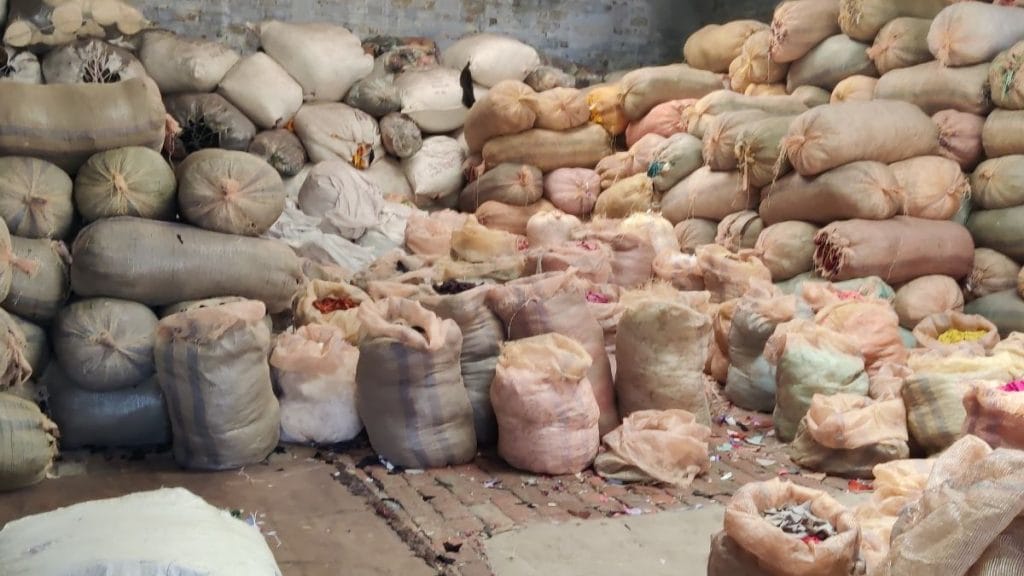
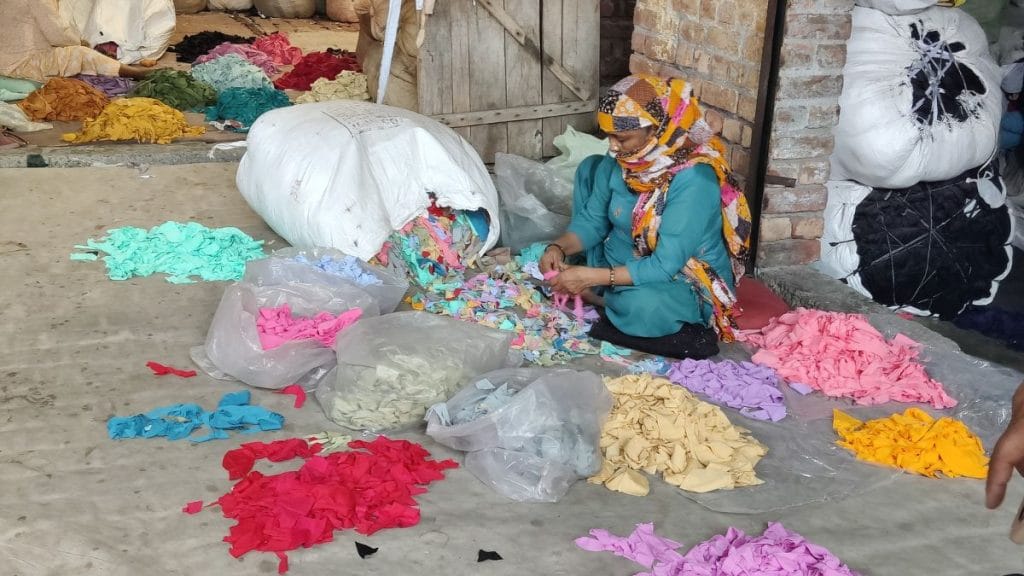
The first step is sorting. Workers separate each piece by material and colour. Buttons, zips, and fittings are removed before the fabric is cut into smaller fragments and prepared for shredding.
Sorting is largely done by women workers, who are paid on a piece-rate system — earning per kilogram of fabric processed rather than fixed wages.
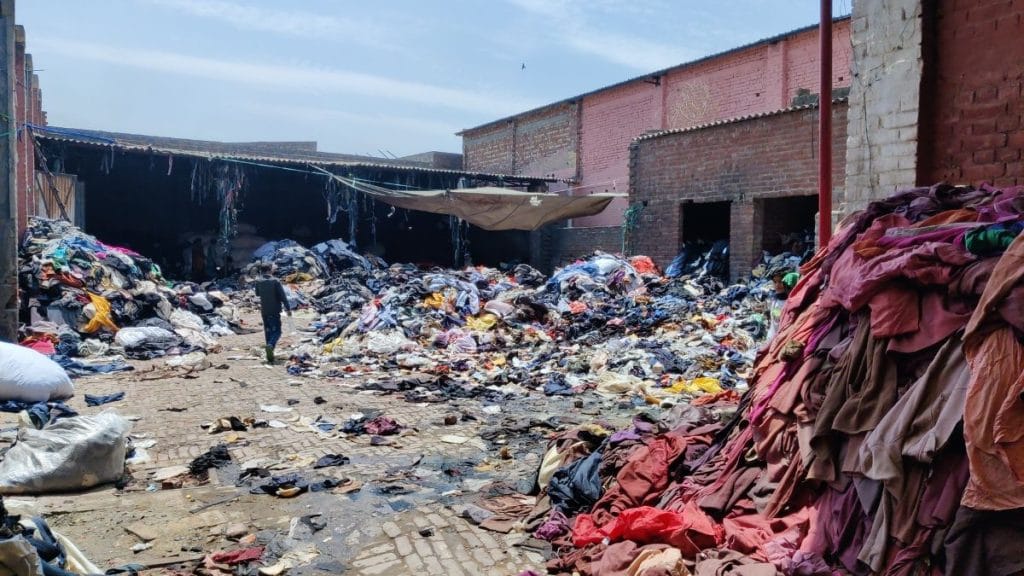
The coloured mountains of cloth scraps that now define Panipat’s landscape are born at this stage, then piled in warehouses, loaded onto trucks, and even scattered along roadsides.
Two types of waste feed this system: post-industrial and post-consumer. Most imports are post-consumer, which industry actors say are easier to process because they arrive partially sorted and relatively uncontaminated. Indian consumer waste, they argue, is harder to recycle at scale due to mixing, contamination, and lack of segregation at source.
What appears chaotic from a distance is a carefully organised system designed to maximise value from waste.
“The quantity of waste is increasing everywhere because people are buying more clothes and discarding them faster,” said Siya Ram Gupta, director of TSM Cotspin, one of Panipat’s major recycled-yarn manufacturers.
This surge is being driven by fast fashion’s relentless production cycle.
Clothing has become cheaper, trends move faster and garments are often discarded long before they wear out. The result is a growing global waste stream that countries across Europe and North America are struggling to manage.
Asked about criticism that Panipat has become a dumping ground for global textile waste, Gupta pushed back, arguing that the sector is often misunderstood.
“Everyone in the industry knows how it works. It is more widely discussed now, but the system has been running for decades,” he said.
Panipat has emerged as one of the places willing — and economically equipped — to take it.
The human cost of circular fashion
For Uttam Kumar, the job is less about sustainability than survival. His 12-hour shift is about to begin.
The 32-year-old migrant worker from Uttar Pradesh’s Bijnor has spent the last eight years inside Panipat’s textile recycling units, transforming discarded clothing into raw fibre. He found work through labour chowks and contractors soon after arriving in the city and has remained in the industry ever since, currently working at TM Cotspin.
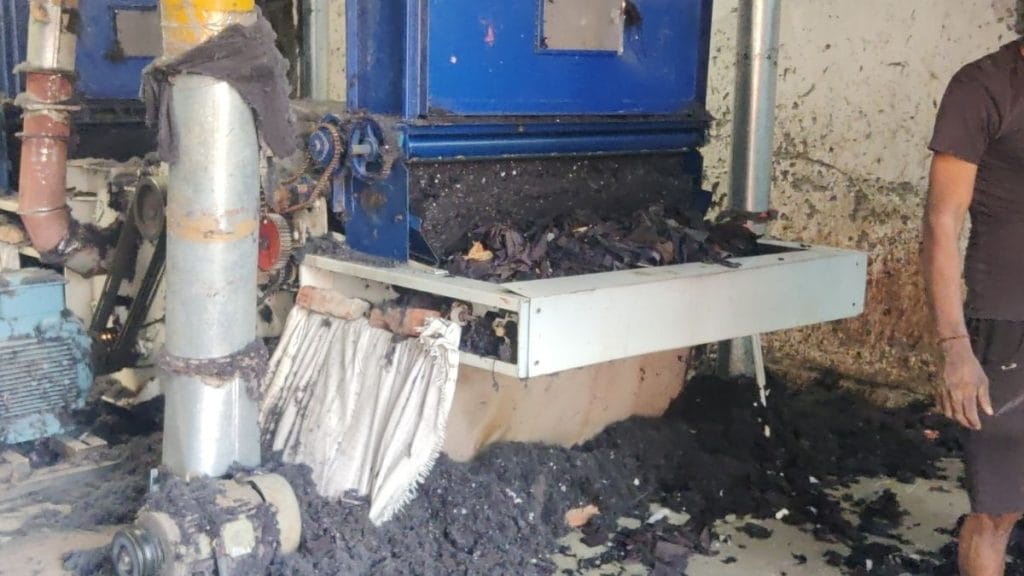
“The material is first cut in the cutter, then it goes into this machine where raw fibres are created. After that, it is taken inside to be made into thread. We just create this “kaccha maal” for the plant,” he said.
The work is repetitive and physically demanding.
By the time he steps out of the shredding section, his body is coated in fine navy-blue fibres — the residue of hours spent inside the processing units. But for Kumar, this has become part of the job rather than a concern.
The city employs more than 2 lakh workers across textile recycling, sorting, spinning, and processing units. Most are migrants from Bihar, Uttar Pradesh and West Bengal who arrived looking for stable work. For many, concerns about long-term health risks are overshadowed by more immediate priorities — monthly wages, rent and remittances sent home.
“As long as the work is consistent and any problem is solved by the employers, the job is good,” Uttam added.
But normalisation does not eliminate risk.
Vitasta Kaul | ThePrint
Textile recycling is often marketed as one of fashion’s most promising environmental solutions. Every garment that is shredded and reused is one less garment headed for a landfill and every kilogram of recycled fibre reduces the demand for fresh raw material.
Yet the process itself remains intensely labour-dependent.
Before a shirt can become fibre again, it must first be sorted by colour and material. Buttons, zips and fittings are removed by hand. The fabric is then cut into smaller pieces before being fed into shredders that reduce it to fibre.
Thousands of workers perform these tasks every day. Many do so without protective equipment.
At a tea stall outside one of Panipat’s industrial clusters, workers gathered after their shifts say many remove their masks within hours because of the heat and discomfort.
Doctors say the consequences often reveal themselves years later.
At Panipat Civil Hospital, respiratory illnesses are among the most common complaints seen among textile workers.
“The most common is COPD, due to inhaling a lot of dust and cloth fibres,” Dr Hitesh said. “Because these machines heat up the environment, and there is a lot of dust, it often shows up as hyperthermia and silicosis as well.”
According to him, nearly one in five textile workers who visit the hospital report breathing-related symptoms ranging from chronic cough and chest congestion to difficulty breathing. Chemical burns from dyes and chemicals are not that common as people usually take precautions.
“The only thing I can recommend to them is to wear a mask. That reduces the risk of COPD majorly,” he said. “But either they are not provided by the employer or they feel uncomfortable wearing it.”
A recent health survey found that 93 per cent of families living around recycling clusters reported serious health issues including chronic respiratory diseases, tuberculosis and cancer over the past five years. Coughing, skin irritation, and eye discomfort are common and access to proper healthcare remains out of reach for most.
Inside the factories, however, such risks rarely dominate conversations. Production targets do.
The business of waste
For many in Panipat, textile recycling is not an environmental project.
At TSM Cotspin, director Siya Ram Gupta traces the industry’s origins back to global price pressures and evolving textile trade flows.
The company has been operating since 1980 but shifted more formally into recycling in the early 2000s after exploring technologies in Spain and Turkey.
“Earlier, cotton yarn was becoming expensive and China was producing much cheaper alternatives,” Gupta said. “We saw this recycling technology abroad and started work in 2002.”
The process, he explained, begins with collecting discarded textiles — wool, acrylic, synthetic fabrics, and cotton — sourced through markets and trading networks, primarily via Delhi’s scrap market system. These materials are then sorted locally by fibre and colour before being shredded, processed into raw fibre, and spun into yarn, sometimes blended with polyester for strength.
“Everything is recycled. We don’t use fresh material,” Gupta said, adding that the factory produces yarn that is later sold to traders, exporters, and manufacturers across domestic and international markets, including Bangladesh, Vietnam, and Kenya.
He estimates that around 70-80 per cent of input material comes from discarded garments, while a smaller share is derived from PET bottles and plastic waste.
The company employs around 100-150 workers but operates on thin margins.
“Profit is around 5–7 per cent. It is not a high-margin business but there is never any loss,” he said. The profit is just a few rupees for a kilogram of waste.
That assessment holds true across Panipat’s industrial belts.
Ashwani Jindal, whose family has been in the textile trade since the 1940s, operates two recycling units in Panipat’s Kabri Road industrial area — one of the city’s oldest and most densely packed textile clusters — one for cotton and another for wool. Together, the units employ around 200 workers engaged across sorting, shredding, and yarn production processes.
Over the decades, the business has shifted from carpet yarn production to large-scale processing of imported textile waste into recycled yarn and blankets, becoming one of the foundations of Panipat’s economy.
After the fibre is spun into yarn, it enters a layered supply chain dominated by traders and dealers based in Panipat. These intermediaries purchase bulk quantities and supply them onward to exporters and manufacturers, rather than the unit engaging directly with end buyers.
Hundreds of small and medium enterprises survive on this, but it has also created an industry where competition is intense and compliance costs can become a burden.
Gupta, for instance, maintains that his unit does not engage in dyeing or bleaching.
“From sorting to making the yarn, we don’t use any bleach or dyes. Since the clothes are already sorted according to colour, the yarn is also made of that colour. It’s a purely mechanical process,” Gupta said.
The pollution crisis
If Panipat’s factories are where discarded clothes are given a second life, its drains tell a less celebratory story.
Across the city, textile recycling units, dyeing houses and processing factories form one of the densest industrial clusters in northern India. They made it an economic hub but also turned Panipat into one of Haryana’s biggest sources of industrial pollution.
The city is said to account for 45 per cent of Haryana’s Yamuna pollution — the highest concentration of polluting industries in the state. A 2021–22 survey by the Central Pollution Control Board found 181 polluting industries in Panipat discharging untreated effluent into the Yamuna, with textile dyeing and bleaching units contributing 64.2 per cent of all polluting industries.
Officials from the Haryana State Pollution Control Board say industrial units in Panipat operate under the Air and Water Pollution Acts and require consent to operate, with prescribed limits for emissions and wastewater discharge. Inspections are carried out, but not on a fixed schedule.
“We go for checking at random. If everything runs regularly, we get an idea that it is running,” a senior official said, adding that both air and water samples are collected and tested to assess compliance.
According to the board, dyeing units remain the primary focus of monitoring due to their wastewater discharge.
A 2026 Diagnostic Study by the Foundation for MSME Clusters found that 7,684 tonnes of hazardous sludge is generated annually across more than 350 recycling units, with 80 per cent of wastewater from bleaching units discharged untreated. The sludge moves through an untracked, unmonitored disposal chain with no meaningful oversight. The study found compliance is “installation-driven” — equipment exists, permits are held, but the residue’s fate remains invisible.
In other words, the waste created while managing the world’s textile waste frequently disappears into a regulatory blind spot.
Many factories operate on limited capital, with investments of less than Rs 1 crore. Monitoring every facility consistently is difficult, particularly in an industry spread across multiple industrial clusters and dominated by small and medium enterprises.
Regulators have repeatedly found violations.
Since 2018, pollution-control authorities have ordered the closure of more than 37 textile units in Panipat for environmental non-compliance. Nine dyeing units were shut in 2019. Additional closures followed in 2023 and 2025 after inspections found pollution-control systems either malfunctioning or not operating at all.
On microfibre and dust emissions, the board said particulate matter is captured through pollution-control devices, though enforcement challenges persist across industrial clusters.
The environmental burden has merely shifted, not disappeared. And nowhere is that accumulation felt more directly than in the neighbourhoods that border the city’s industrial zones.
Residents beside the world’s wardrobe
In the residential colonies that sit on the edges of Panipat’s industrial belts, the recycling economy does not stop at factory gates. It follows them home.
The smell arrives first, they say.
The smell of chemicals and damp fabric often hangs in the air, especially in the early morning and late evening when units are fully operational.
“It is always there. You get used to it, but it doesn’t go away,” said a resident living near one of the older industrial clusters.
Water is a bigger concern. In several pockets near industrial discharge routes, residents say groundwater has developed a faint odour over the years and is rarely consumed. Many rely on packaged water or municipal supply when available, though supply is often inconsistent.
For older residents, the transformation has been difficult to ignore.
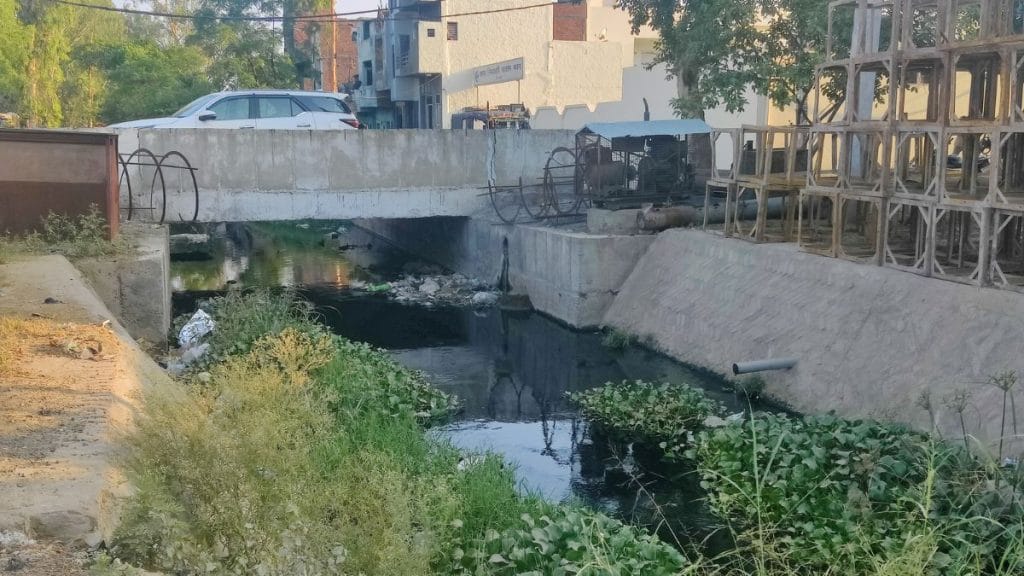
Standing beside Drain no 2 — a major channel that ultimately feeds into the Yamuna — a resident points towards the dark water moving sluggishly through the concrete channel.
“Ten years back, these drains had all clear water. We used to bathe in it but now it is untouchable,” he said. “But often we see trucks dumping waste into these drains. How is this allowed? How is this not impacting our health?”
For most, relocation is not an option. Housing is tied to low-cost proximity to industrial work, and many families depend directly or indirectly on the recycling economy for livelihoods.
As a result, residents find themselves trapped within the same paradox that has made Panipat globally significant. The jobs stay in Panipat. So do many of the environmental consequences.
From profit to purpose
Parvinder Singh has spent more than two decades in Panipat’s textile industry. When he entered the business in 2003, sustainability was not part of the conversation.
The objective was simple: buy discarded textiles, process them and sell them again. It was purely commercial.
The shift, he says, came gradually, as global supply chains and sustainability expectations began to change. Europe’s tightening regulations on textile waste and emerging circularity mandates pushed recycled fibres from being a low-value input to a strategic requirement for global brands.
“Recycling is now mandatory in Europe,” he said. “They have to mandatorily import recycled goods from 2027. Second is WSR—Waste Shipment Regulation. India will be greatly impacted by that.”
For Panipat, that could mean both opportunity and scrutiny.
Singh then founded the Global Alliance for Textile Sustainability Council (GATS), an organisation that works with industry stakeholders, educational institutions, and fashion labels to promote circular, zero-waste systems in textiles. The council positions itself within the growing global push for sustainable fashion, linking manufacturers in clusters like Panipat with international brands including H&M and others that have begun setting recycled-content targets.
Earlier this year, the council also signed MoUs with institutions including the Panipat Institute of Engineering and Technology, IIT Delhi, Krea University, several Delhi University colleges, and NIFT, among others, to collaborate on textile recycling research, design, and innovation.
Also Read: Delhi’s industries are gasping. Pollution crackdowns & fight for nala-sadak-pani
“All the brands in the world have given recycled, regenerated fibre sourcing targets of more than 90 per cent,” Singh said. “But small units are not aware of how much this can increase their value.”
For him, this shift has also changed the way he views his role in the industry.
“It has become about giving back,” he said. “To take care of the world, and to take care of the industry that provides employment to thousands.”
That industry, he emphasises, is built almost entirely on MSMEs—small and medium units spread across Panipat’s industrial belts. Together, they form a dense, fragmented ecosystem that processes global textile waste but rarely finds structured representation in national policy conversations on sustainability or manufacturing.
“There is no one to tell them how sustainability and circularity can be a business case,” he said, pointing to what he sees as a gap between policy discourse and ground-level industrial reality. “If you comply with certain rules, then you are eligible to get upgraded. Sustainability and circularity as a business, as an investment—no one will tell them.”
But even as global sustainability frameworks evolve, the structure on the ground remains largely unchanged: MSMEs operating on thin margins, informal labour networks, and an industry still negotiating its place between global climate narratives and local industrial survival.
A steady job
Khushbu works at the final stage of recycling in a Panipat unit, ensuring the yarn-spinning machines are loaded with enough fibre to keep running. It is repetitive work: lifting, feeding, adjusting, over and over again.
Her dupatta is loosely wrapped around her face, slipping constantly as she moves between machines. It offers little protection.
“Masks are uncomfortable. I usually just try to cover my face with my dupatta and keep wiping the sweat too,” she said. “If I don’t, I leave home feeling sick, with a cough.”
Originally from Bihar, Khushbu works in the same industrial cluster as her husband, who is employed in a shredding unit. His cough is worse than hers, she says.
But neither has considered quitting. The job is steady, and that is what matters most.
(Edited by Stela Dey)