



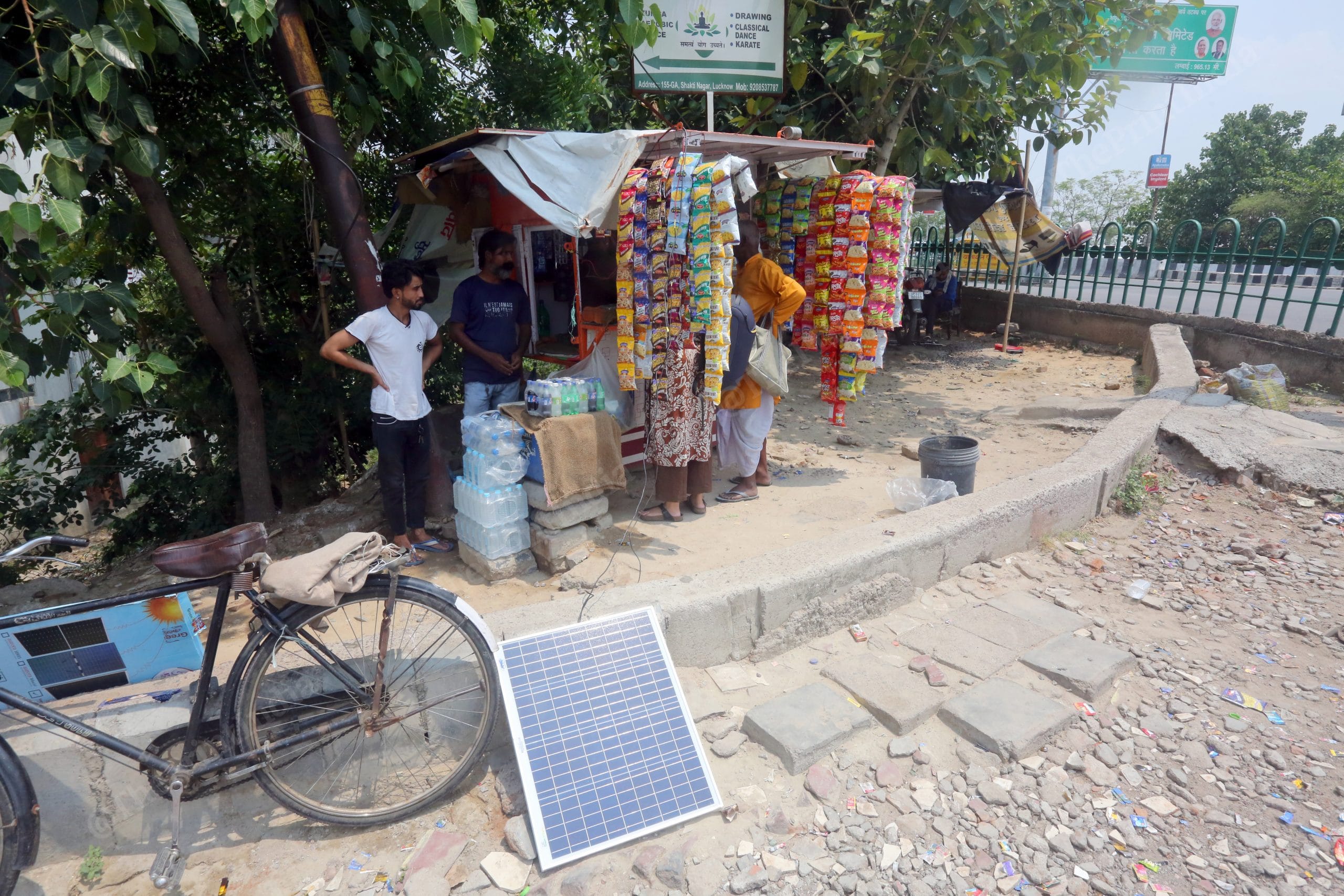
Lucknow: On a scorching afternoon in Lucknow, a paan vendor on Barrage Road adjusts a small solar panel propped against the footpath kerb beside his bicycle. He bought it three days ago for Rs 3,000. He and his brother run the stall together, earning around Rs 40,000 a month between them—money that until recently also went toward renting a battery for Rs 30 a day, to run a light and a small fan. Now the fan runs on sunlight, and at night the same panel powers the light. At closing time, the vendor packs the panel back into its box and leans it against his cycle; it’s a tool he has already learned to depend on.
Uttar Pradesh’s capital has quietly become India’s solar capital. By April 2026, Lucknow had crossed 88,000 rooftop solar installations under the PM Surya Ghar Muft Bijli Yojana—the first district in the country to do so. It has overtaken Surat in Gujarat, which had long been the uncontested benchmark for urban solar adoption. The gap, however, is no longer narrow: Varanasi, the second-highest district within UP, has fewer than half of Lucknow’s installations.
“A lot of my friends had been saying solar is great,” the vendor says, squinting against the sun’s glare.
“I liked the idea because I needed it. It’s a roadside shop, so an electricity connection wasn’t possible—that’s why I bought a panel. Especially in this heat,” he adds.
The state’s solar push has not gone unnoticed in Delhi either. At the Prime Minister Surya Ghar Free Electricity Scheme Awards held on 5 June, UP topped the country in the consumer-base category—with the highest number of solar applications, the highest number of installations, and the highest vendor registrations. Lucknow was ranked first in the country for total rooftop installations. Officials credit what they call a “decentralised implementation, centralised monitoring” model adopted under the Yogi government, with coordination at the district level and active participation from DISCOMs.
The question everyone is asking is: how did Lucknow manage this miracle?
The rise of solar panels
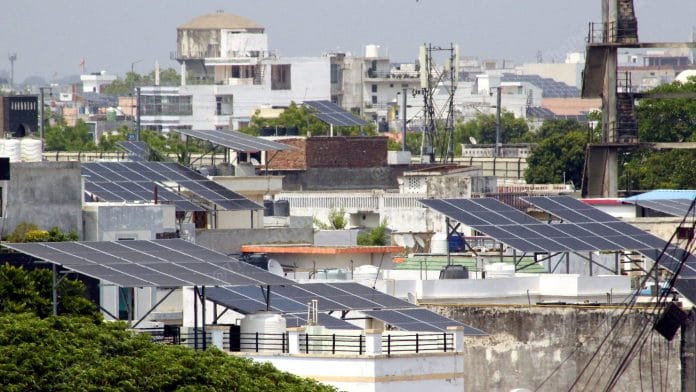
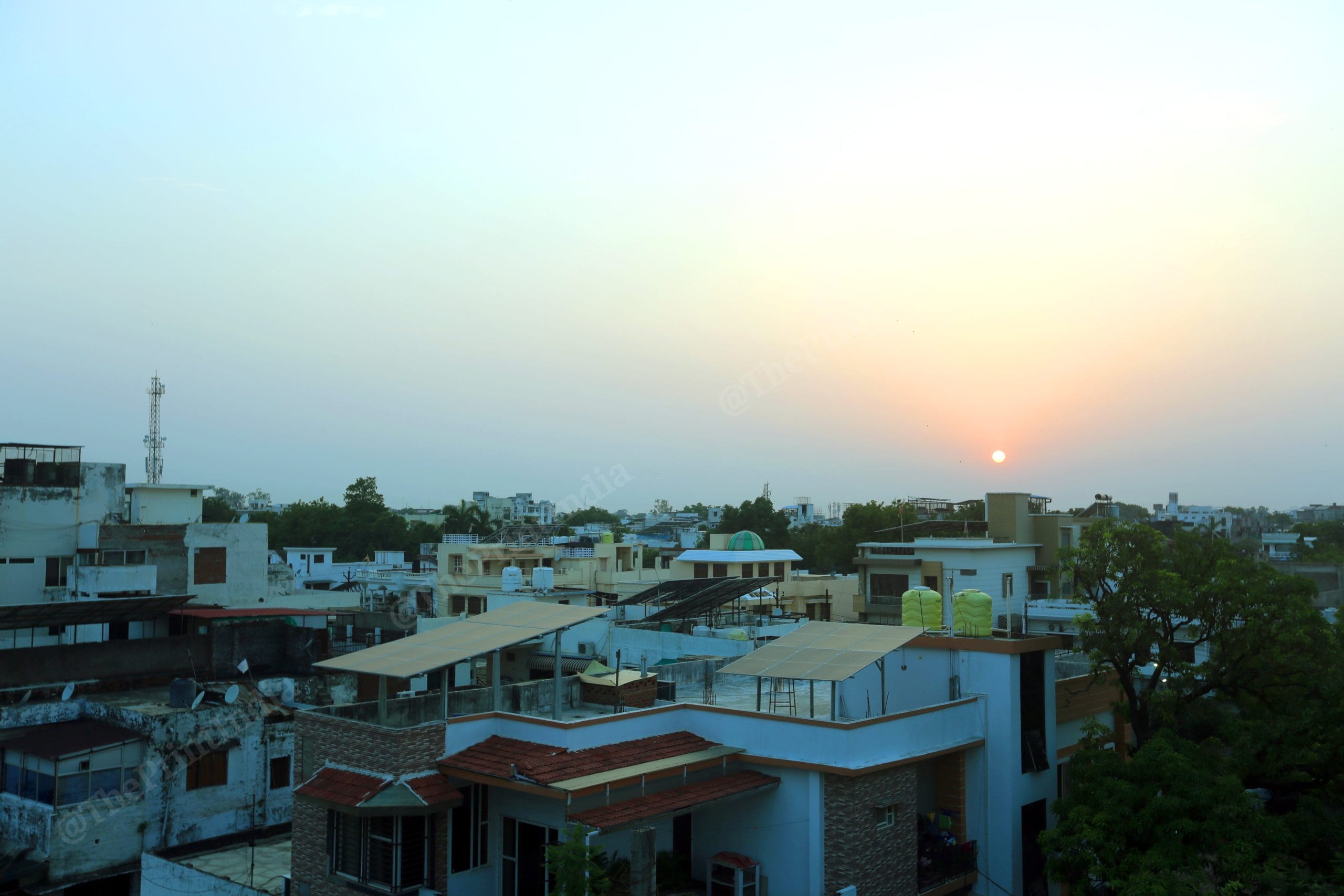
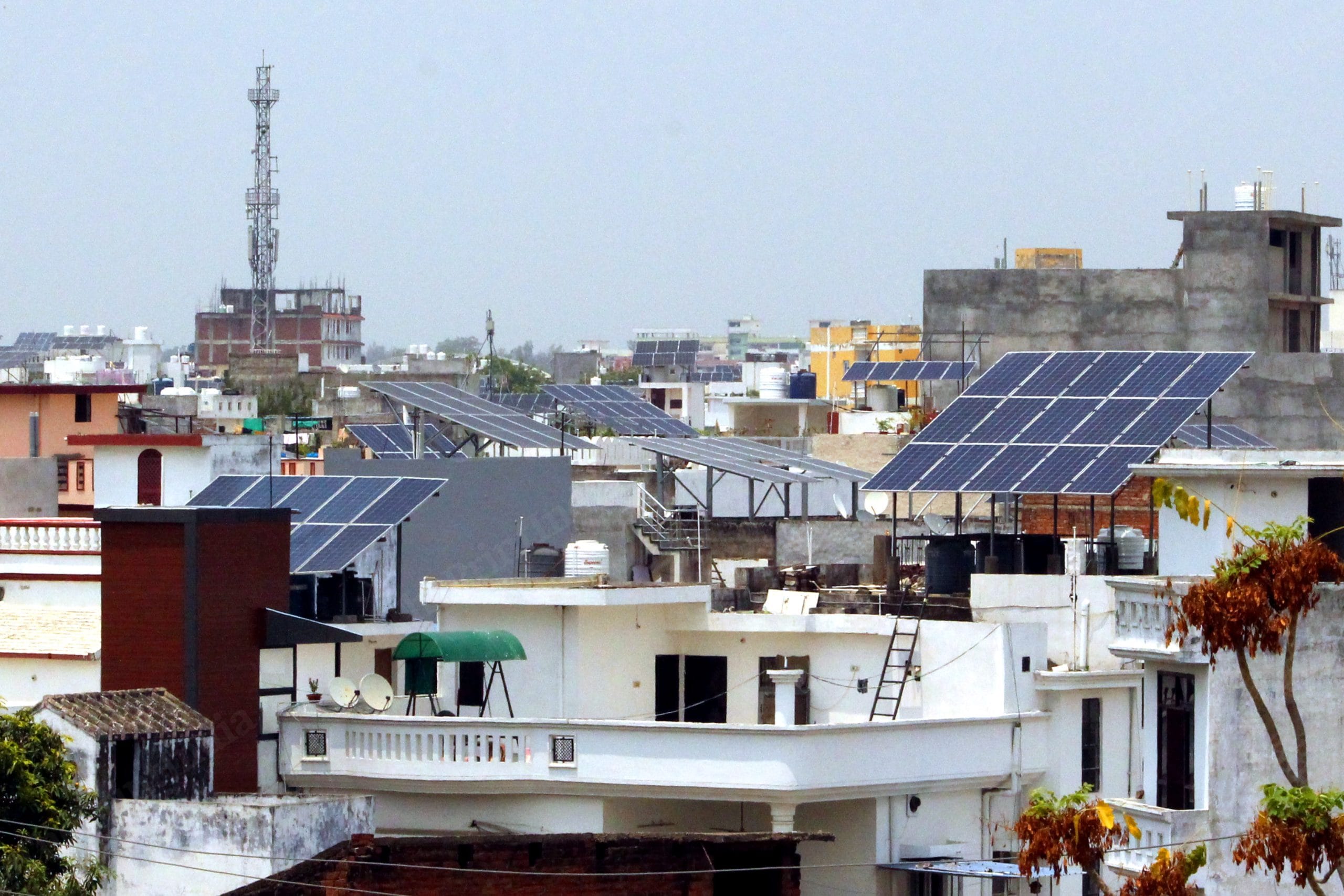
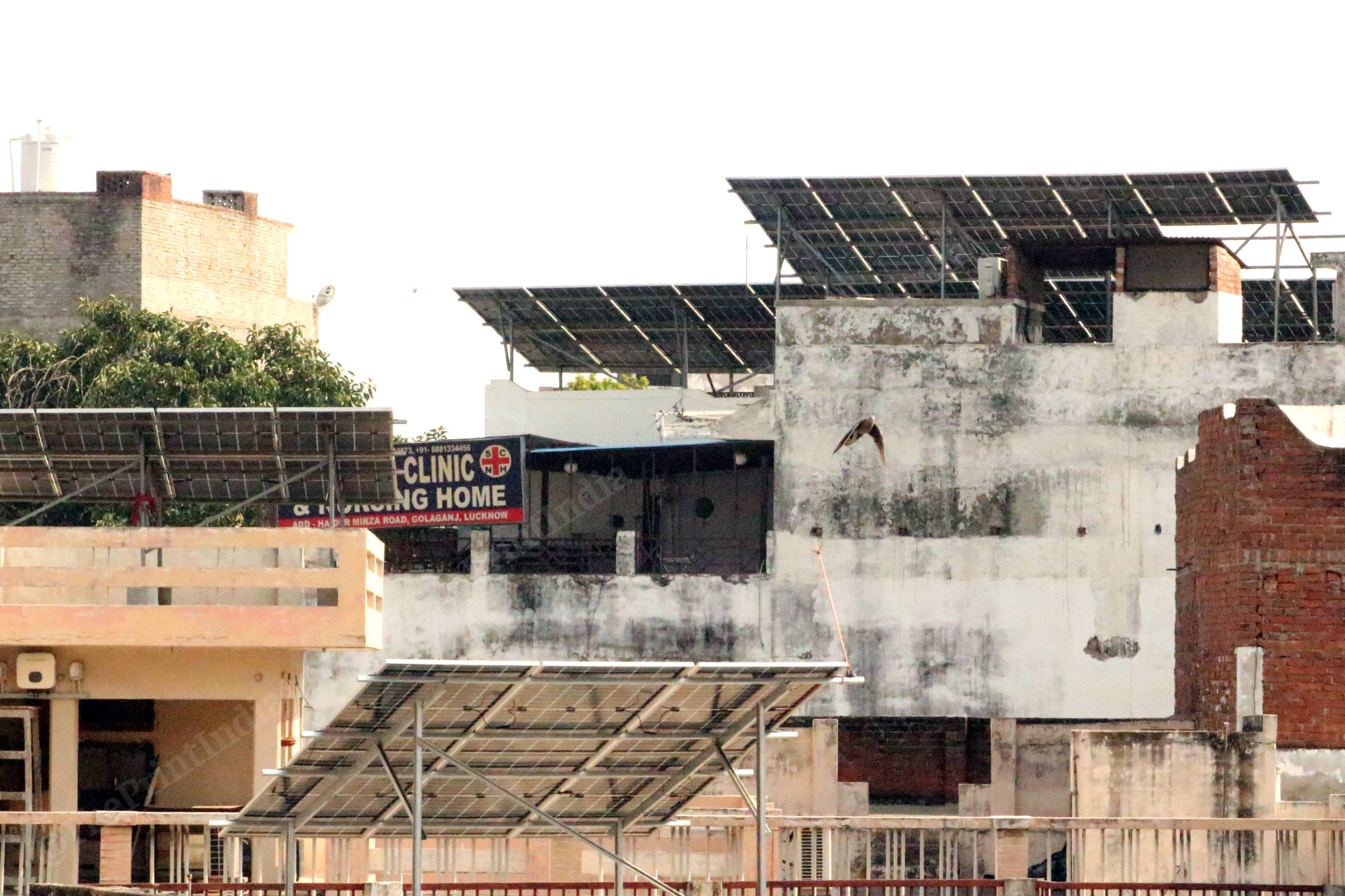
Aerial view tells the story before any statistic can. Flying over Lucknow’s residential colonies such as Indira Nagar, Gomti Nagar, Vikas Nagar or Aliganj, the density of blue-black panels on rooftops is striking. And it isn’t limited to wealthy households either. In Indira Nagar, a jhuggi or slum has a panel angled toward the sky. On the city’s outskirts, in areas one would not ordinarily associate with infrastructural ambition, panels sit on rooftops. Even in Old Lucknow, where lanes are narrow and buildings crowd together, the solar panels have seamlessly blended in.
Since April, the numbers have climbed further. Lucknow has now recorded 1,02,603 cumulative installations. In May 2026 alone, the district added 9,667 systems. On May 31, it installed 333 units in a single day—more than any other district in the state.
The state as a whole added 64,742 installations in May, accounting for more than 20 per cent of the national monthly total of 3.16 lakh installations, as per data by the UPNEDA. The state is the fastest-growing solar market in the country, even as it ranks third cumulatively behind Gujarat and Maharashtra.
Uttar Pradesh New & Renewable Energy Development Agency (UPNEDA) project officer Ajay Kumar puts UP’s position clearly, “In total installations since the scheme launched in February 2024, UP ranks third, but it has emerged as the national leader in monthly installations for the last several months. In total installations as well as those in May, Lucknow is on top in the country, with Surat being the second highest.”
An estimated 3.5 lakh homes across UP now have solar panels, with a combined capacity of 385.82 MW. The state has created 1,888 MW of rooftop solar capacity under the PM Surya Ghar scheme. Beneficiaries have so far received over Rs 3,602 crore in central subsidy and Rs 1,200 crore in additional state subsidy.
To appreciate what this means spatially: the rooftop solar installed in Lucknow alone corresponds to roughly 300 MW of capacity.
“If we had tried to implement it on land instead of rooftops, it would have needed around 1,500 acres. By installing it on rooftops, we are not only producing extra electricity, but we are also saving 1,500 acres of land,” the new UPNEDA director, Ravindra Singh, explained.
Also Read: Thousands throng UP Police Constable exam centres. Battle begins when train arrives
UPNEDA’s push for solar panels
The figure credited most often with this surge is Inderjeet Singh, a 2016-batch IAS officer who served as Managing Director of UPNEDA until recently. Singh is not an unfamiliar name in Lucknow. While serving as Municipal Commissioner from 2022 to 2024, he oversaw the city’s rise in the Swachh Survekshan rankings from 41st to third—converting garbage-strewn plots into green parks, deploying over 1,200 electric vehicles for waste collection, and commissioning the city’s first waste-to-energy plant.
When he moved to UPNEDA, his first move was to use his time at the municipal corporation justly and properly.
“After I joined UPNEDA, I talked to the mayor, and she implemented this. That is one of the reasons that led many people to adopt solar. The Lucknow Municipal Corporation gave a 10 per cent rebate in property tax, which was the real impetus,” he says.
The rest of the campaign was built on reaching people where they already were.
“We have spread this awareness through schools. Lucknow has a very large number of good school chains which have the potential to reach households. We addressed the students and told them this is good for the environment, for India’s energy security, so that they would go home and tell their parents,” Singh adds.
Alongside the schools, UPNEDA went directly to residents’ welfare associations—over 700 of them—and addressed all 110 municipal corporators.
“The motive of our awareness drive was to reach a multi-stakeholder constitution,” he says.
A separate state initiative gave the campaign an unexpected boost.
Singh said of the campaign: “At that time, the smart meter campaign was going on, and it was compulsory. I was also looking after the power sector as a special charge, so wherever a smart meter was installed, we immediately sent someone to convince that household to install solar too. That helped.”
The vendor network itself had to be rebuilt at scale.
“Within a year, we increased the number of vendors dealing in solar from 600 to 6,000. We approached students from IIT Kanpur and other institutes, organised seminars, and kept in daily or weekly touch with vendors through online meetings. That was the real game-changer—vendors are the ones who actually push consumers to install solar, because it’s their business,” the IAS officer shared.
A team of 40-50 people also worked with more than 100 social media influencers to spread the message. The other trick, he says, was speed.
“But the real thing, in general, was the timely delivery of the subsidy — both state and central. We started by releasing it within 20 to 25 days. That was the beginning.”
Singh’s transfer to Sultanpur as District Magistrate was announced just days after Lucknow overtook Surat—a timing widely noted in the state’s administrative circles.
“Actually, I was due for a transfer to another district; that’s a routine posting. We do the duty, and now I’m taking up this objective of energy in my district too,” Singh says matter-of-factly.
The solar schemes are released on a five-year cycle; the 2022 policy runs until November 2027. Whatever lessons are learned in this policy will be implemented in the next one.
Sums, subsidies, and schemes
Large public transformations rarely have a single cause. Beyond the administrative push, Lucknow’s solar surge rests on a scheme with genuine financial logic and a subsidy structure that cut the payback period to a point where refusing became the harder choice.
The PM Surya Ghar Muft Bijli Yojana provides subsidies of Rs 30,000 per kilowatt for systems up to 2 kW, tapering as capacity increases, with total central subsidy reaching Rs 78,000. Uttar Pradesh adds another Rs 30,000 on top, which brings the total subsidy for a 3 kW system to Rs 1,08,000.
The subsidy now reaches one’s bank account about a year after installation, but loans are available at a concessional 6 per cent interest rate.
“The subsidy from the central and state governments together makes it a very profitable proposition for most households…If you include the loan facility at just 6 percent interest, it almost becomes a free-electricity scheme, which is why its name has the tagline ‘muft bijli yojana’,” Ravindra Singh, the new UPNEDA director, said.
The financial case is clearest in the accounts of those who have already made the switch. Ayush Kumar, a lawyer who resides near the Lucknow bypass, had the system installed about a year ago. He gestures toward the panels on his rooftop as he speaks.
“We started using solar about six months ago, after we moved into this new house. We had heard about it from friends and family who were already solar users,” Kumar adds.
His brand choice was deliberate: “My solar is from Tata. There are other local players, and Adani Solar is also there. Tata and Adani are the most popular choice right now.”
The total setup cost came to Rs 2.8 lakh, but the savings have been immediate.
“There’s been a huge reduction in electricity costs. In summer, the bill used to be around Rs 4,000-5,000, running three to four ACs. Right now it’s zero. There was also a rental cost of Rs. 430 for 5 kW, which has also gone to zero because the solar is producing a magnificent amount of electricity,” Kumar shared.
He hasn’t yet received the Rs 80,000 subsidy, but expects it within the year.
Noman, a resident of Barabanki district bordering Lucknow, ran the same arithmetic.
“It’s been six months since I got solar. It cost me Rs 1.80 lakh for installation, and I got back Rs 1.08 lakh as subsidy. Daily, we’re making 14 to 15 units. We’ve been using the AC all day, but there’s been no bill for the past two months,” he counted.
These are not exceptional outcomes. But the average case, which is precisely why the scheme has spread the way it has: through conversation, through visible panels on neighbours’ rooftops, through electricity bills that have quietly gone to zero.
What sets Lucknow apart
Favourable economics and outreach alone don’t fully explain adoption of solar panels at a city-wide scale. What sets Lucknow apart is the degree to which implementation was treated as an active, performance-managed exercise and not an entitlement available only to those who already knew how to navigate government paperwork.
Neeraj Bajpai, a solar vendor since 2018, describes the mechanism with the precision of someone who has watched it work up close.
“What UPNEDA has done more recently is hire a private agency specifically to drive implementation. The agency’s job is to call people, motivate them to adopt solar, help them take low-interest loans, and approach those who are still submitting their electricity bills in person,” Bajpai adds.
This is not passive outreach. The district magistrate has been tasked with ensuring pending loans are disbursed promptly.
It is the intensity of follow-through that Bajpai emphasises most: “The officials of UPNEDA hold on-call meetings with each and every vendor daily. They make calls and their backend team ensures net-metering. A huge impact of these initiatives has been the solar boom in UP.”
Officials are deployed across all 75 districts, each reporting to their respective DMs. Approximately 2,000 systems are being installed every day across the state.
The new UPNEDA director frames the current moment not as a peak but as an ongoing campaign: “We are constantly in touch with our customers as well as vendors to find potential issues or bottlenecks. Lucknow has done really well, but we have not reached saturation. If we consider the entire population of Lucknow, there is a lot of scope for further growth. Our next step will be to work with district administrations and municipal corporations to identify wards or areas where we can focus expansion.”
Bridging the solar panel gap
Despite the high adoption rate, Lucknow’s solar map has a conspicuous gap. Residential rooftops have been transformed, but commercial establishments—offices, shops, small manufacturing units—have been largely absent. According to UPNEDA data accessed by ThePrint, only 143 industrial units across Lucknow have solar, with a combined capacity of 20 MW. A fraction of the residential footprint, despite commercial operations consuming significantly more electricity.
Bajpai says the reason is structural, not motivational.
“The main issue is that UP does not have net metering for commercial establishments, and a net feed system is followed instead. Because of this, commercial establishments are not adopting solar,” he explains.
The distinction matters enormously in financial terms. Under net metering which is available to residential users, units exported to the grid during the day are offset against units consumed at other times, which can bring a bill down to zero. Under the net feed system for commercial users in UP, exported units earn a flat rate of Rs 3.88 per unit. The commercial unit then buys electricity back with much higher commercial tariffs. Without unit-for-unit adjustment and without any subsidy to offset the upfront cost, the economics that make residential solar compelling simply don’t apply.
The UPNEDA director acknowledges the gap but is more optimistic.
“Even though commercial entities don’t get subsidies under any scheme, when they look at the economics, most realise it is still a profitable proposition. It may not be as profitable as for individual households, but given their consumption patterns and land availability, many have decided to go ahead with solarisation.”
Also Read: Modi’s ‘Make in India’—a case study in what happens when strategy is replaced by storytelling
The Make-in-India push
Even as Lucknow’s solar story reaches its current peak, a policy change that took effect earlier this year has introduced a new source of concern. New regulations require that panels installed under government-subsidy schemes be domestic content requirement compliant, meaning both the solar cell and the panel must be manufactured in India. The policy is a Make-in-India push. The problem, industry players argue, is one of timing and supply.
The price gap between DCR and non-DCR panels is stark.
“A non-DCR panel is available for Rs 13 to Rs 15 per watt, but a DCR panel costs around Rs 24 to Rs 28 per watt,” says Bajpai.
Adding: “There is a huge problem with the recent policy changes that could really hurt our industry. Today, the demand for DCR panels far exceeds their manufacturing capacity.”
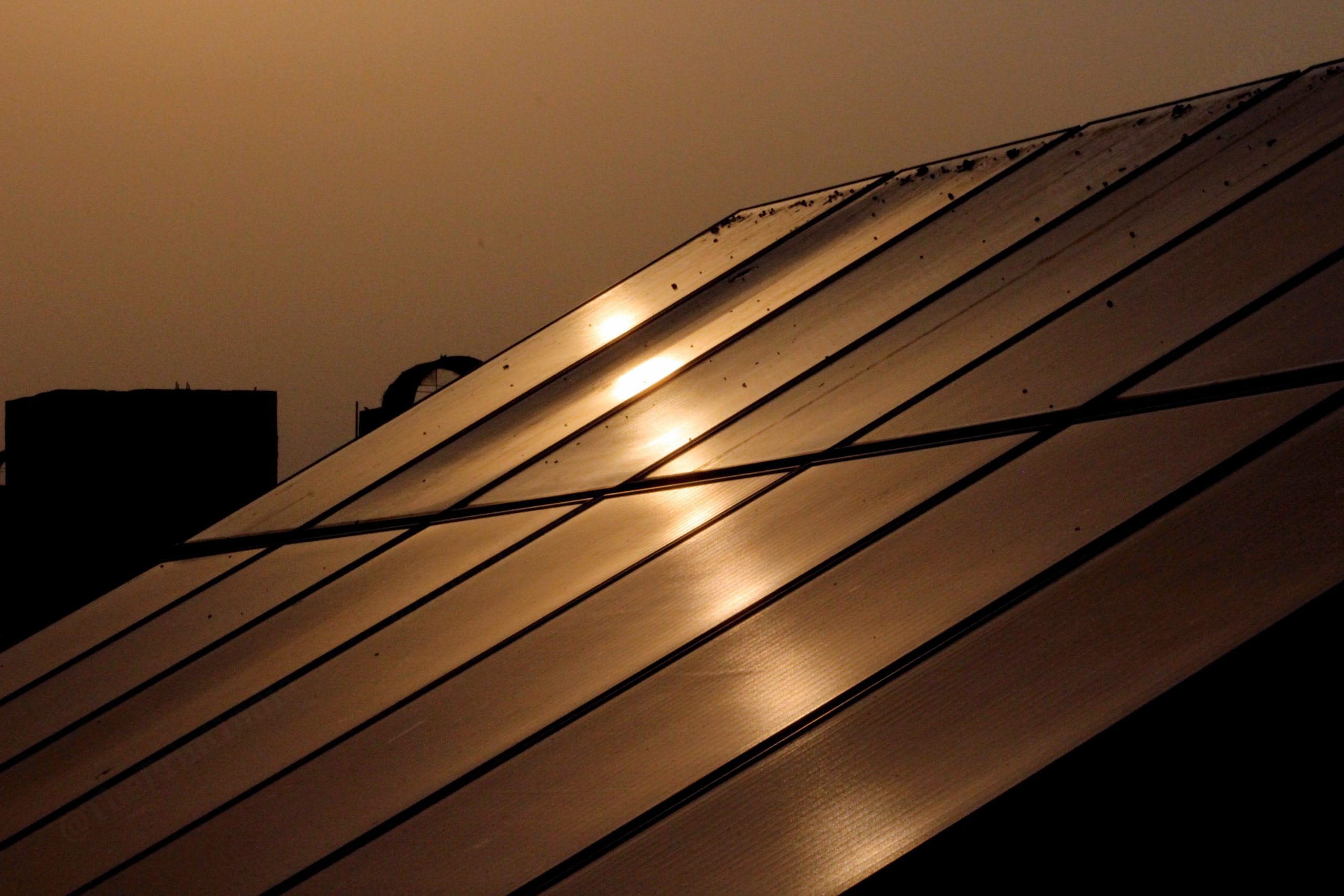
The gap is structural, not temporary. The “wafer”, or the primary raw material in panel manufacturing still comes largely from China. Cell and panel assembly happen in India, but the upstream dependency remains.
Bajpai is careful to frame his objection as not being against Make-in-India: “We do not have an issue with Make in India. We want panels to be made here. But until the prices of the two panel types converge, and until our capacity to make DCR panels increases, this policy should not be implemented.”
His larger worry is about who gets left out.
“Because of this, small-scale vendors and MSMEs who want to adopt solar for their commercial buildings won’t be able to because the costs will be too high. So if they want to cut their recurring electricity costs, they won’t be able to.”
The state produces almost none of these panels itself. UP has a few assembly units in Ghaziabad, but the large manufacturing clusters are in Gujarat, Maharashtra, and Karnataka. The state is experiencing a surge in installations without becoming a manufacturing base, and the DCR policy could create supply shortages that make further expansion a real constraint.
‘Aap kab laga rahe hain solar’
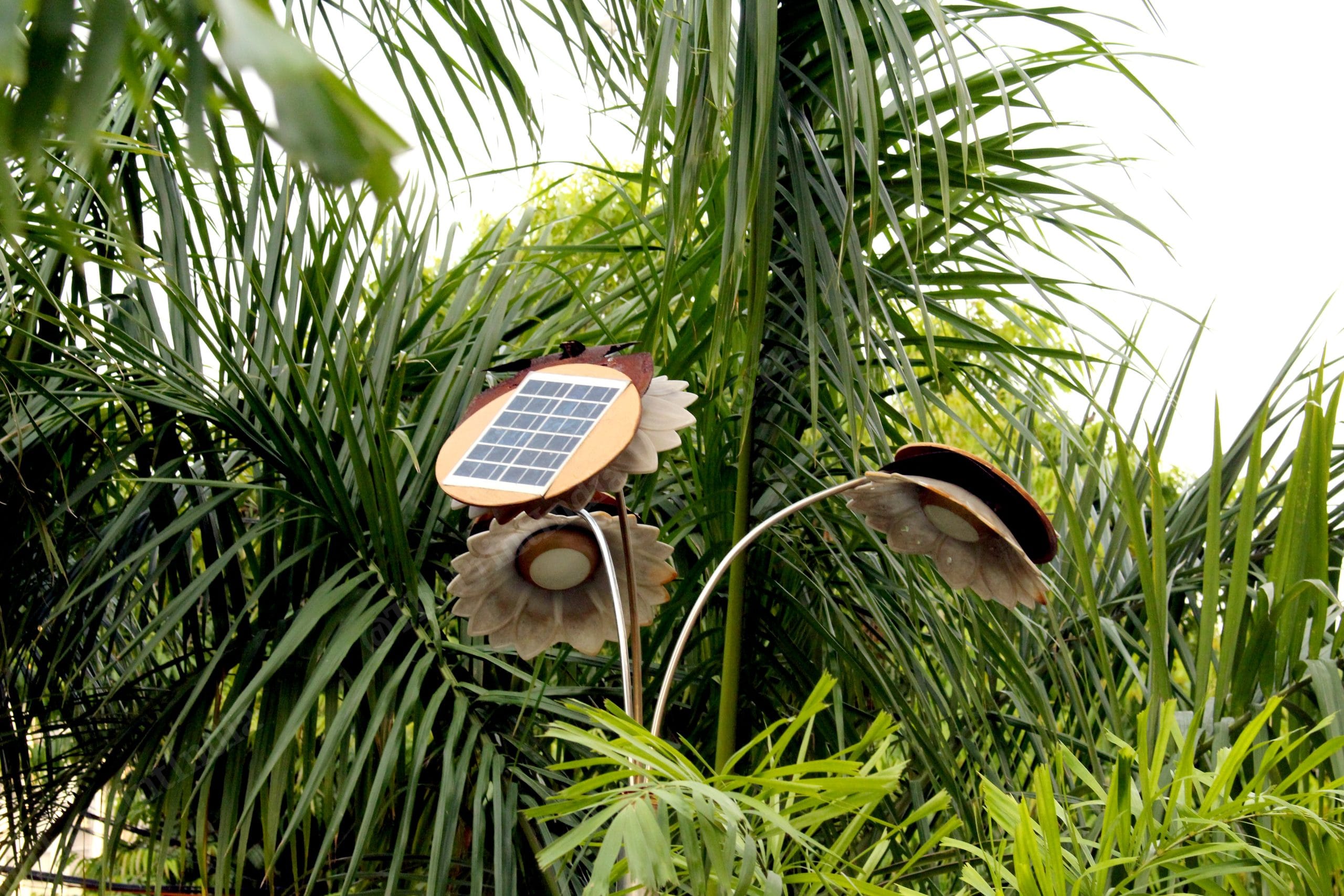
For now, Lucknow has a solar presence that announces itself at every scale. The UPNEDA office has panels on its rooftop. The lights in its lawn, including a flower-shaped decorative fixture that runs on solar. School buildings and hospitals sport panels. So do banks and petrol pumps. Cross a flyover or ride the above-ground metro, and panels are visible on rooftop after rooftop below.
Solar advertising has spread across the city, too. Inside Lucknow’s metro stations, UTL Solar has billboards asking in Hindi: “Aap kab laga rahe hain solar (When will you install solar)?”
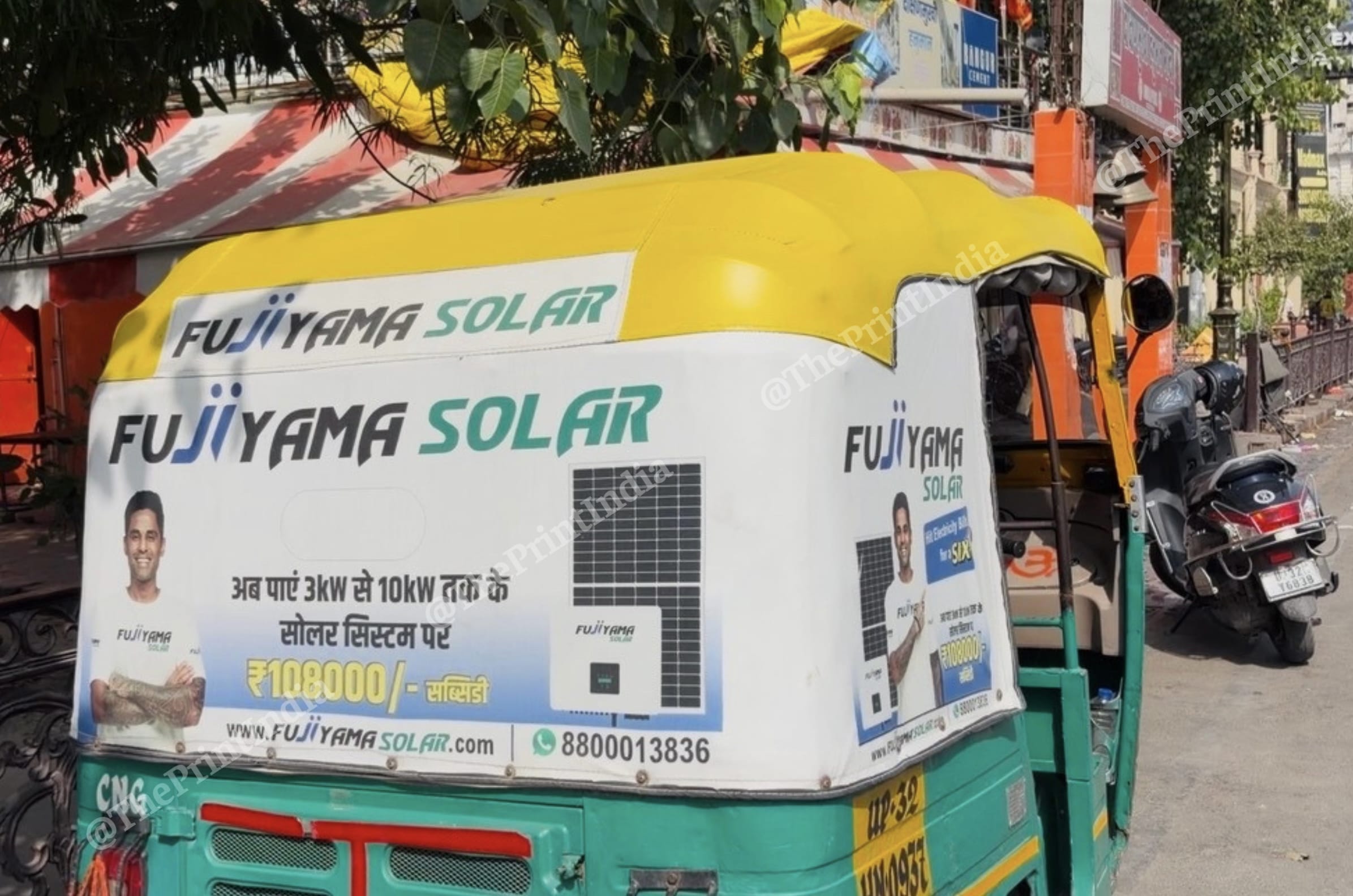
On the back of an autorickshaw, a Fujiyama Solar ad promises the government’s subsidy of Rs 1,08,000 on systems between 3 kW and 10 kW, with a WhatsApp number for enquiries. Even Punjab National Bank has plastered solar loan ads on walls across the city. Solar is now a government project, a commercial product, and a social norm.
188 government buildings in Lucknow have adopted solar, carrying a combined capacity of 33 MW.
And then there is the Dandaiya Mandi.
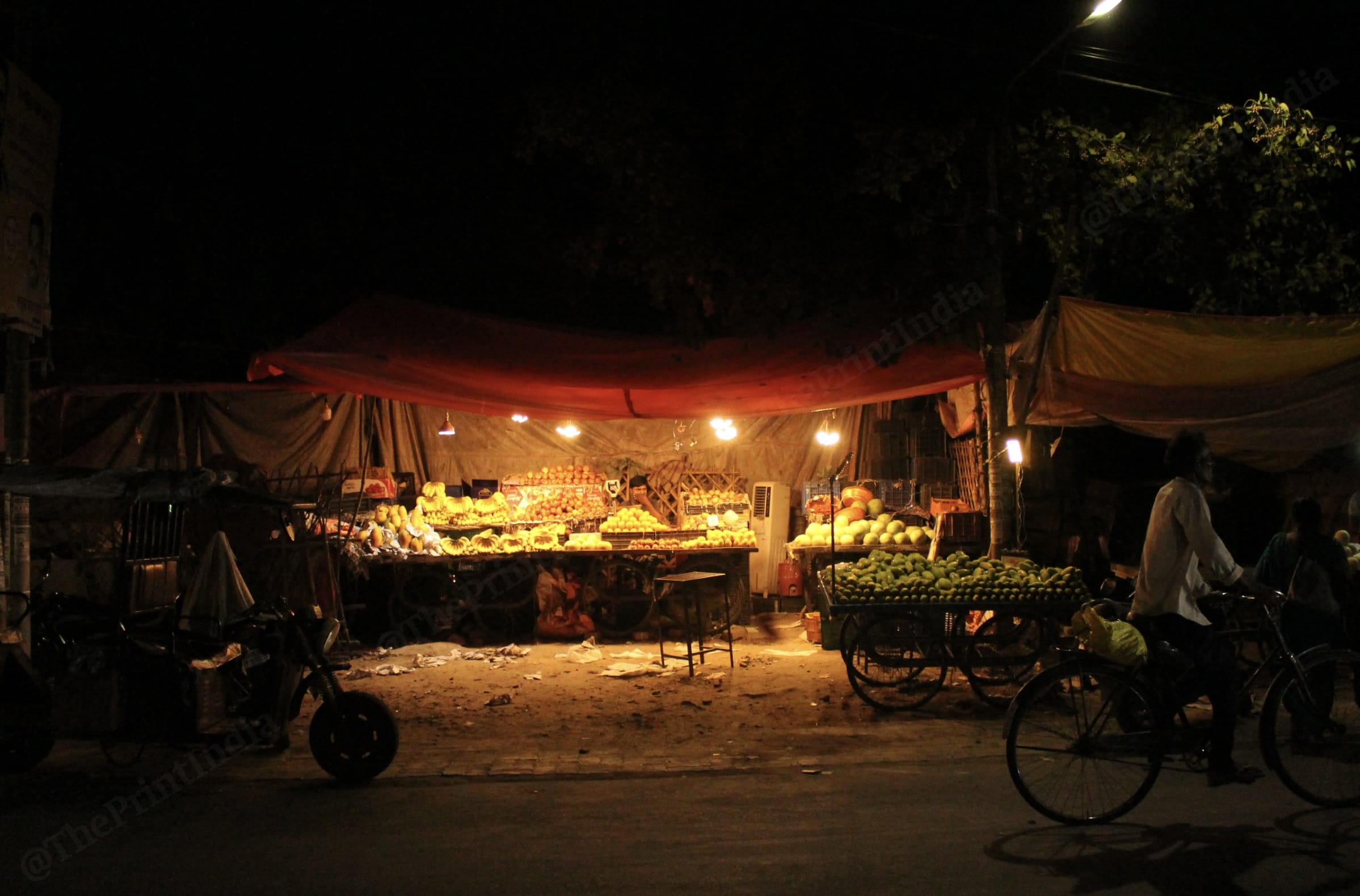
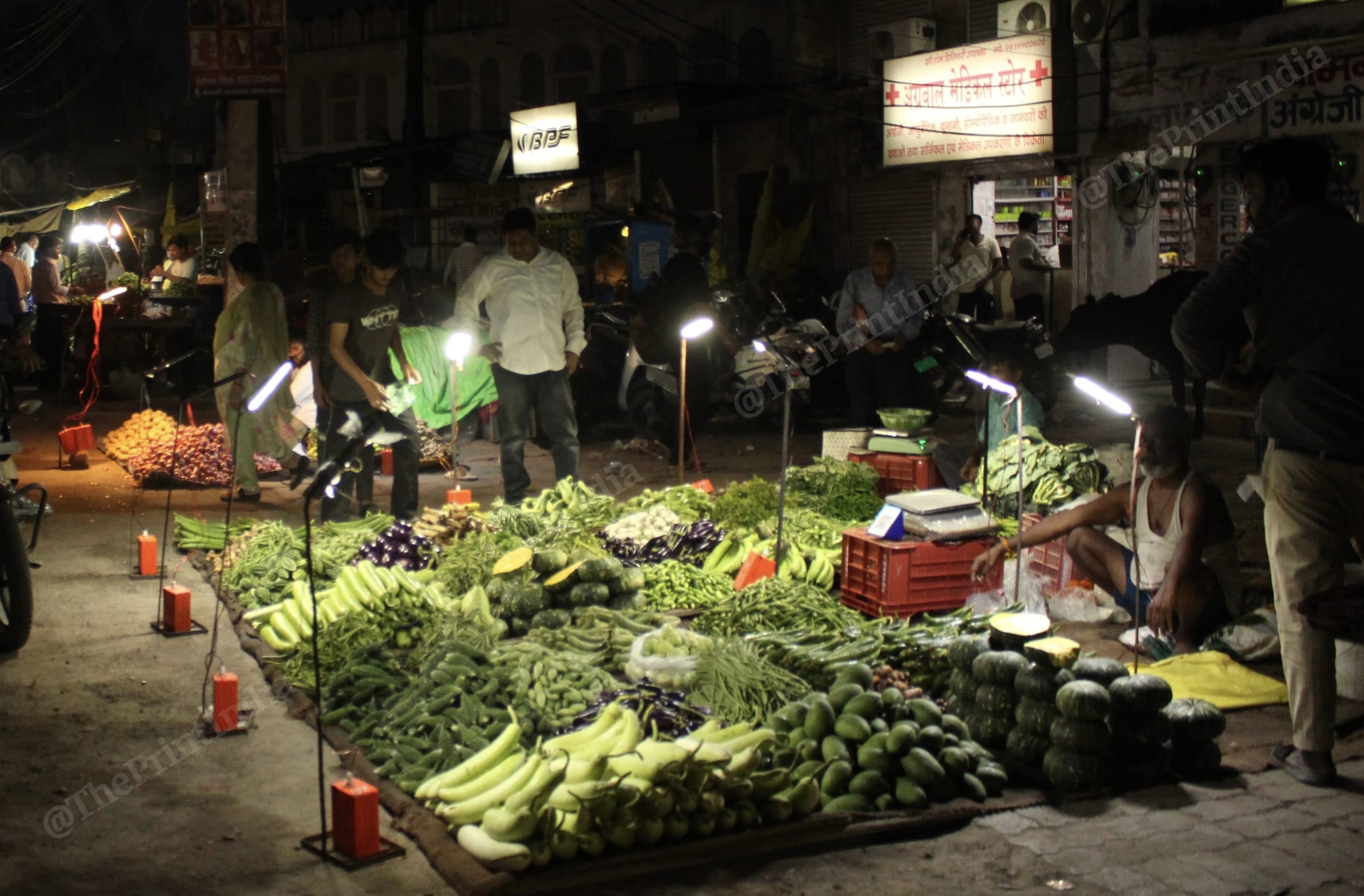
In this dimly lit vegetable market, sellers rent electric lights for Rs 30 per day to illuminate their thelas (stalls). Even a small solar installation would recover this cost within months. But the market has not converted yet. The vendors don’t own the ground they operate on. The logistics of a panel at a mobile thela are different from a fixed rooftop. The paan vendor on Barrage Road solved this by treating his panel as furniture—something he packs up at closing time and leans against his bicycle through the day. The vegetable sellers haven’t found the same solution yet.
Uttar Pradesh has been selected for the PM Surya Ghar Excellence Award, to be presented at a national event marking two years of the scheme. Against the districts where the story has been weakest is Shravasti, which has 928 installations, and Lalitpur and Siddharth Nagar have recorded zero on 31 May. Compared to these districts, Lucknow’s achievement looks like a different country.
The new UPNEDA director acknowledges the unevenness.
“The figures indicate that rooftop solar adoption remains concentrated in a handful of urban and economically stronger districts. The next challenge for the state will be to replicate Lucknow’s success in regions where adoption remains limited, ensuring that the benefits of rooftop solar reach all parts of the state,” he told ThePrint.
The conditions that produced Lucknow’s surge—an engaged IAS officer in the right posting at the right time, a vendor ecosystem that could scale, an urban population dense enough to generate word-of-mouth, and a subsidy structure that made the numbers work—are not automatically portable to Shravasti, Mahoba, or Siddharth Nagar, the least performing districts in UP. The geography is different. The incomes are different. The existing electricity access is different.
For now, Lucknow is what it is: a city of one lakh solar rooftops, where a paan vendor repacks his panel every evening like a valuable tool, where many residents say that their electricity bill has gone to zero, and where the abundant sun has been wired into the grid, becoming the city’s most productive resident.
Nikitha Naveen is an alum of ThePrint School of Journalism, currently interning with ThePrint.
(Edited by Insha Jalil Waziri)