





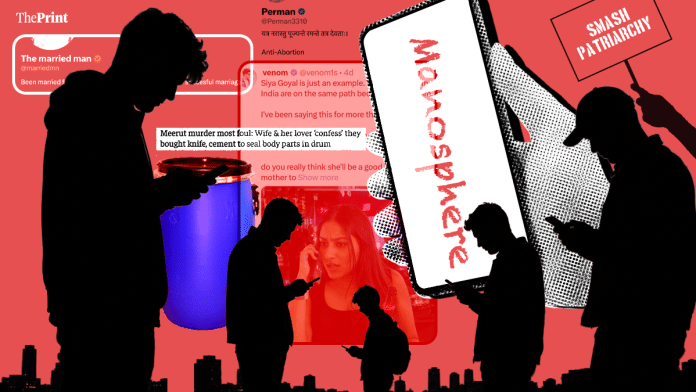

New Delhi: For a user on X, Indian men are in danger. And they can only be saved if they come together. He is doing his bit by sounding the alarm but behind a social media handle Venom. And his principal target: feminists.
For the last 20 days, Venom has been relentlessly posting updates on the killing of Ketan Aggarwal, who was pushed off a cliff by his fiancé Siya.
“Siya Goyal is just an example. Millions of girls in India are on the same path because of feminism. I have been saying this for more than two years. If a girl has sex with multiple boyfriends, smokes, drinks, and parties. Do you really think she will be a good wife and mother to your kids?,” one of his tweets reads.
The man behind the account has emerged as one of the loudest voices in India’s budding, bold online men’s rights universe. For long, it remained in alternative spaces protesting the anti-dowry law, Section 498 A of the Indian Penal Code (IPC). But it has steadily grown with every controversy Sushant Singh Rajput-Rhea Chakraborty, Sonam Raghuvanshi and now Siya Goyal. The Indian manosphere has walked away from each case claiming victimhood. These cases have split the already gendered room in India. In a country where the predominant narrative, jurisprudence and scholarship has been one of women being the victims of cultural patriarchy, the aggrieved men’s club has so far struggled to find voice and space.
“I hide my identity because of biased laws. I get a lot of hate and abuse on a daily basis, mostly from feminist girls, even death threats. But there is no action against those girls,” Venom said.
Also Read: How Siya Goyal case has shaken Pune’s Marwaris
The ‘Red Pill’ Activists
Venom ticks all the manosphere boxes: anti-feminist, anti-abortion, pro-virginity. It’s an online ecosystem, where crimes by women against men have increasingly become fodder and flashpoints for larger narratives of male victimhood and calls for men’s unity. On X, Facebook, Instagram, many of these handles inspire tens of thousands of followers. And in recent years, they have floated many trending hashtags such as #BengaliWitch and #BathroomBurial.
The discourse has also spilled into debates over how women dress, demands for “traditional” or virgin brides, and broader prescriptions about women’s behaviour and gender roles.
They call themselves “red-pill” activists, borrowing from a popular reference from the movie The Matrix. The term, widely used in the West, refers to the belief that modern society is biased against men and oppresses them. Several accounts – Daku Incel Singh, The Married Man, Shark, The Forgotten Man and The Breaking Beta – have built large followings by posting about their perceived injustice against men.
But this movement is not new. Men’s right activist Amit Lakhani traces it back to 2005, when a few men facing dowry allegations came together and created a group on Yahoo.
“It was called Save Indian Family Group, and comprised of men with good educational backgrounds, like engineers and IT professionals,” said Lakhani. “They started discussing their personal courtroom experiences, and how allegations of dowry and sexual molestation against them were risking their jobs and careers.”
It soon started taking shape as a larger movement and NGOs for men’s rights started popping up. Until the past few years, however, the movement was limited to activist circles.
It was the death of actor Sushant Singh Rajput in 2020 that opened the floodgates to dozens of conspiracy theories flowing out of hundreds of anonymous accounts – many using Rajput’s name or image. They portrayed his girlfriend, actor Rhea Chakraborty, as the villain — creating narratives about women being manipulative, hypergamous, gold diggers and beneficiaries of a system supposedly biased against men.
It didn’t stop there. These accounts became fiercer, more emboldened with each murder — be it the Sonam Raghuvanshi case or the blue drum murder case. They used every story with a male victim to harden their suspicions about feminist women.
“The guys are now voicing their opinion on feminism, which is centered on equality. But when it comes to demanding gender-neutral laws, feminists have been opposing it. Essentially, men don’t have any place where they can just go and voice their concerns,” said Lakhani, who is also a lawyer. “In fact, we have also been neglected by the government as we are not votebanks. So, we need to unite.”
Also Read: The secret lives of young India in small-town gyms. Dumbbells, desire, freedom
Indian manosphere distinct from the West
By 2020, the manosphere had visibly entered the mainstream in the West. It thrived not only on social media but also on gaming platforms and online communities, where men bonded over discussions about women and modern gender relations. It is the same ecosystem that has mushroomed in India as well.
It would be a disservice to talk about the manosphere and not mention Andrew Tate, the British-American businessman and former kickboxer, who is known worldwide for his hyper misogyny. His sexist statements were so strong that several social media platforms including Facebook, Instagram, and even YouTube had to ban him. “Misogyny is a hateful ideology that is not tolerated on TikTok,” a company spokesperson said after suspending Tate’s handle.
But that is not to say that he lacked a fan following. Tate had 4.7 million followers on Instagram when he was removed.
The manosphere in the West comprises mostly alpha men — muscular, hyper-masculine, with an aggressive tone. Then there are podcasters, who belt out self-help styled manosphere content wrapped in financial, life and career advice.
In a research paper on how manosphere, podcasts and strongman politics shaped the 2024 US Presidential elections, the authors note the success of Donald Trump’s re-election campaign in making significant gains with several demographic areas, in particular male voters and especially younger men. “Votes from young male voters increased from 41% of voters in 2020 to 54% in 2024,” the paper states.
However, the Indian manosphere is both similar to and distinct from its Western counterpart — similar in core ideology, but different in cultural and social aspects — in that it is layered with Hindu nationalism, caste dynamics, and arranged marriage.
For instance, an X account named Warlock Hindu, who speaks for rights of Indian men, is also a supporter of Hindu nationalism. One of his posts reads,”One struggles to keep going, the other continues her carefree, comfortable life. Yet society claims men have it easy.”
Himanshu applied everywhere, got rejected by all, and openly shared his story of not knowing what to do next his family surviving on his salary now left devastated.
Meanwhile, Sejal Pawar has resumed college as usual after a committee that did nothing, enjoyed the Argentina vs… pic.twitter.com/9vP0iHZf3v
— Warlock Hindu (@WarlockHindu) July 6, 2026
Another account on X which goes by the handle Voice for Justice, and whose bio reads, “Fighting gender bias against men. Equal rights are human rights,” claims that Indian men are frustrated with the system that is biased against them.
He says that the “gender war” on the internet was initiated by radical feminists, who blamed men for everything. And manosphere is a response to that.
That this resentment also features in pop culture references, only reinforces the ideology of these men’s rights activists. “There has been a return of the angry young man protagonist in movies. In the 1970s, the angry young man was angry at the system, the government. But in the current era, the protagonist is also angry at the label of “feminized men’,” Voice of Justice, another such account, told The Print.
For many in India’s manosphere, filmmaker Sandeep Reddy Vanga of Animal and Kabir Singh fame has become a cultural icon, while actors Ranbir Kapoor and Bobby Deol have become embodiments of unapologetic masculinity.
“This comeback shows how men were yearning for role models they felt had been missing for years. It is also why South Indian films became so popular and why Bollywood needed a reset,” said Voice of Justice. Even OTT has caught on to the bandwagon. A show named Honeymoon Se Hatya is a five-part crime docudrama series on wives killing their husbands.
But at the same time, these accounts try to maintain cautious distance from the West. They say, unlike the West, atrocities against them and not loneliness has fuelled the manosphere in India. They agree that men are lonelier now but the rigid Indian family structure has created a pathway for companionship that takes care of the isolation to a certain degree.
“Yes, I do believe men are far lonelier than before, but it’s not just because of feminism. There are various factors such as unemployment, the cost of living, economics, and high expectations by women,” said Venom. “Compared to the West, Indian men aren’t that lonely. Most people get arranged marriages anyway…”
Many of these self-styled, online men’s rights activists also idolise Prime Minister Narendra Modi. They portray him as the ideal masculine leader – a bachelor in his seventies who has devoted himself to the nation, a proud Hindu who projects strength, and takes on Pakistan with muscle and machismo.
A post on X by an account named Srinivas MN reads, “There are many reasons to be a fan of Narendra Modi…First of all, he will never be seen in tattered clothes or disheveled hair. Second, his body language seems very influential and his gait is full of masculinity.”
Also Read: Hindu boy, Muslim girl got married in Budaun. Celebration in one area, mourning in another
Men’s rights activists and their thoughts on marriage
Venom has never had a girlfriend. He is not sure if he will ever marry. But if he does, he says, his wife must be a virgin. He is anti-abortion. He says, a woman should only abort in cases of rape or danger to the mother’s life.
“If there is a valid reason, then yes. Otherwise, no. Why would I abort an innocent child? And the majority of Hindu men won’t do this. It’s a sin,” he says.
He says he has never personally been cheated by a woman and has no personal grievance to share. Instead, he points to the experience of his friends and the dozens of messages he receives from his followers. He says, together this paints a grim picture of what men go through behind closed doors.
The display picture on his verified X account is that of a male model smoking a cigarette and his bio reads, “It’s not who I am underneath, but what I do that defines me.” He refuses to disclose his identity or exact age, but maintains that he is in his 20s. He has more than 103,000 followers.
“After 2020 (in the aftermath of Sushant Singh Rajput’s death), Indian feminists adopted the Western trend of hating and blaming all men whenever any crime happened against them. This makes men feel as if they are being punished or somehow held accountable for what they haven’t done,” Venom said. “A vast majority of men on social media are Gen Z and they have no role in oppressing women or doing anything wrong,” he added.
Venom follows news involving crimes against men almost obsessively. With complete location and details, he updates his followers every day on a new case. “Agra, Uttar Pradesh. Ruby mixed sleeping pills into her husband Surendra Kumar Sharma’s kheer, killed him, and buried his body beneath the bathroom floor,” his post from July 5 from reads.
Agra, Uttar Pradesh
Ruby mixed sleeping pills into her husband Surendra Kumar Sharma's kheer, killed him, and buried his body beneath the bathroom floor.
Surendra had been missing since May 18. His wife, Ruby, filed a missing person case on May 26.
She said that he had gone… pic.twitter.com/XPnXukUmTZ
— ︎ ︎venom (@venom1s) July 5, 2026
He says he does this to unite men, as cases involving crimes against men receive no empathy from women.
“If women aren’t empathetic towards men’s suffering, then men also have no reason to do the same,” he says.
According to Venom, the Siya Goyal case is the latest example where a section of accounts on X are defending the killing. And he is skeptical that she would be set free. He has the name of “women murderers” on his fingertips.
“Siyal Goyal is being defended the same way hundreds of other women criminals are. Women criminals like Sonam Raghuvanshi being free, Nikita Singhania not facing any punishment, adds fuel to the fire. Women mocking blue drums on social media, making memes and such, doesn’t help either,” he says. “When a man is killed, people say the wife was oppressed, tortured and abused, and that somehow justifies the crime?”
“If there’s manosphere there’s womanosphere too where women are now asking for killings of men to spread fear. We have seen innumerable posts since Ketan Agarwal Murder case where women are justifying such murders, saying men who get into arrange marriages should be eliminated and a woman went to the extent of saying she would like to kill 5-6 men,” said male rights activist Deepika Narayan Bharadwaj.
Also Read: India’s IVF boom has a dark side. Unlicensed clinics, embryo mix-ups & DNA tests
But Venom is not the only one
Venom is among a growing crop of accounts on X that identify as men’s rights activists, post about men’s issues while amplifying the anti-feminist rhetoric, and call for male solidarity. Many of these are verified, blue-tick accounts with a sizable following. They have emerged as self-appointed gatekeepers of women’s morality on social media, dictating what qualities make for a sundar-sushil woman who is fit to be a good wife or mother.
The online discussions are not restricted to the crime itself. They often extend to broader attacks on women – their character, personality, the clothes they wear and the men they choose to date. These accounts repeat that women who are accused of killing often share these common traits.
“In most cases of husbands being murdered in the country, their wives had a past. Their past lovers were involved in the murder, Siya Goyal being the latest example. Sonam Raghuvanishi being another,” Venom says. “Such women cannot be good wives or mothers. People rarely change.”
His latest post is not about a crime as such, but about what he calls “modern women”. It features a screenshot of a woman commenting under Madonna’s photos, asking others to “be like her”. Venom uses it to criticise women who choose not to marry or have children.
“Modern women’s dream is just to be a hoe until they’re old. They forget that Madonna is a super-rich millionaire, while they’ll end up working double shifts until they die, without a husband or kids to look after them,” the post reads.
One of the comments by a user named Pradeep reads, “These idiots are comparing themselves to one of the most popular females in history, who earned billions in her prime…they literally live in a dream land, only to wake up to see themselves broken like hell…”
Another anonymous account, Breaking Beta, carries a bio that reads: “Masculinity isn’t toxic. Cowardice is. Reject weakness. Build yourself.”
While Breaking Beta refused to talk, he actively posts anti-women and pro-men rights content. His cover photo displays a Russian fitness model Ernest Khalimov, who is popularly known as ‘GigaChad’. GigaChad is a slang term used to describe alpha men.
His latest tweet reads:
Indian women pretend to be sati savitri but in reality they’re passed around more than a soccer ball at FIFA world cup
— Breaking Beta (@MenMuscleMoney) July 6, 2026
The account is also part of an X community called Manosphere. The group was created in February, has just 52 members and is largely inactive. Its feed is filled with motivational posts for men.
The handle posted a photo of Siya Goyal with a comment, “Guys my friend got a marriage proposal from her, what should he do?” One response read, “He should go to Loghard fort with her.”
In another post titled, “7 Must- Remember Rules for Conquerors,” Breaking Beta writes, “Choose Your Woman Wisely…Look for the one who takes care of you the way you take care of business, loving, low-body count, high loyalty. Modern dating is a minefield. Vet hard. Lead harder. Never simp.”
Since the news of Siya allegedly pushing Ketan off a cliff broke, social media has become a den of memes, with men bashing feminists and making reels over fear of going on outstation trips with women.
One such Instagram reel, with over one million views and more than 15,000 comments, depicts a husband living in constant fear of his wife. When she offers him a glass of water, he hesitates, suspecting it might be poisoned. When she asks which vegetable to cook while holding a knife, he nervously recoils. And when she suggests a trip to the mountains, he quickly refuses, insisting they should go somewhere nearby instead. The caption reads: “Zinda rakhlo Bhagwan” (God, keep me alive).
Also Read: Rich Indians don’t just want cooks, nannies & drivers. They’re hiring lifestyle managers now
Can the manosphere protect men?
Behind these social media accounts waging a war online, are organisations that have been working on the ground for years.
Every weekend, Amit Deshpande, founder of the men’s rights NGO Vaastav Foundation, counsels men facing personal and legal crises. He says he regularly receives distress calls from men dealing with issues ranging from alimony disputes to what they allege are false dowry and molestation cases.
“When a man is innocent, more than anything else, he requires emotional support. That is what the system tries to strip him off,” said Deshpande.
But Deshpande says he has seen a shift in the distress calls. “Before 2020, we used to receive 70,000 calls a year. But the calls have now skyrocketed. Last year, we clocked 138,000 calls,” said Deshpande.
The nature of these calls has also changed over the years.
Deshpande says that after every case, in which a man is killed by a woman, the conversations take on a different tone. He recalls receiving one such call after the blue drum murder case. A young man, who was about to get married, called to ask how he could protect himself from ending up in a similar situation.
“There is only one thing we could say, that you can never be ready for such a situation,” Deshpande said.
(Edited by Aakriti Handa)
Be unbiased over criminals.do not segregate indian society on the base of gender favour.already western media ruled asia by creating misunderstanding between diverse communities for survival and for power capture.india was ruled by the British for 200 years by west by creating misunderstanding between indian kings divide and policy.that time is over.we are united with one voice under modi ji fight for truth and do not tolerate any western idealogy to create misunderstanding in our society.we give importance to dharma over rights.