



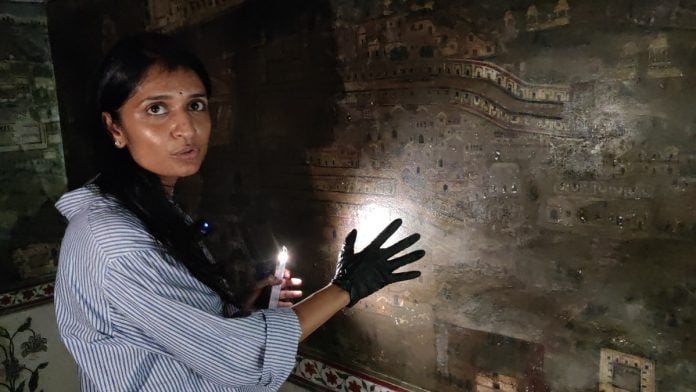
Jaipur: Kirtipal Singh Parmar walked through the narrow corridors of Amber Fort and past its imposing gateways and courtyards. He stopped at a locked door leading to the Bhojanshala — the royal dining hall.
When the door opened, the five rooms beyond revealed a hidden side of the fort. Paintings of Ayodhya, Kashi, Mathura and Vrindavan covered the walls in muted reds, yellows and other natural pigments. Created using the traditional Araish technique, in which pigments are applied to wet plaster, the murals were meant to do more than decorate the dining hall.
“The reason for creating such paintings in the dining hall was to ensure a sattvic atmosphere while dining,” said Parmar, project manager for the conservation work at Amber Fort, and associated with the Indira Gandhi National Centre for the Arts (IGNCA).
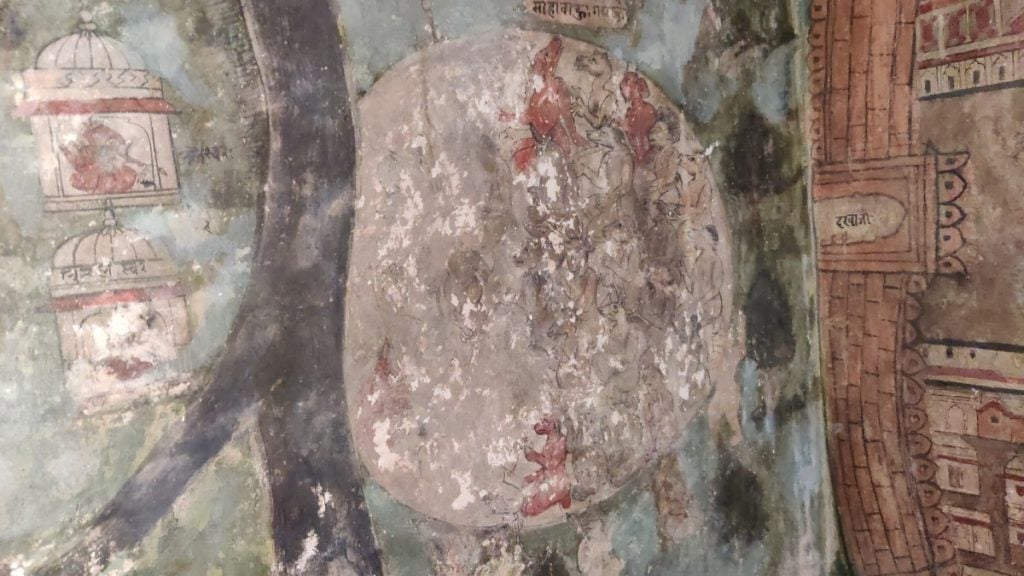
But the centuries-old murals are in trouble. Water seepage, dampness and neglect have left their mark. Painted surfaces have yellowed, and layers are peeling off the walls. Ironically, earlier attempts to restore the murals worsened the deterioration. Now, conservators are making use of science to repair the damage.
There was conservation work on the Amber murals in 2008 and again in 2017. But at that time it was done through private contractors and not scientifically. The material and colours used then are now harming the surface of the walls
– Kirtipal Singh Parmar, IGNCA project manager
This time, the makeover of the murals is moving from cosmetic touch-ups to forensic examination. IGNCA, in collaboration with the Amber Development and Management Authority (ADMA) and the state archaeology department, is using multispectral imaging, X-ray fluorescence and chemical testing to identify original pigments, detect earlier retouching and assess the damage. At the UNESCO World Heritage Site, the aim is not to bring back colour at any cost, but to stabilise the murals without erasing the layers of history they carry.
“Conserving all the murals and motifs in a better way is a tedious and challenging task,” added Parmar.
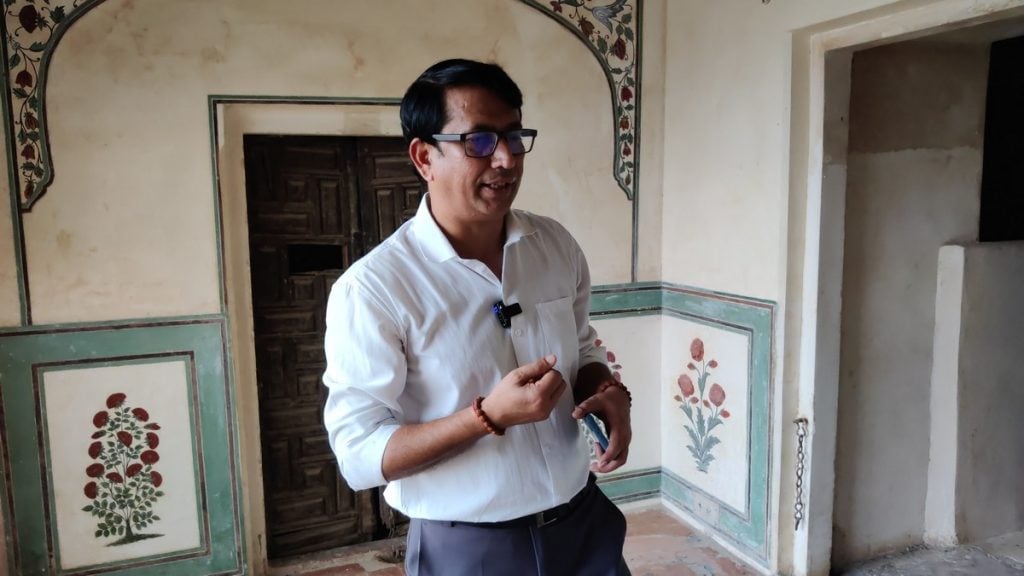
The 2.5-year project is estimated to cost Rs 2.32 crore, according to Rakesh Chholak, fort superintendent with Rajasthan’s Department of Archaeology and Museums. It’s a sizeable allocation within the larger Rs 50-crore conservation plan for Amer, about 11 km from Jaipur. By comparison, only Rs 32 lakh is planned for Sheesh Mahal and Rs 1.61 crore for Man Singh Mahal.
The mural restoration is one of the largest conservation projects currently being undertaken in Rajasthan. The challenge is to save the original artwork without repeating the mistakes of the past.
“There was conservation work on the Amber murals in 2008 and again in 2017. But at that time it was done through private contractors and not scientifically. The material and colours used then are now harming the surface of the walls,” said Parmar, who led conservation work at Jaipur’s Albert Hall Museum for around five years following a flood in 2020. IGNCA has also undertaken restoration projects at Alwar Museum in 2017 and at sites in Bikaner and Bharatpur.
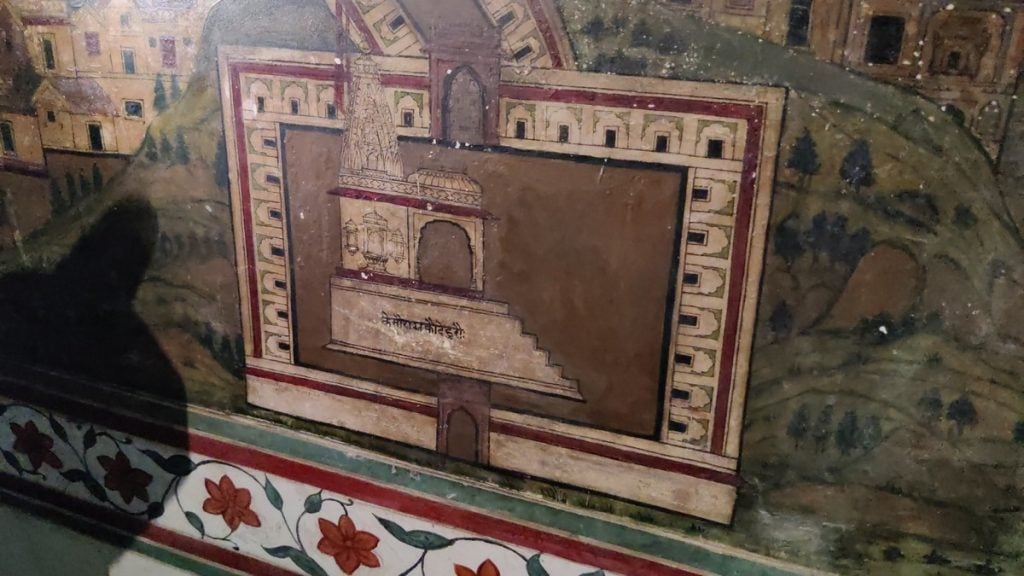
The first phase of the Amber Fort mural project covers four locations: Singh Pole, Ganesh Pole, Man Singh Palace and the Bhojanshala. Parmar’s seven-member team includes archivists, artists and conservators.
At the Bhojanshala, the work is painstaking. Shikha Shekhawat, a member of the conservation team, put on gloves before touching a floral painting. Using distilled water, she gently cleaned a small patch on one of its petals. For now, the team is testing treatments on tiny sections rather than attempting to clean entire paintings.
The delicate task at hand is not just to preserve the paintings but to inure them against further damage at a fort that receives around 2 million visitors every year and is one of Rajasthan’s biggest tourist attractions.
“I observed that the wall paintings at Amber Fort were damaged and faded and needed urgent conservation. Thousands of people daily visit this monument and it’s our responsibility to give them a better experience,” said Chholak.
Also Read: ASI officer built a new Jaipur museum with 1,200 objects. It never opened, bosses are upset
A centuries-old canvas
Inside the Bhojanshala, epic stories play out across the walls, even where time has faded them. One mural depicts the Samudra Manthan, with gods and asuras pulling at opposite ends of a giant serpent coiled around a mountain to churn the cosmic ocean. Beneath it, Vishnu takes the form of a tortoise, supporting Mount Mandara on his back.
Out at the grand gateway Ganesh Pol, delicate hand-painted flowers, vines, and leaves trace the arches, pillars, and entryways. These motifs illustrate the artistic exchange between Rajput and Mughal traditions, particularly the Mughal fascination with gardens and the natural world.
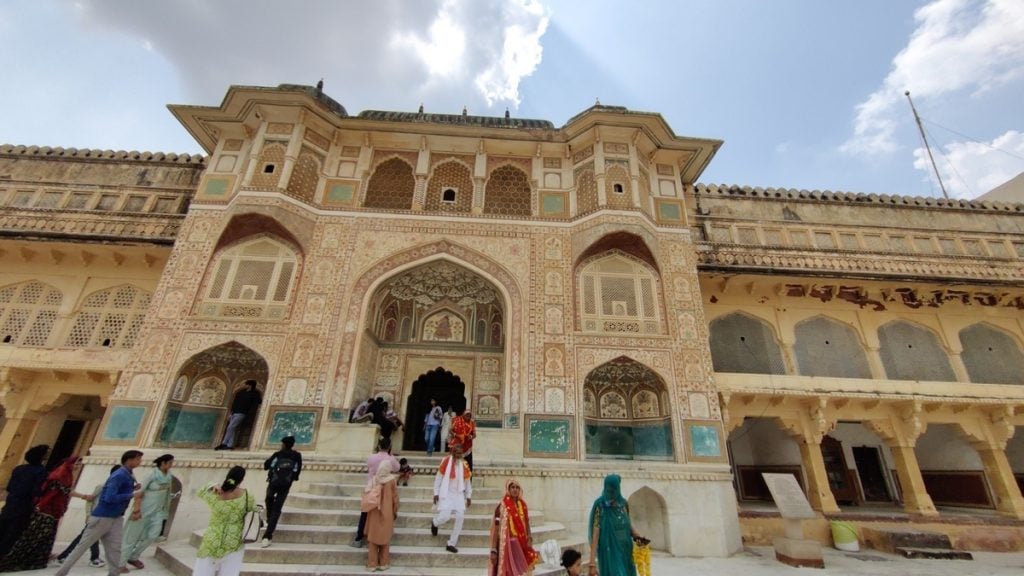
While the Bhojanshala itself dates to the 16th-century reign of Raja Man Singh I, its murals reflect artistic developments under successive Kachwaha rulers. Under Sawai Jai Singh II, Vaishnava themes and mythological narratives became prominent in the palace’s decorative art. As the religious identity of Ayodhya as the ultimate city of Ram gained traction across Northern India during the 17th and 18th centuries, the Kachwaha Rajputs mapped that sacred landscape directly onto their palace walls.
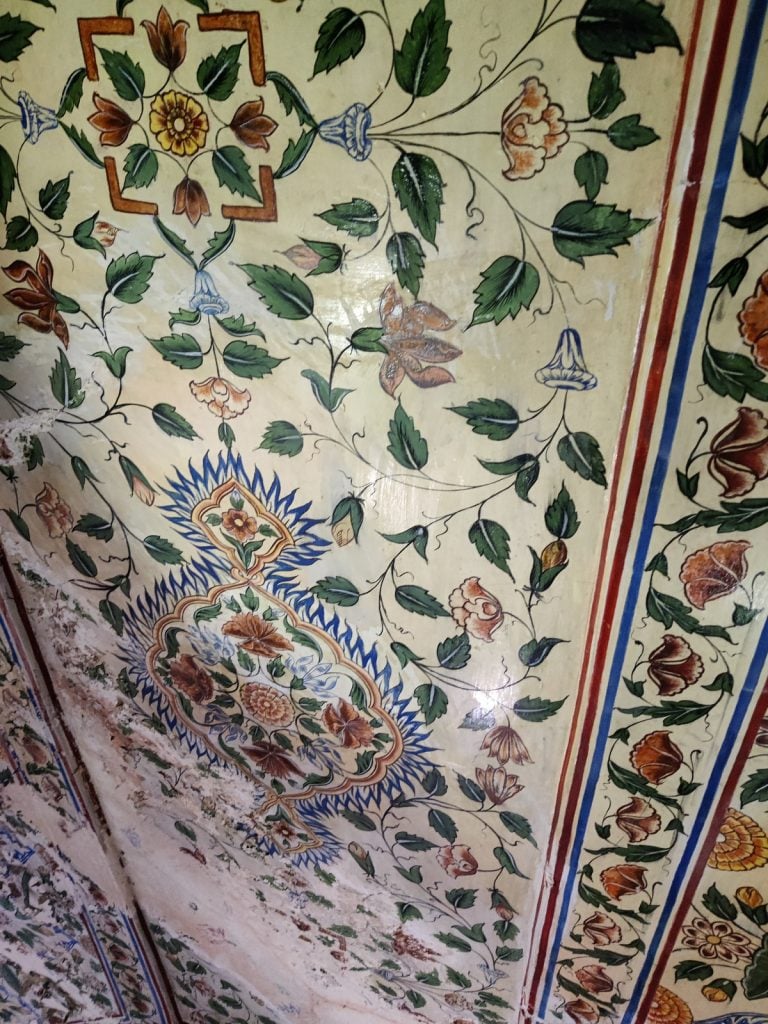
For Parmar, what’s most remarkable is the way religious imagery and palace art came together in a royal dining space.
“Amber murals are rich in heritage and represent a unique blend of religious devotion and artistic evolution. They were commissioned under the patronage of the Kachwaha rulers, including Sawai Jai Singh, and hold a distinct position in Rajput palace art,” he said.
Each layer, pigment and previous repair can offer clues about how the paintings were created, altered and preserved over time. The Bhojanshala also has unfinished panels depicting the 24 avatars of Vishnu, which provide conservators with an opportunity to study how the artists planned the sequence of religious imagery.
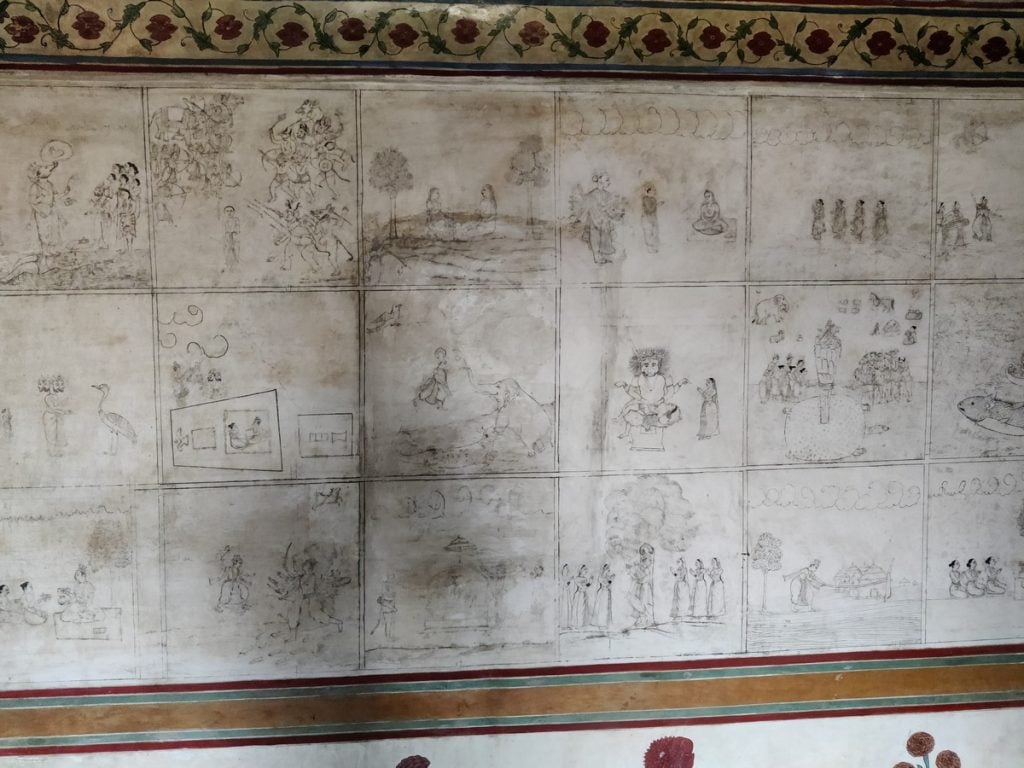
For Parmar and the conservation team, the challenge is to stabilise the paintings without compromising their original pigments and surfaces. Every layer removed or added today could alter what survives for the next generation.
“This makes scientific documentation important before any intervention is carried out,” he said.
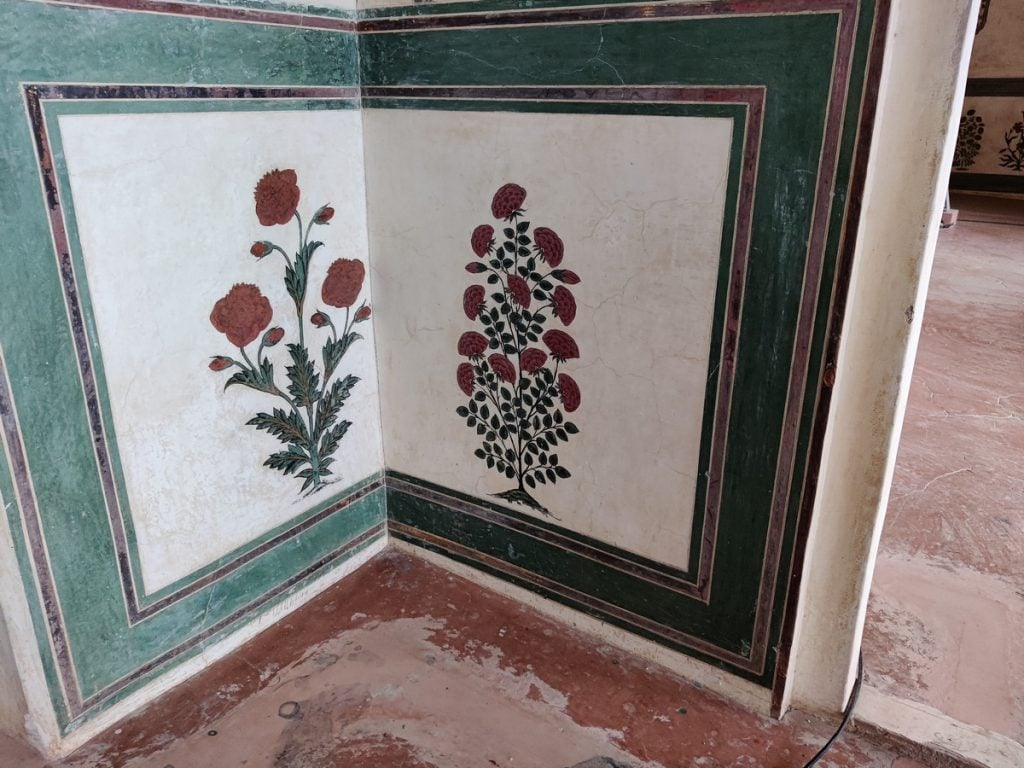
There’s already been a lesson in what can go wrong. ADMA had earlier hired private contractors to restore the murals, but they botched the job.
“They were not up to the mark and the material they used was not as per the standard. This time we don’t want to repeat that mistake,” said an ADMA official.
This is not an uncommon story. Restoration projects across India have repeatedly been criticised for ham-handed work—from the odd shades of white and blue applied to Quli Khan’s tomb at Delhi’s Mehrauli Archaeological Park to the damaging use of cement at Lucknow’s Chhota Imambara.
“Conservation is not just about fixing a building but understanding the building. In our country we often think that conservation is anti-development, but it’s a science and an art,” said Ratish Nanda, conservation architect while delivering a lecture titled Conservation-led Development in India this year.
Scientific conservation
When Parmar and his team began work at Amber Fort in June, they first examined earlier conservation records to understand what had been done to the murals over the years. But the documents could only tell them so much. The paintings themselves had another story to tell.
For the first time, the team turned to multispectral imaging (MSI), photographing the murals in daylight as well as under infrared and ultraviolet light. The images brought out details that were not visible to the naked eye and revealed extensive areas of earlier retouching.
“The exercise revealed extensive areas of earlier retouching. X-ray fluorescence (XRF) analysis was then used to identify the chemical composition of the pigments and binding materials,” said Parmar.
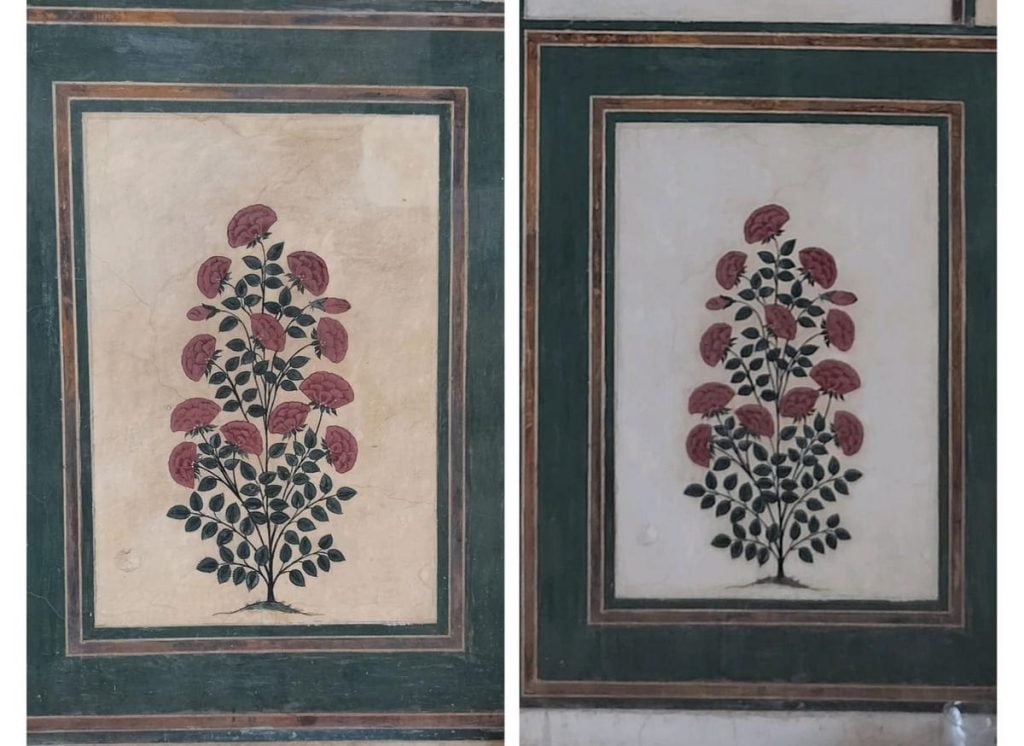
The scientific analysis helped the team identify the materials present on the surface — information that would determine how, and how far, the paintings could be cleaned without disturbing the original layers.
Only then did the conservators begin touching the murals, and even that was done cautiously.
Rather than cleaning an entire painting at once, they started with small test patches. These were first treated with distilled water and, where necessary, with very low concentrations of ethanol and acetone.
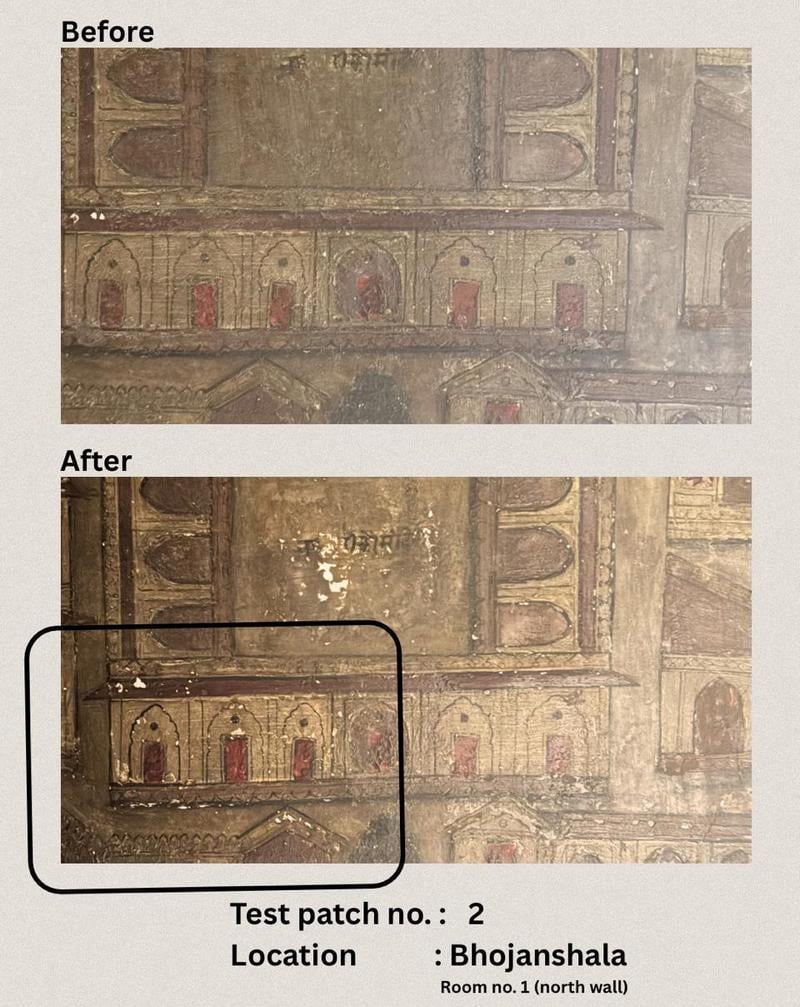
At one floral motif, a test patch offered the team an encouraging glimpse of what lay beneath the yellowed surface. The area had appeared dull and yellow, but after treatment, the original reds and blues made themselves known.
“Instead of immediately cleaning or repainting the murals, the conservation team is working in small patches. We first did condition mapping. The level of damage varies, and some of it is due to weather, seepage and retouching,” said Shikha Shekhawat. “We are using chemicals only in very small concentrations to ensure that the original paint layer is not damaged.”
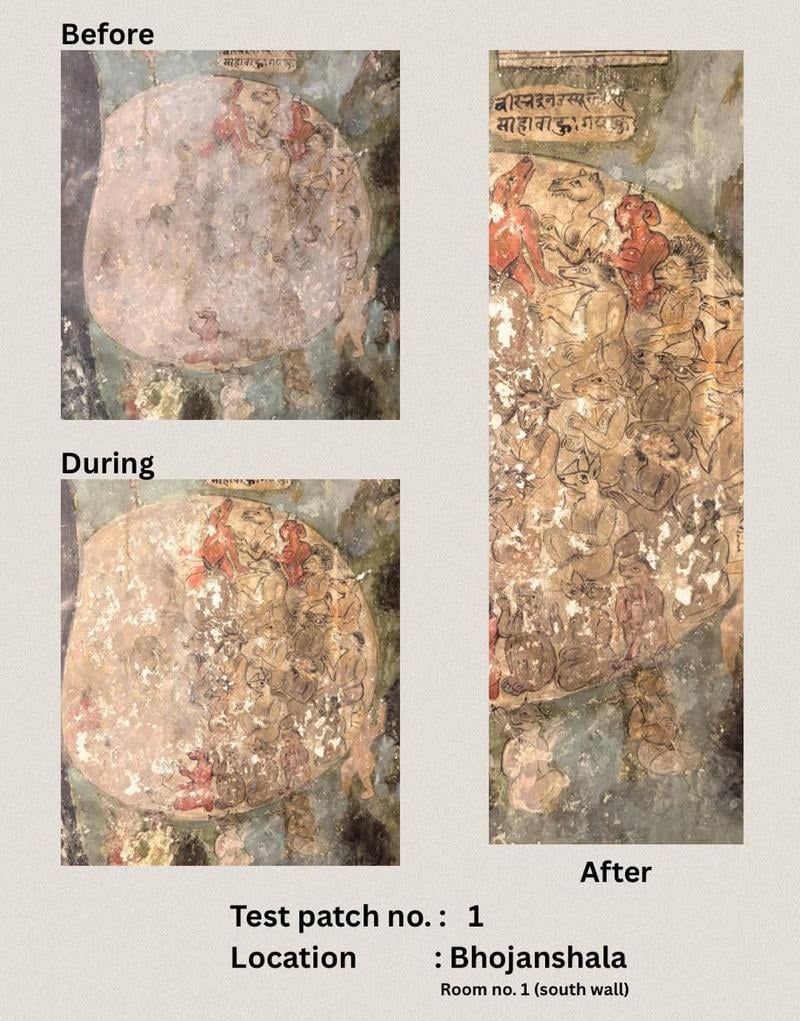
Each test patch is also a kind of investigation. It helps conservators distinguish between the original surface and layers added during earlier repairs.
“Taking a test patch before conserving the whole area helps us identify the original surface and the type of chemicals used over it,” said Neha Sharma, another member of the team.
Thousands of people daily visit this monument and it’s our responsibility to give them a better experience
– Rakesh Chholak, Amber Fort superintendent
But cleaning the paintings is only part of the job. Water seepage continues to threaten the murals, with plaster peeling away in several places. The team plans to use ground-penetrating radar (GPR) to investigate where moisture is entering the structure. If this seepage continues, cleaning the murals would only offer a brief revival.
“When there is leakage in old heritage buildings, it damages the painted surfaces. We need to address the root cause,” Parmar said.
Chholak has also called for the seepage problem to be tackled before work progresses.
“There is no sense to work on the paintings before the seepage thing is not fixed,” he said.
Also Read: Archaeology needs more science, says scientist pushing for labs at ASI institute
Committees and crowds
After three months of detailed work at Amber Fort, Parmar’s team prepared a scientific report based on its preliminary investigations and test patches.
But conservation at a UNESCO World Heritage Site comes with strict guidelines on preserving original materials, architectural design and the monument’s cultural significance. Before restoration begins on a larger scale, IGNCA and the state archaeology department will set up a committee of experts within the next month.
“There are significant challenges as we must strictly adhere to established guidelines at the UNESCO site. An expert committee will decide how much we can make the intervention,” said Parmar.
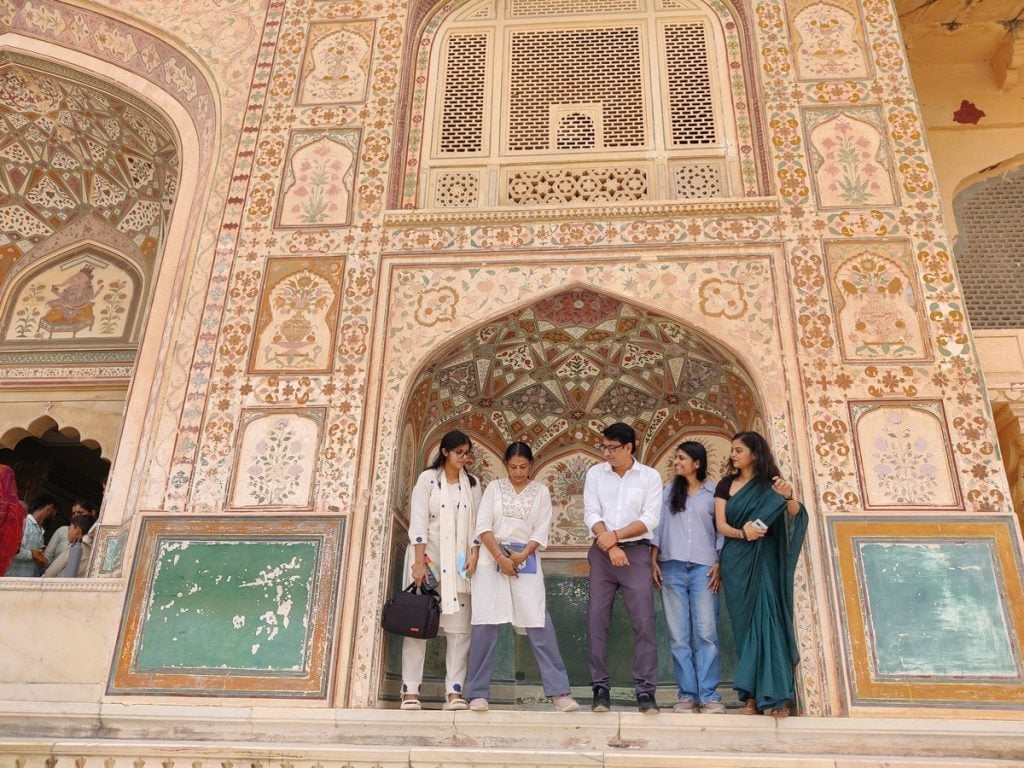
There is now more urgency over the condition of the fort in general. In August 2025, heavy rain brought down a section of the wall near Rambagh at Amber Fort. Deputy Chief Minister Diya Kumari subsequently inspected the site and directed officials to begin repairs and safety work immediately.
According to Chholak, the pace of conservation work picked up after her visit.
The next challenge is the footfall at Amber Fort. Winter brings a flood of visitors, and the team will have to carry out its work even as the crowds pour in.
Once the first phase is complete, the team plans to tackle other neglected murals in the fort.
“If the approach will work, the team could next turn to the fort’s Rang Mahal—another space where the murals require the same delicate balance between cleaning what has accumulated over time and preserving what has survived,” said Chholak.
(Edited by Asavari Singh)