






New Delhi: A week after former IAS Arun Singhal was appointed as an administrator at the Greater Noida-based Pt. Deendayal Upadhyaya Institute of Archaeology, he received an e-mail from scientist Anil Pokharia suggesting the institutional upgradation of the seven-decade-old premier institute under the Archaeological Survey of India (ASI).
This was not the first time Pokharia, a scientist and Archaeobotanist at the Birbal Sahni Institute of Palaeosciences (BSIP), highlighted the importance of Science in Indian Archaeology.
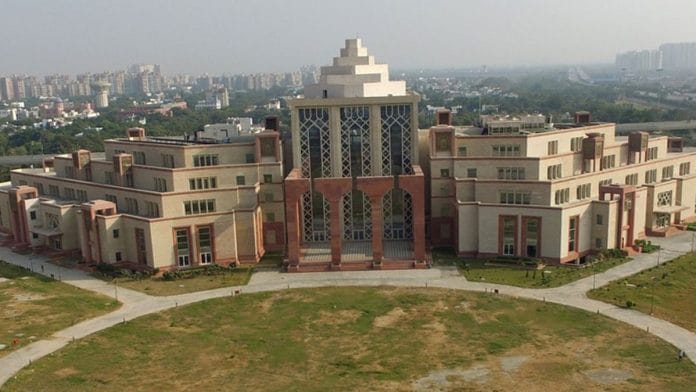
Since 2022, Pokharia has been pushing for a Centre of Excellence in Archaeological Sciences at the Pt. Deendayal Upadhyaya Institute of Archaeology, a new 25-acre campus inaugurated by Prime Minister Narendra Modi in 2019.
ThePrint had earlier reported that the grand campus, built at the cost of Rs 289 crore, had just 15 students and no faculty. A week after the report, the Culture Ministry appointed an administrator to oversee its functioning.
For many years, Pokharia raised the matter of the institute’s betterment at several levels—he reached out to the culture secretary, ASI’s Director General, senior archaeologists, and now the institute’s administrator. He sent agenda and vision documents to senior officials recommending the changes at the institute.
“But no one takes this issue seriously. Archaeology is dependent more on the observation of artefacts and correlation of them with past human activity, but it has to be transformed more scientifically, which is lacking at present in India,” said Pokharia.
Pokharia added that India is far behind in adopting novel and multidisciplinary scientific approaches in archaeology.
However, Arun Singhal said he joined in June and has not seen this proposal of Pokharia.
“Please ask the ministry and ASI about it. We are making efforts to improve the Institute in general and take it towards being an Institute of international standards,” Singhal said in a written reply.
The officials, on the other hand, have thrown it back to Singhal.
“The administrator is now looking after the working of the Institute. If there is any recommendation to make the institute a Centre of Excellence, only he can do it, as he is directly reporting to the Culture Ministry,” said a senior official at the ASI.
Pokharia’s recommendations
In a five-page vision document accessed by ThePrint, Pokharia suggested the change in the name of the Institute from Pt. Deen Dayal Upadhyaya Institute of Archaeology to Pt. Deen Dayal Upadhyaya Institute of Archaeology and Archaeological Sciences.
“It will enhance the periphery and gravity of the institution,” said Pokharia.
Pokharia also proposed the Centre of Excellence in Archaeological Sciences and said that, in the era of archaeological advancement, the establishment of a fully equipped archaeological centre is a basic need to unearth the mystery of the human past.
“We wish to propose a novel centre at Pt. Deen Dayal Upadhyaya Institute of Archaeology, Greater Noida, to establish sophisticated laboratories equipped with the instruments needed for Archaeological investigations under one umbrella,” reads the vision document.
Currently, ASI is mostly dependent on Birbal Sahni Institute of Paleosciences (BSIP) and some other institutions for sample checking.
However, when the institute was inaugurated, PM Modi said it would provide modern amenities for research scholars and students from India and all over the world.
Much of the infrastructure, such as laboratories, a museum and a library, remained unused.
Pokharia suggested five scientific laboratories that could be established under the Department of Environmental Archaeology/Biogeoarchaeology.
These are Archaeobotany lab, Archaeozoology lab, Residual Analysis lab, Stable Isotope lab and Ancient DNA lab.
“The botanical aspect in archaeology is no longer secondary but of considerable significance to many unresolved problems of the human past. It is desirable to extend the area of enquiry further back in time and space,” said Pokharia.
Pokharia argued there are few institutions in India that are running zooarchaeology laboratories such as Deccan Colleges, BSIP and Kerala University.
“Novel well equipped lab and approach will generate new stimuli as well as research opportunities in the zooarchaeological sciences in India and will answer several unanswered questions related to human activities and their diet and movement,” he said.
Establishing a residual protocol at the institute could provide a great opportunity for Indian scholars to analyse and develop data on Indian culinary practices from Indian sites in in-house laboratories.
Pokharia said the laboratories may also serve as an educational hub for students and researchers, promoting a deeper understanding of ancient societies and fostering interest in historical sciences.
“Within these laboratories, there could be sub-branches dealing with specialised studies.
Each of these sub-specialised branches will offer a nuanced perspective on different aspects of human-plant-animal interactions,” said Pokharia.
Also read: ASI still unable to find senior consultant for Underwater Archaeology Wing
Science in Archaeology
Before shifting to Greater Noida in 2019, the Pt. Deendayal Upadhyaya Institute of Archaeology ran from the Red Fort. Pokharia has been a visiting faculty since 2015—he taught Science in Archaeology.
The Pt. Deendayal Upadhyaya Institute of Archaeology had it as a two-year PG Diploma course, which is now curtailed to one year.
“With the growing dimensions of multidisciplinary approaches in Archaeology, the importance of Science in Archaeology, especially floral & faunal remains, ancient DNA, and geo-archaeology, is well realised,” said Pokharia.
Pokharia recommended that students from Botany, Zoology, Chemistry, and Geophysics should be included for admissions and appointments related to ASI to strengthen science in archaeology.
“In order to develop Science in Archaeology, the representation of students from science streams, especially botany and zoology, from the grassroots level is the need of the hour. The present entry level in the PGDA course has only students from Geology,” he said, adding that Archaeobotany and Archaezoology have contributed a lot to uplift science in Archaeology from a national and global perspective.
In 2012, an Archaeological Sciences Centre was established at the Indian Institute of Technology, Gandhi Nagar. Archaeologist VN Prabhakar is now heading the centre. But he was barred for three years in his individual capacity from associating with ASI. The reason is still not known.
Pokharia also pointed out the lack of seats at the Pt. Deendayal Upadhyaya Institute of Archaeology. Currently, 15 students are enrolled every year, and Pokharia demands an increase in this number.
“The intake should be increased from 15 to at least 30 to provide opportunities to Departmental Assistant Archaeologists (5), students from SAARC countries (5) and students in the science stream, especially botany and zoology (5), as these two disciplines have contributed and can contribute a lot to Indian Archaeology in the near future as well,” said Pokharia.
(Edited by Ratan Priya)