


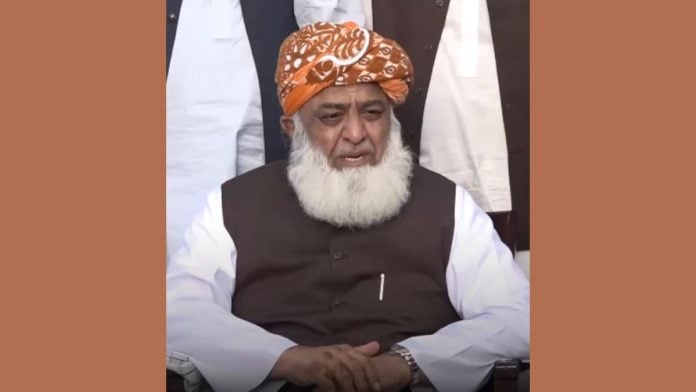
For much of his career, Maulana Fazlur Rehman has been seen as one of Pakistan’s most pragmatic political operators: a religious leader who could negotiate with governments, strike bargains with powerful institutions and keep his party relevant through shifting arrangements. His recent attacks on the military establishment have therefore raised a question in political circles: what has changed?
The answer, according to security analyst Muhammad Amir Rana, is not to be found in domestic politics alone. His recent broadsides have rattled ‘the power corridors’ but the turn has been building for years, shaped by the consequences of Pakistan’s regional strategy, the Taliban’s return to power in Afghanistan, the uncertain returns from the China-Pakistan Economic Corridor (CPEC) and the military’s growing grip on political and economic life.
Former Imran Khan adviser Shahzad Akbar, however puts the weight on one factor: the concentration of power under Army Chief Field Marshal Asim Munir.
Two rivals, one policy
In an analysis published on his Substack, Rana, the former head of the Pak Institute for Peace Studies (PIPS), argues that two bets made over the past decade lie at the heart of the current unease.
The first was the Taliban’s return to Kabul, a process in which Pakistan worked alongside the United States in the hope of a friendly government on its western border. The second was CPEC, which was meant to bring economic development at home and give Pakistan more weight in the region.
“Neither gamble has paid off as intended, and the political fallout of these failures is now surfacing in unexpected places,” he wrote. Rana resigned a week before posting his article.
Pakistan’s friendship with the Taliban did not stop the TTP from expanding, and Islamabad is now carrying out strikes inside Afghanistan while publicly insisting that dialogue is its preferred route.
Meanwhile, CPEC has left Pakistan being seen in Washington as an extension of China, a perception the military leadership concluded was damaging to its defence capabilities and interests, even as Beijing became more assertive on commercial contracts and defence agreements. China, Rana argues, never entirely trusted Khan, and Beijing and Riyadh were arguably among the external actors most comfortable with his removal.
For Fazlur Rehman, Rana says, the shift began after Kabul fell. When the Taliban seized Kabul, Maulana Fazlur Rehman and the PTI were bitter political rivals, but they found common ground on one issue: opening negotiations with the Tehreek-i-Taliban Pakistan (TTP). The PTI’s position was aligned with the thinking of the military establishment at the time. Fazlur Rehman, meanwhile, had his own channels to the Afghan Taliban and believed he was better placed than anyone else to bring the TTP to the negotiating table. In effect, the two rivals were competing to claim ownership of the same policy.
The JUI-F and the PTI drew on overlapping constituencies, especially in KP, where the PTI’s main competitors have included the PPP, the PML-N and the JUI-F. They had also, in effect, been competing to own the same policy. The PTI government’s approach reflected the thinking of the military under Bajwa and Faiz Hameed.
The prospects looked promising at first. But the regional environment changed, and Rana says the new military leadership was no longer bound by the policies associated with its predecessors. In the order that followed, both Khan and Fazlur Rehman were pushed to the margins. They had become passengers in the same boat, but neither was willing to give up the political space they shared.
“Maulana waited a long time to capture that space, hoping for a better deal from the establishment. When that hope faded, he picked up the anti-establishment banner more or less where Mr Khan had left it”, Rana wrote.
A curated opposition
Shahzad Akbar, who served as accountability adviser in Khan’s government, however offers a more immediate explanation. Speaking to ThePrint, Akbar offered several further readings: The confrontation could be a staged contest, a “WWF-style wrestling match”, by the military to create a new curated opposition, in which politicians appear to challenge the establishment without seeking to dismantle the arrangement.
“Even earlier, the military was the kingmaker but it did give space to politicians, madrasas or others. There was always some latitude. Now under Munir it is completely gone and Maulana understands that,” Akbar argued.
However, Akbar remains unconvinced. According to him, Munir’s insistence to create new provinces does not sit well with PPP and that’s perhaps why Zardari may have encouraged Fazlur Rehman to open a rift.
Nawaz Sharif does not want to openly oppose it and so Zardari has stepped in.
According to Akbar, Zardari had hoped a PTI march in KP would succeed and delay what he called the establishment’s political “onslaught”, but the mobilisation was not allowed to proceed. Here’s why Maulana comes in.
Fazlur Rehman’s own wish to stay relevant is another factor. With Munir consolidating power, he may be unwilling to accept political oblivion. Akbar also added that one of Rehman’s larger complaints also were as to why if the military could “rig” elections in every province and nationwide, did they not do it in KP, which is his home ground?
Pressures at home
The TTP has expanded its influence across parts of southern KP, central to Fazlur Rehman’s base, while local rivals, particularly the Kundis and the Gandapurs, hold influence in the provincial government. Violence in his own constituency, combined with the marginalisation of his party, has made silence harder, Rana argues.
There is also an economic constituency behind the discontent. The military’s growing presence in mines, minerals and large development projects, alongside allegations of corruption, has reportedly caused resentment among contractors and mine owners in KP and Balochistan. These interests need political figures who can voice their grievances, and a politician of Fazlur Rehman’s stature would give those complaints far greater reach.
Fazlur Rehman, and perhaps Asif Ali Zardari and Nawaz Sharif too, appear to have concluded that the military is seeking comprehensive control over politics and the economy, Rana says. In that arrangement, established politicians have little room. The preferred model appears to be a new political team aligned with the establishment’s vision and working under its close supervision.
The groundwork is reportedly underway, he writes, through engagement with local influentials and workshops organised by the XII Corps and the National Defence University. The first new platform is expected in Balochistan, followed by one in KP, two provinces where Fazlur Rehman has considerable influence.
“Both provinces fall squarely within Maulana’s sphere of influence. This raises an uncomfortable question: who stands to lose the most? The answer is fairly obvious, and Maulana knows it better than anyone. He has no intention of becoming a casualty of this reengineering, nor of accepting a quiet exit from the political stage. His rhetoric suggests he is holding out for either a complete political victory or a major ‘super deal’, Rana argues.
He has a history of doing it.
Shaped by Pakistan’s military alliances
Fazlur Rehman’s present stance stands out because of how tangled his past dealings with the military and the political system have been. Born in 1953 in Dera Ismail Khan, he inherited a religious and political legacy from his father, Mufti Mehmood, a prominent Deobandi cleric who opposed Partition on religious grounds before accepting Pakistan as a reality. Mehmood joined the Jamiat Ulama-e-Islam, defeated Zulfikar Ali Bhutto in the 1970 election and became chief minister of what was then the North-West Frontier Province.
Unlike his father, Fazlur opposed Zia from the start. When the PPP invited the JUI to join the Movement for the Restoration of Democracy, he backed it and many senior figures did not. The disagreement split the party in 1981: his faction became the JUI-F, and Sami-ul-Haq founded the JUI-S.
The JUI-F’s alliance with the PPP lasted until the army dismissed Benazir Bhutto’s government in 1996. His rise then coincided with the emergence of the Taliban, who were Deobandi in origin and many of whose commanders had studied at JUI-F-linked madrassas.
After the 9/11 attacks the JUI-F fiercely opposed Gen Pervez Musharraf’s decision to join the US-led coalition. Leaders close to Fazlur Rehman argued Musharraf had effectively placed himself outside Islam, and the party held mass protests, especially in Quetta. Yet before the 2002 elections Musharraf encouraged Islamist parties to form the Muttahida Majlis-e-Amal (MMA), whose closeness to the military earned it the label “Military-Mullah Alliance”.
It formed the government in Peshawar, with Fazlur Rehman nominated as chief minister, became part of the ruling coalition in Balochistan, and helped keep the PPP and the PML-N out of the system. The military supported his election as leader of the opposition. The MMA then helped Musharraf pass the Legal Framework Order, which legitimised military rule, in return for its Sharia legislation.
The confrontation now
The federal government has since the past month imposed emergency measures and governor’s rule in KP, citing security and administrative concerns. The opposition calls this an assault on provincial autonomy, and Fazlur Rehman has been among the loudest critics. The JUI-F’s provincial leadership says the emergency appears aimed at facilitating anti-encroachment operations rather than countering terrorism.
The party’s provincial executive committee, meeting at the Mufti Mahmood Centre in Peshawar under provincial chief Senator Maulana Atta-ur-Rehman, has now announced protests across KP on 15 November in support of Fazlur Rehman’s position on the province’s mineral resources. It demanded that the government make public all agreements with foreign countries on mineral exploitation, and announced an awareness campaign. It also raised what it called smear campaigns against party leaders involving fabricated videos and photographs.
“Though the JUI-F has staunch supporters on the streets who are ready to answer their party’s call, its leader has never been one to take needless risks”, Dawn wrote in its editorial Wednesday.
From then to now, Fazlur Rehman’s position is hard to separate from the contradictions of his career. He has opposed military rule, worked within military-backed alliances, supported the Afghan Taliban, negotiated with successive civilian governments and sat on opposition benches while helping a military ruler legitimise his government. His strength has come from his ability to negotiate across competing centres of power. The concentration of authority under Munir, as Akbar and Rana describe it, may have narrowed the space for that bargaining.
Whether he is after a decisive victory, a negotiated settlement or the “super deal” Rana says he may still hope to shape the next phase of the confrontation between Pakistan’s civilian politicians and its military establishment. What is already clear is that he does not appear prepared to accept an exit.