







New Delhi: Pakistani civil society is protesting the government’s handling of events in Pakistan-occupied Kashmir on social media, arguing that violence cannot sustain state authority and legitimacy.
The region has been reeling under violent protests and a deadly Army crackdown since early June after the Joint Awami Action Committee (JAAC) called for a protest march to Muzaffarbad, the occupied region’s capital, demanding electoral reforms ahead of 27 July elections and the abolition of 12 reserved seats for refugees from India.
Voting is currently underway to elect a new Legislative Assembly and prime minister of PoK. While Islamabad has granted PoK special status, it continues to call the shots. All candidates, including the prime minister, are required to furnish an undertaking affirming PoK’s accession to Pakistan. Any candidate advocating independence or any arrangement other than union with Pakistan is barred from contesting.
The PoK Assembly was expanded in August 2019, allocating one additional seat each to Muzaffarabad, Neelum, Sudhanoti, and Kotli. This brought the total strength to 53 and raised the majority mark to 27.
Of the 53 seats, 45 are directly contested. Thirty-three represent constituencies within PoK, while 12 are reserved for refugees from India and are spread across Pakistan’s provinces, including Lahore, Rawalpindi, Gujranwala, Faisalabad and Sialkot. The remaining eight seats are also reserved: five for women, and one each for a technocrat, religious scholar, and an overseas Kashmiri. Major political parties fill these seats through proportional representation after the general election.
Also read: Deadly violence mars polls in Pakistan-occupied Kashmir, 30 civilians killed in clashes with Army
Elections and violence in PoK
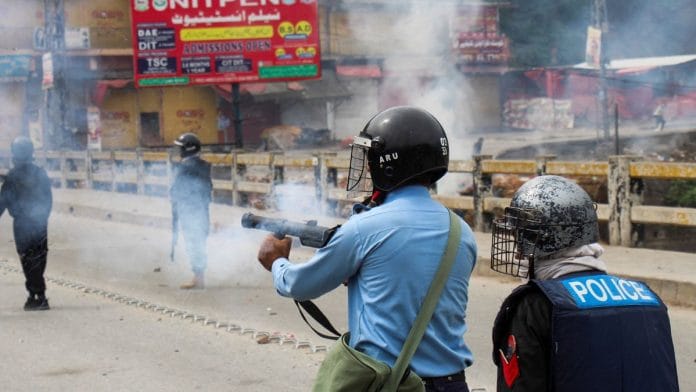
Voting began on Monday and will continue until 10 August. The election is being held in three phases for the first time. It unfolds against internet shutdowns, a spate of arrests, and deadly clashes between protesters and security forces that have claimed at least 40 lives, including six police and paramilitary personnel. By some estimates, as many as 14,000 personnel from Pakistan’s Punjab province have been deployed in PoK to oversee the polling process.
JAAC members argue that the reserved seats allow the federal government to deepen its interference in the region’s affairs and serve as a political lever for mainstream parties such as the PPP, PTI and PML-N to extend their influence in PoK. The government, however, says the seats ensure representation for refugees dispersed across Pakistan and cannot be abolished through unconstitutional means.
The dispute over the Assembly seats has turned deadly, with the Pakistan Army accused of firing indiscriminately at civilians, resulting in at least 90 deaths across the region. On Monday, JAAC members also alleged that security forces deliberately removed bodies from local hospitals amid a complete communications blackout.
The violence, particularly the crackdown on peaceful protesters in Rawalakot and Mirpur over the past two days, has triggered widespread anger against the government. PoK comprises three divisions and 10 districts, with Muzaffarabad as its capital. Voting for the 13 constituencies in Mirpur division was held on 27 July, followed by the nine constituencies in Muzaffarabad division and all 12 refugee constituencies on 2 August. The remaining 11 constituencies in Poonch division will vote on 10 August.
The first phase of polling on Monday was marred by violence, even as results began to emerge. According to preliminary results reported by Dawn, the PML-N was leading in Mirpur, with the PPP in second place. PTI, which won last year’s election, has boycotted the polls, while JAAC members were barred from contesting as independents.
Social media full of govt criticisism
Content creators from PoK have taken to Instagram to document the situation on the ground and appeal for international attention. Human rights organisations, including Amnesty International and the independent Human Rights Commission of Pakistan, have called for restraint, dialogue and a peaceful resolution.
“What happened in Rawalakot should never have happened. Some are saying that the Kashmir cause has been buried today. The state has committed the ultimate cruelty by firing on its own people,” prominent Pakistani journalist Hamid Mir wrote on X.
Others criticised Pakistan’s mainstream media for failing to adequately cover developments in the region. Journalist Neelam Aslam called it the “death of Pakistan media” in a video posted on X, saying television channels were preoccupied with portraying the election as a contest between the PPP and the PML-N while ignoring the voices of people on the ground.
“You keep saying it is foreign-funded. Had they been sellouts, why did they wait until 2026? Wouldn’t they have chosen to be sellouts in 1947?” Aslam asked angrily.
PTI leader Meher Bano Qureshi also criticised the government’s response, saying, “Shahbaz seems more concerned with wildfires in France than the one in his own backyard.”
Former Dawn editor Cyril Almeida added, “Nothing matters… except office and power.”
Even Dawn, in an editorial, argued for free and fair polling in the region, though it stopped short of directly criticising the government’s handling of the unrest.
“…free and fair general elections are essential to finding a democratic solution to AJK’s issues. Which is why the current three-phase exercise… should be conducted with absolute integrity — and without any phase of the electoral process influencing the outcome of the next,” the editorial said.
Journalist Asma Shirazi likewise criticised the muted political and media response.
“There is a terrifying silence regarding the situation in Rawalakot. Political parties and the media are sitting with their eyes closed like ostriches… the use of force is in no way appropriate under any circumstances. Politicians, it is better to take action in the field now rather than drawing lines later, otherwise it will be too late,” she wrote on X.
Several social media users contrasted the extensive attention Pakistani commentators paid to protests in New Delhi with what they described as the silence over Rawalakot.
“Pak Gen Z & askari media had every minute update… regarding events unfolding in Jantar Mantar… yet the criminal silence regarding the massacre in Rawalakot—located merely 120 kms from Islamabad—will go down in history as a prime example of hypocrisy…” X user Ammad Khan wrote.
Others questioned whether elections should proceed amid the violence.
Former Pakistani High Commissioner to India Abdul Basit said the polls “should have been postponed for a couple of months.”
“It’s painful to see present situation for those who genuinely believe in the slogan “hum Pakistani hain Pakistan hamara hai’,” he wrote on X.
Responding to Basit, military analyst Ayesha Siddiqa described Pakistan as a “colonial state”, arguing that decades of military authoritarianism had reduced the federation’s constituent units to colonial-style peripheries.
(Edited by Prashant Dixit)