





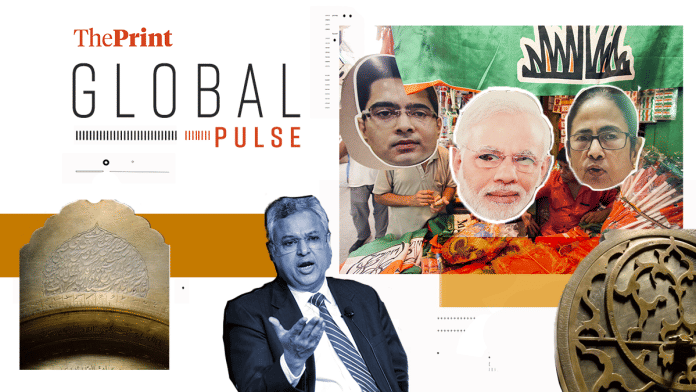

New Delhi: As West Bengal approaches its second phase of voting, global media analyses highlight contrasting testimonies of voter support for the Trinamool Congress and the BJP in the state assembly elections, all amid controversy over the recent electoral roll revision.
“In India, the world’s largest democracy, a single misspelling from years ago can now threaten a person’s right to vote,” Anupreeta Das and Hari Kumar of The New York Times report.
With nine million voters deleted from the West Bengal rolls, disputes over alleged falsifications in the Special Intensive Revision (SIR) process have reached the Supreme Court. Despite these ongoing legal battles, voting and results will proceed, leaving the rights of millions uncertain.
“Many of those deleted were Muslims, and opposition parties have accused Prime Minister Narendra Modi’s government of abusing its power to disenfranchise Muslim voters,” the NYT reports.
The “Hindu nationalist” BJP, it adds, has long described Muslims as “invaders who compromise its idea of a Hindu nation”.
“By deleting Muslim names from the voter list, the party may raise its chances in a state that has India’s second-largest Muslim population, and which it has never won.”
Mamata Banerjee is fighting to become the state’s CM for the fourth time.
But the BJP is mounting a serious challenge.
“The stakes are particularly high in West Bengal because the BJP has been steadily making inroads. From winning only three of the 294 seats in the legislative assembly in 2016, it took 77 seats in the last election, in 2021. While many election analysts still expect Ms Banerjee to win, they predict a smaller margin and that Mr Modi’s party could win more than 100 seats.”
The report notes that the BJP’s inroads are a marker of the forays Prime Minister Narendra Modi and “the Hindu Right have made in their quest to dominate India”.
The Economist writes about one man’s quest to “turn things around” for India’s statistics ministry, which has been marred by controversies.
“For decades after Independence, India boasted a statistical infrastructure far superior to what its level of development would suggest. But the system suffered from both neglect and political interference. Things reached a nadir in the 2010s under governments led first by a distracted and scandal-plagued Congress party and then by an inexperienced and ideological Bharatiya Janata Party. Controversies in 2018 and 2019—over GDP calculations, unemployment rates, payroll data and consumption—sapped confidence, at home and abroad, in India’s numbers.”
Then, in 2024, the Indian government installed Saurabh Garg, a veteran of the civil service. “Among the terminally nerdy crowd that pays attention to these things—policy wonks, researchers, journalists—Mr Garg is spoken of in glowing terms.”
The column says he avoids ideological debates. “Since Mr Garg took over, he has created a calendar of data releases, cleared the backlog of pending surveys, sped up the pace of data-gathering and publication, and organised dozens of workshops and consultations.”
Commenting on India’s civil service infrastructure—often called the “steel frame” of governance—the column points out that India is way behind in standing up to the moniker. The civil service of India comprises 5,577 officers. The UK, with a population less than 20th of India’s, has over 7,500 senior civil servants.
“If he [Garg] has done his job well, India’s statistical system may even rise above the individuals who run it.”
Nikhil Inamdar of the BBC writes about a 17th-century ‘supercomputer’ once owned by Indian royalty heading for auction.
“A spectacular brass astrolabe—or a hand-held astronomical computer—from the 17th century, once part of the royal collection of Jaipur city in western India, will go under the hammer at Sotheby’s in London on 29 April.”
Earlier, it was part of the royal collection of Maharaja Sawai Man Singh II of Jaipur, the report notes. Next, it passed to his wife, Maharani Gayatri Devi, before joining a private collection during her lifetime.
“Astrolabes are metallic disks with multi-layered, interlocking components that were historically used to tell the time, map the stars, the direction of Mecca and the motion of the sky.”
Dr Federica Gigante of Oxford terms the brass astrolabe a modern-day smartphone, due to the device’s versatility.
“You can calculate the time of sunset, sunrise, the height of a building, the depth of a well, distance and even use them to predict the future. Along with an almanac, they were once used to cast horoscopes,” she says.
(Edited by Madhurita Goswami)