





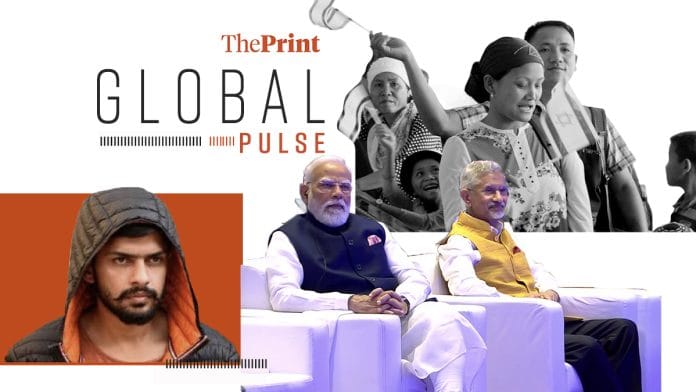


New Delhi: The West Asia war has left the Indian government to “ponder its irrelevance”, writes Vaibhav Vats for The Atlantic. Referencing Pakistan’s peacemaking role in the war between the US and Iran, Vats argues that Islamabad’s talks are “making India feel small”.
“Indian Prime Minister Narendra Modi has spent the past decade promoting the notion that India is the leader of the global South and, as such, is indispensable to world affairs. Now a conflict in the Middle East has thrown the global economy, and, with it, India’s, into crisis,” Vats writes.
Citing Dhurandhar, he adds, “The hypernationalist blockbuster is typical of India’s current public discourse in its detachment from reality and profound unseriousness about the real challenges India faces.”
Earlier, EAM S. Jaishankar called Pakistan’s intermediary role ‘dalali’, “a pejorative Hindi word for a kind of unsavoury middleman”.
But following the 8 April peace talks, criticism of the Indian government has poured in from all quarters, including Congress leader Jairam Ramesh and AIMIM chief Asaduddin Owaisi.
Meanwhile, the India-US-Pakistan dynamic has been uneasy since last year, when US President Donald Trump announced a ceasefire after a four-day armed conflict between the neighbours. Trump’s announcement “embarrassed Modi, who likes to project a strongman image”.
But that was not all.
“Last year, Islamabad profusely thanked Trump for his role in the ceasefire with India, and Prime Minister Shehbaz Sharif nominated the US president for the Nobel Peace Prize. Embracing Trump’s transactional style, Pakistan signed a rare-earth-minerals deal with the US and joined the president’s Board of Peace.”
Modi, on the other hand, could not bring himself to acknowledge Trump’s role in the ceasefire, Vats writes.
Trump sparked another controversy when he reshared a transcript from a Right-wing podcast that made remarks against Indian migrants, Amy Qin of The New York Times reports. “President Trump provoked a broad backlash this week when he posted a transcript from a right-wing podcast in which the host referred to China and India as ‘hellhole’ places and said recent immigrants from those countries had not ‘integrated’ into America as ‘European Americans’ had.”
Trump reshared the transcript on Truth Social after an episode of The Savage Nation, hosted by Michael Savage, a popular ‘conservative’ talk radio host. “The president did not add any commentary to his posts, but across Asia and the United States, many people saw an unwelcome message that demanded a response,” Qin writes.
The Indian government, while making no mention of Trump, called the comments “obviously uninformed, inappropriate and in poor taste”.
“Asian American advocacy groups and some Democratic lawmakers faulted Mr Trump for amplifying xenophobic rhetoric at a time when the administration’s efforts to restrict even legal immigration have left many Indian Americans and Chinese Americans worried about their place in American society,” the report adds.
In the clip, Savage alleged, without offering evidence, that recent immigrants have “almost no loyalty” to America, and that the country is being “overrun with Chinese coming here just to drop a baby on our shores to then bring in the entire family”.
The NYT report further notes that Savage also said that Indians and Chinese have created “internal mechanisms”, ensuring that only people from their own countries secure tech jobs in California.
On the other hand, Hari Kumar and Alex Travelli of The New York Times report on some thousand Jews in Northeast India, waiting to be flown back “home”.
B’nei Menashe, followers of Judaism, believe themselves to be one of the ten lost tribes of Israel, children of Manasseh, a king of Judah who was exiled nearly 2,800 years ago.
“There are about 10,000 of the B’nei Menashe spread between the Indian states of Manipur and Mizoram and, increasingly now, Israel itself, 3,600 miles to the west.”
“We have good faith in the Israeli government. They promised that all the B’nei Menashe will go to Israel by 2030,” Ngamthenlal, who lives in one such community in India, says. “We all have our passports ready.”
Under Operation ‘Wings of Dawn’, Israel is flying about 250 more of the Menashe, via Delhi, to Tel Aviv. The rest are to follow soon after.
The Economist reports that India has a noise problem affecting the economy and cardiovascular health. The report discusses a noise source: urban traffic.
“Noise levels on Delhi’s streets average around 75 decibels—four times the threshold recommended by the UN’s World Health Organisation (WHO). Peak readings in some cities have exceeded 100 decibels, roughly the equivalent of standing next to a chainsaw.”
“Noise is no mere irritant.”
A growing body of research, as the report notes, suggests that consistent exposure to it can pose a serious public health threat. Over 60 million Indians live with hearing loss—an issue that researchers partly link with noise pollution.
A 2020 review of studies also found that higher levels of road-traffic noise were associated with an increased risk of heart disease, as loud sounds trigger the body’s stress response and disrupt sleep.
For an experiment, Indian and British participants were asked to react to identical traffic noise recordings from their respective countries. “When exposed to the sound of an average Delhi street, the heart rates of British participants, used to more tranquil environments, increased. They also displayed other signs of physiological stress. Indians, by contrast, seemed less fazed when exposed to Delhi’s cacophony.”
Despite all this, the report notes that governments in the country are doing little. The pollution control board’s noise-monitoring network extends to 80 stations across ten cities.
“Its call to maintain ‘silent zones” in cities—areas near hospitals and schools—has also fallen on deaf ears. A ten-year analysis that concluded in 2020 found that noise levels in these zones were more than twice the regulator’s limit.”
“Poor planning has made Indian traffic chaotic as trucks, auto-rickshaws, motorcycles, bicycles and pedestrians jostle for space. In this free-for-all, the horn has morphed from a warning instrument into an all-purpose communication device: a way to signal a turn, nudge a dawdler, or simply announce one’s presence.”
Tackling this noise pollution requires an overhaul of cities and how they’re managed.
Atul Dev of The Guardian profiles India’s “most notorious” gangster, Lawrence Bishnoi, and his many high-profile encounters, while operating from a high-security prison in New Delhi.
“In October 2024, members of the Bishnoi gang carried out one of the most high-profile murders in recent memory: Baba Siddique, a senior Indian politician, was left in a pool of blood next to his car in a wealthy Mumbai neighbourhood. Shortly afterwards, Bishnoi was linked to a number of killings and attempted assassinations on Canadian soil.”
But Bishnoi was already well-known by this point.
Two years before, he had ordered the killing of Punjabi rapper Sidhu Moosewala.
The most remarkable element of this series of killings was that Bishnoi planned these murders sitting inside a “high-security” prison in New Delhi.
“The Bishnoi gang has about 700 members, according to the NIA, spread across north-western India, the Middle East and North America. He has been incarcerated for more than 10 years, awaiting trial on several counts of murder and extortion, but it hasn’t been a limiting experience.”
His most serious crimes have occurred while in custody.
(Edited by Madhurita Goswami)
Who cares ?! Poi panni nokk