



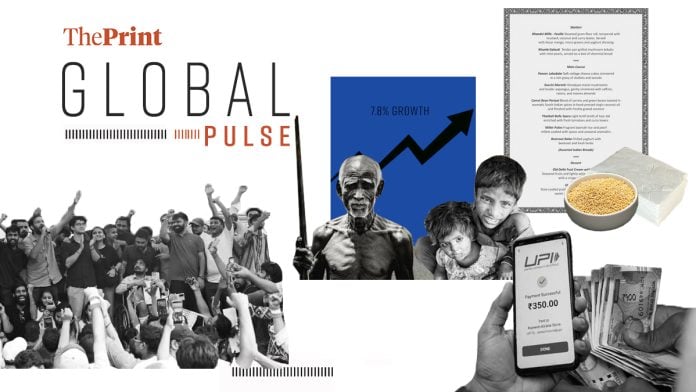
New Delhi: India’s economy grew by 7.8 percent year-on-year, yet The Economist argues that robust macro metrics do not reflect the nation’s mood.
Despite critics calling the numbers misleading, the column says, rising car sales, credit growth and power consumption reflect “genuine growth”. So, what caused the skepticism among pundits, journalists and economists about India’s economic growth numbers? The column identifies two reasons for the outrage.
“The first is that his (Modi) government has spent a dozen years delaying, suppressing and weakening India’s statistics,” it says. The magazine refers to the long overdue census, which, it says, should have been conducted in 2021.
“Unflattering datasets have been held back with the excuse that their methodology needed work. Long-established surveys suddenly dropped sections of their questionnaires.”
The second, and bigger reason is that Indians are not witnessing this 7.8 percent growth around themselves. “Surely the country should seem richer, more functional, less chaotic? Indians look around and see the precise opposite,” the column says. It refers to the PG accommodation building that collapsed in Satya Niketan in Delhi killing seven, and the explosion in Malviya Nagar that killed 21.
“Last month, Gurugram, a satellite city of Delhi with some of the most expensive flats in India, was paralysed on several days as its streets flooded.”
For the author of the column, Prime Minister Narendra Modi’s “gloating” over growth numbers brings back memories of prime minister Atal Bihari Vajpayee’s failed election campaign around rapid economic growth. In 2004, 8 percent growth gave Vajpayee confidence to launch the “India shining” campaign and bring elections forward to capitalise on the “feel-good factor”.
“For millions of voters the ads only reminded them that they had been left behind. The BJP suffered a shock defeat and was out of power for a decade,” the column says.
The column says Modi is “intent” on forgetting that lesson. “Robust macroeconomic numbers may make the government look good. They do not necessarily make the nation feel good.”
Yan Zhuang and Alex Travelli, of The New York Times, write about the “meatless meal” served to world leaders during the BRICS 2026 gala dinner. While the guests were served paneer and mushrooms, meat was “conspicuously absent”.
Zhuang and Travelli highlight the importance of a right diplomatic meal. The report says that this has become a pattern with diplomatic meals in India. Presidents of Seychelles and Vietnam were also served vegetarian meals during their visits to New Delhi this year.
“Mr Modi is vegetarian and does not drink alcohol. At functions he attends, public or private, alcohol is removed from view; at wedding receptions, for example, his security agents have had bars closed before his arrival,” the report adds.
“Meals served to visiting dignitaries can have an important diplomatic function,” said Keri Matwick, a scholar at Nanyang Technological University in Singapore who studies food and culinary diplomacy, told the NYT.
The report also recalls incidents where diplomatic meals have caused a row. When South Korea hosted Trump for a state dinner in 2017, he was served shrimp caught near islands controlled by South Korea but also claimed by Japan, prompting a complaint from Tokyo.
Meals are used to foster good diplomatic relations between two countries, but if they are not handled well, Matwick said “it can spark a lot of conspiracy”.
Meanwhile Cockroach Janta Party founder Abhijeet Dipke details his lessons from the youth movement to The New York Times. The first lesson Dipke says he learnt from the protest was that “luck and timing” matter.
He was referring to Chief Justice Surya Kant’s comment calling youth “cockroaches” which sparked the movement. Dipke posted on X: “What if all cockroaches come together”. The post went viral immediately gathering following in millions on social media platforms.
And soon after, people were writing, “Let’s make this happen”. The second lesson, Dipke says he learnt from the protest was to “be bold”.
“You need to take the risk nobody is willing to take,” he told the NYT. So “I decided that I will go back to my country to show that I am not a national threat,” he added.
The third lesson Dipke learnt from the movement was to “be stubborn”. Despite getting threats and being worried for his family, Dipke continued to lead the protest as numbers kept growing. Talking to the NYT, he said that even after the police cracked down on protesters, they returned to the site with fractures, wounds, and all sorts of injuries to demand then Union education minister Dharmendra Pradhan’s resignation.
Dipke said they now plan a nation-wide campaign to talk to people, and listen to their problems and the issues they face.
Soutik Biswas of the BBC writes about India’s growing currency abundance even as daily individual cash-based transactions decline.
“Every year, more Indians tap, scan and swipe. Every year they also hoard more paper,” he writes.
The Reserve Bank of India has 176 million notes in circulation as it is printing 28-30 billion notes across six denominations every year, and retiring 21 billion.
“And yet, as Unified Payments Interface (UPI) digital transactions surge towards a billion a day, cash sloshing around the economy keeps climbing at a brisk pace,” Biswas says.
Biswas points to a few reasons for this “cash paradox”. According to Anirudh Tagat, an economist, currency still serves three purposes—as a means of payment, a store of value and a hedge against calamity. “Apps are replacing only the first. That helps explain why digital payments alone cannot tell the whole story of cash demand,” Biswas notes.
An important factor that could explain the increased “holding” of cash despite using it less for payments is black money, or money involved in illegal activities. “Property deals in India routinely involve cash payments, partly because stamp duty and government-set “circle rates” can lag market prices, giving buyers and sellers an incentive to under-declare the transaction and settle the difference in cash,” he writes.
Another conundrum for the RBI is the control it holds over both cash and the UPI. Tagat says it creates a problem for the central bank: How much to invest in managing cash and how much in promoting digital payments.
“The lesson for policymakers is clear, and mildly humbling: Digital payments have not made cash obsolete. Cash is less a technology being replaced than an insurance policy nobody wants to give up,” Biswas writes.
(Edited by Viny Mishra)
What an irony! This article criticizes Modi govt of not having proper dataset, but this same article uses “global media” articles to give an image that very few things are good in India. When was the last time the global media was positive about India story? So why should the The Print refer to global media? I again request to please remove articles by Sana Hashmi which tells what he Chinese say about India.