





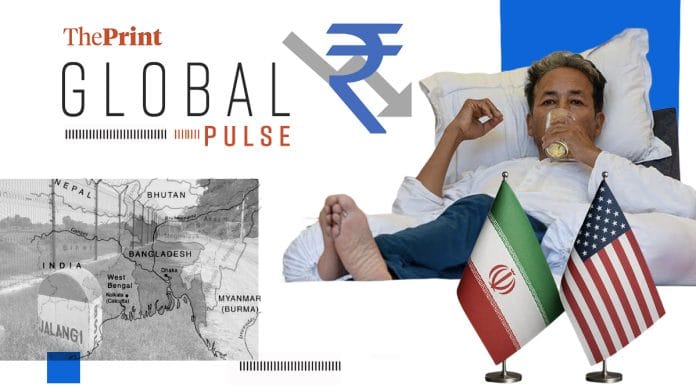


New Delhi: The US, Israel and Iran war has put sustained pressure on the Rupee, prompting India’s central bank to announce a slew of measures in an attempt to prop up the currency’s value. Chris Kay of Financial Times reports on one such latest measure.
Union Finance Minister Nirmala Sitharaman has urged state-owned banks to “lure” more overseas citizens to deposit foreign currency in India’s banks. This is being seen as a bid to shore up foreign currency reserves in India.
“The rupee has weakened more than 6 percent against the dollar this year, making it one of Asia’s worst-performing currencies, as elevated oil prices from the war in Iran increase India’s energy import costs,” Kay reports.
Based on a meeting between bank executives and Sitharaman, FT reports that the response from the diaspora has been encouraging, with deposits being estimated at USD 37 million. But, there is another cause for concern. India’s inflation rate has breached RBI’s 4 percent mark, going up to 4.4 percent, highest in the last 18 months.
As West Bengal Chief Minister Suvendu Adhikari gives a renewed boost to the *border fencing project, migrants are being ‘pushed out’ at the India-Bangladesh border, sometimes even leading to armed standoffs. Anupreeta Das, Saif Hasnat, and Hari Kumar of The New York Times report from the ground on what is going on at one of the longest shared borders in the world.
“But that sievelike, roughly 2,500-mile border has increasingly become a fault line between the traditionally friendly neighbors,” the report says.
NYT reports that Indian officials are rounding up those with Bangladeshi papers, or undocumented immigrants suspected of being from that country. The migrants are then deported across the border, sometimes in the dead of night. Bangladesh, on the other hand, says that India is avoiding proper repatriation channels, and has also ramped up patrols to push people back across the border, the report adds.
The report also cites a recent incident that left a family squatting for 24 hours close to the pervious border. Bangladeshi border guards captured a man, three women and a child in the farming village of Durgapur. The group, according to the report, made its way from West Bengal on foot, at night, when a fisherman spotted them.
Following this, the family squatted for 24 hours in the so-called buffer zone while the Indian and Bangladeshi guards met to decide their fate. The report notes that such events have increased in frequency since Suvendu took office and “began fulfilling his election promise to find and eject undocumented immigrants”.
While Indian officials have claimed that hundreds of undocumented migrants have returned to Bangladesh after hearing of the supposed crackdown, Bangladeshi officials are contesting the claims. The report says that according to Bangladesh only 300 deportees have been taken back through formal repatriation channels since January. Officials have also foiled attempts made by Indian authorities to push in 850 migrants.
*ThePrint ran a three-part series on the Bengal border fencing project. Read them here:
- The great Bengal border fencing project: BJP govt’s race to keep poll promise faces test on the ground
- The great Bengal border fencing project: In border villages, white flag means a new battle
- Peculiar obstacle stands in way of Bengal border fencing push. A Bangladeshi enclave, surrounded by India
In New Delhi, Sonam Wangchuk’s hunger strike has entered its 17th day as the Cockroach Janta Party (CJP) continues their protest at Jantar Mantar, demanding Union Education Minister Dharmendra Pradhan’s resignation over the NEET paper leak. Geeta Pandey and Nikita Yadav of the BBC report.
“I’m weak from the outside, but I’m strong from inside,” Wangchuk told BBC.
According to the latest health bulletin released Monday morning, Wangchuk has lost 8.2 kg, his blood pressure is 107 by 70 and his sugar levels are down to 67.
“His worsening health parameters are causing serious alarm among his supporters, with thousands appealing to him to end his fast,” the report adds.
Abhijeet Dipke, CJP founder, told the BBC that he has urged Wangchuk to break the fast multiple times, but Wangchuk would just scold him and ask him to not worry about him. “I have to take what I’ve begun to its logical conclusion,” Wangchuk told the BBC.
“Describing himself as a follower of Indian independence leader Mahatma Gandhi, Wangchuk says he believes in his philosophy of non-violent protests and—just like Gandhi—is using hunger strike to awaken the conscience of the government,” the report adds. “He’s finding it difficult to even walk to the washroom. He’s really struggling. He’s in a lot of pain,” Dipke told the BBC.
The report also notes that doctors have warned against continuing the strike, saying that it could have serious implications for Wangchuk’s health. Dipke added that the party has been receiving a deluge of messages asking Wangchuk to call off the hunger strike, according to the BBC report.
Meanwhile, Iran and the US have resumed fighting, and the last vestiges of the ceasefire have fallen apart. Walter Russell Mead writes in The Wall Street Journal, that the strikes are no more mere ceasefire violations, this is a war.
“The Iranians have no plans to negotiate an end to their nuclear program. The Americans aren’t giving Iran sanctions relief. Iran is firing missiles at commercial ships. The US is retaliating against targets across Iran. Iran responds by targeting countries ranging from Oman to Jordan. President Trump calls the Iranian leaders “evil people” and “scum” before reinstating the American blockade. Mosques all over Iran echo with calls for the assassination of Mr Trump,” he writes.
There are multiple reasons for this seemingly “irrepressible” war. And it all boils down to the narrow Gulf choke point: Strait of Hormuz. He writes that while Iran wants to control energy sources in the Persian Gulf, America is the only country powerful enough to block it. Moreover, the US has, for 80 years, believed that free passage of oil and energy from the Gulf is “essential to America’s prosperity”.
“Both sides seem to see more reasons to keep fighting than to throw in the towel.”
(Edited by Amrtansh Arora)
Also Read: India’s brutal exam culture, failure to groom footballing talent catch the eye of global media