



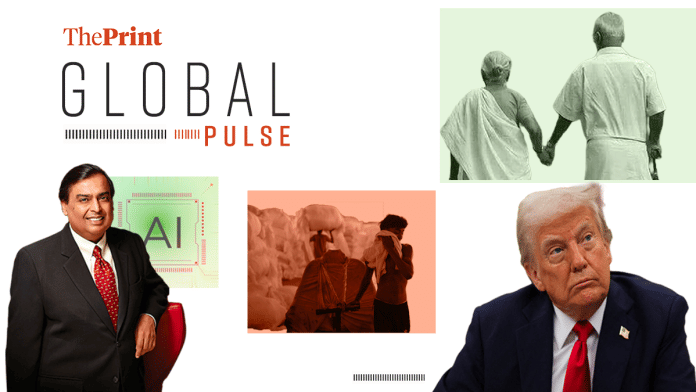
New Delhi: After achieving near-universal literacy and virtually eliminating extreme poverty, Kerala has set out on another ambitious mission: Caring for its ageing population. The state has the highest proportion of people aged over 60 in India, while many younger residents live away from their parents in search of work, leaving a growing number of elderly people without family support close at hand.
Nikita Yadav and Ashraf Padanna of the BBC report on the state’s efforts to ensure no one grows old alone. “Last month, the state government announced a dedicated department for elderly welfare, which officials say is the first of its kind in India, to address the challenges of an ageing population,” BBC reports.
For generations, as the report notes, elderly Indians have lived with their children and depended on them for care. However, migration for work and education has strained that tradition, particularly in Kerala, India’s fastest-ageing state, where the government is now trying to respond, the report says.
The department’s strategy is based on the “aging in place” principle to help the elderly live their lives amidst the comfort of their homes and communities.
The state government, as the report highlights, also plans to launch a certified caregiver training programme, build a professional care workforce, and create elderly parks, day-care centres and fitness facilities. “A statewide survey of senior citizens will inform a long-term Silver Economy roadmap.”
How Surat’s textile workers cope with extreme heat
As India’s working class toils in soaring temperatures, Sibi Arasu of the Associated Press traces a day in the life of a Surat textile worker and how he copes with extreme heat.
India’s heatwave has compelled authorities to issue advisories for workers’ health, but none have been enforced seriously. Amidst all this, Sibaram Pradhan, who works in Surat, lives in a cramped room with nine other men, the report says.
“Like numerous others from his home state of Odisha in eastern India, Pradhan works in a power loom factory that produces polyester cloth in Surat, among the largest hubs for synthetic fabrics in the world. The 35-year-old is among the millions of workers in South Asia who endure appalling living conditions combined with hot, humid, poorly ventilated and incredibly loud factory floors as climate-driven extreme heat is only becoming worse across the region,” Arasu reports.
Pradhan wakes up at the crack of dawn, makes a video call to his family, prays in front of a small picture, and heads to the bathing area which is shared by over a 100 people. “Over 200 workers live on two floors that are essentially huge halls divided into plywood cubicles that each house up to 10 people. There is little ventilation apart from a few ceiling fans. Temperatures have already reached 38 degrees Celsius (100 degrees Fahrenheit) this summer, making both the factories and the workers’ housing feel stifling,” the report adds.
Pradhan’s struggle does not end there. He handles 15 machines, constantly moving between them to oversee the work. “Pradhan says the sweltering heat means he works only in a sleeveless undershirt and shorts. He constantly drinks water and periodically squeezes sweat from his shirt, or else it gets heavy.”
Pradhan migrated from Odisha to Gujarat due to the worsening climate change effects in the first place. “Most of Surat’s textile workers are migrants, and a large portion come from Odisha’s Ganjam district, among the most vulnerable regions in India to climate-driven disasters. Farming has become unreliable in Ganjam because of cyclones, floods and erratic weather, workers in Surat’s factories said. Water shortages and lack of infrastructure further limit their work options, driving them to move for factory jobs.”
Decline of US hegemony?
Days ahead of America’s 250th birthday, British journalist Martin Wolf has decoded the rise and fall of the US hegemony for the Financial Times.
The piece goes back in time, to 1991, when the US, after the collapse of the Soviet Union, took centrestage with not just “unmatched political and economic power”, but “admired values of constitutional government and freedom” as well.
Cut to today, America and “the world order it created are in crisis”, he writes.
A previous edition of Global Pulse had referred to how US allies are increasingly seeking to reduce their dependence on Washington and assert greater strategic autonomy in global affairs. Many of America’s partners now believe that even close ties with the US offer little protection from President Donald Trump’s rebuke. Trump’s tariff wars against foes and friends alike have also left many countries irritated.
In 1914, during the second industrial revolution, the US led through advances in chemicals, electricity, telephony, pharmaceuticals, the internal combustion engine, powered flight and radio. Today, the administration is “corrupt, incompetent and, most important, hostile to the norms and values that animated the founding fathers,” writes Wolf.
The US 1776 Declaration of Independence promised liberation from tyrants, and now “Trump wants to be one”.
“Worse, he is cutting the sinews of US power—the rule of law, world-leading science, trusted alliances and confidence in its economic and political stability,” says the piece.
This, Wolf adds, is bad for democracies worldwide. Citing a V-Dem survey, he says how only 7 percent of the world now lives in liberal democracies. “Xi Jinping can smile.”
He ends by asking whether “arbitrary despotism” will become the global norm or will “freedom and democracy”?
India’s place in AI race
Chris Kay of the Financial Times reports on what Ambani’s deep-tech ambitions reveal about India’s AI limits.
Mukesh Ambani has said that India cannot merely be a consumer of AI. “It must become a creator, adopter and global leader in AI.”
“Reliance is eager to demonstrate that it will not be left behind in the AI arms race. Yet Ambani’s plans also reveal why India remains far from becoming a global tech leader,” Kay writes.
“For all the rhetoric around Indian AI sovereignty, Reliance’s strategy so far is largely built upon western deep-tech innovation. Like tech groups in other countries, it is investing heavily in data centres powered by Nvidia hardware. Reliance is also integrating large language models developed by Google and Meta into its digital and telecoms business Jio.”
Despite Ambani’s talk of India producing its own AI models, his own company has largely worked in collaboration roles with tech giants. And global AI companies seem to understand this reality of India’s AI push.
“So far, global tech giants appear to see India as a market rather than a source of AI technology. After receiving a rock-star welcome at the end of 2024, when he appeared on stage with Ambani in Mumbai, Nvidia chief executive Jensen Huang was later asked whether the chipmaker would start sourcing from India’s nascent semiconductor industry.”
Huang, as Kay notes, did not express any interest in reducing its reliance on Taiwan Semiconductor Manufacturing Company.
“Does it matter for India if it remains just one of many nations without a thoroughbred AI horse in the race? Some of its most influential tech leaders argue the country should focus on its strengths, such as developing applications rather than attempting to create expensive LLMs. In this view, India should look for practical AI services tailored to local needs.”
(Edited by Viny Mishra)