



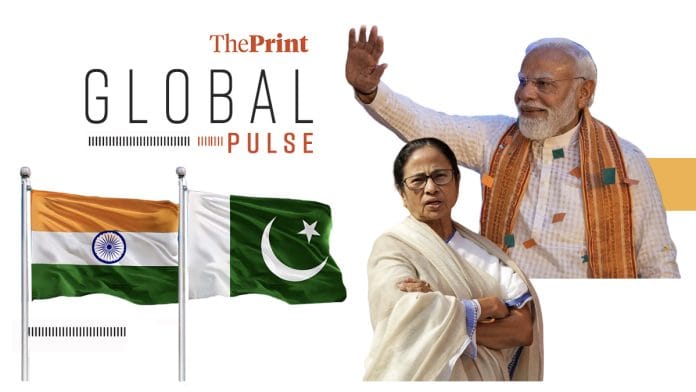
New Delhi: The 4 May results of the assembly elections in India have left one persistent question for the global media: what happens to the regional holdouts now, and what’s the influence of the BJP’s ideology on India’s electorate?
In The Washington Post, Bill Drexel writes about the expanse of the BJP’s Hindu right, particularly referring to the rout of Mamata Banerjee in West Bengal.
Here, the BJP won 207 seats in an assembly of 294 members, ending the 15-year rule of the Trinamool Congress, which had deep organisational roots in the state.
“For decades, India’s most powerful regional parties have been the most resilient limit on the BJP’s national expansion—locally rooted political machines, fluent in their states’ language and identity, that the BJP’s predominantly northern, Hindi-speaking culture often struggled to penetrate,” he says.
Mamata lent “credibility to the idea that India’s pluralism is simply too expansive for any one party to knit together—much less one pushing for a specific, muscular vision of cultural nationalism”.
He adds that with the Bengal win, the BJP proved that it can “now break the regional and cultural barriers that were supposed to contain it”.
According to Morning Consult’s global leader approval tracker, which the opinion piece cites, Prime Minister Narendra Modi has comfortably outperformed all other elected democratic leaders in the world.
“By the metrics that translate to power in a democracy, the Hindu right is already the contemporary world’s most successful political movement,” he says.
And it is the party’s parent organisation, RSS, which has helped build a cadre on the ground, he asserts. RSS focused on “cultivating millions of cadres and dozens of organizations devoted to reviving its vision of Hindu society”.
“The BJP built its dominance the hard way—from the ground up through decades of grassroots organizing, painstakingly melding together a coalition that now spans castes, languages, regions and religious traditions that have otherwise had little reason to vote together,” the opinion piece says.
The Economist writes that “Narendra Modi’s party is on a roll in India”, and that no one should mourn Mamata Banerjee’s exit from West Bengal.
Mamata “silenced critics and jailed opponents. Her party ran extortion rackets. Allegedly, its goons sometimes got away with rape. Businesses were forced to pay bungs for land and licences. No wonder many left,” it says.
The column notes that Mamata’s defeat was part of the larger anti-incumbency wave in the country. “In Kerala, the communist rulers were sent packing. In Tamil Nadu an action-movie-star-turned-politician, the mononymous Vijay, swept away an old dynasty.”
The column uses the instances to prove a point: India’s democracy works.
But there are still signs of concern. “Even if the final result in West Bengal was correct, some of Ms Banerjee’s complaints of unfairness are justified. The national government deployed almost a quarter of a million armed police to oversee voting there. A heavy-handed process of revising electoral rolls disfranchised millions of voters, many of whom got no chance to appeal.”
The Election Commission of India too looks “supine” under Modi, it adds.
“Politics risks becoming narrower and uglier. Parties too often aim to split voters along religious lines. In both West Bengal and Assam, the BJP won a big share of Hindu voters in part by stirring up fear of Muslims,” the column says.
It adds, but for Modi, it is working out quite well, and thus he would be “tempted to ignore such criticisms”.
On Operation Sindoor’s one-year anniversary, Soutik Biswas writes in the BBC about how the 90-hour conflict has put India-Pakistan ties into a permanent freeze.
“Formal diplomacy is almost non-existent now. The border is shut, trade is suspended, cricket ties remain severed and the Indus Waters Treaty remains in abeyance,” he points out.
Former Pakistani diplomat Husain Haqqani told the BBC: “Neither side believes it needs to reach out to the other for either domestic or international reasons.”
“There have been moments of poor relations in peacetime before too, but this is one of the longest periods of frozen ties,” Haqqani adds.
“Most strikingly, the conflict seems to have restored something Pakistan had long lost: geopolitical relevance. Its emergence as an intermediary in the Iran war caught many by surprise,” Biswas notes.
(Edited by Nida Fatima Siddiqui)