


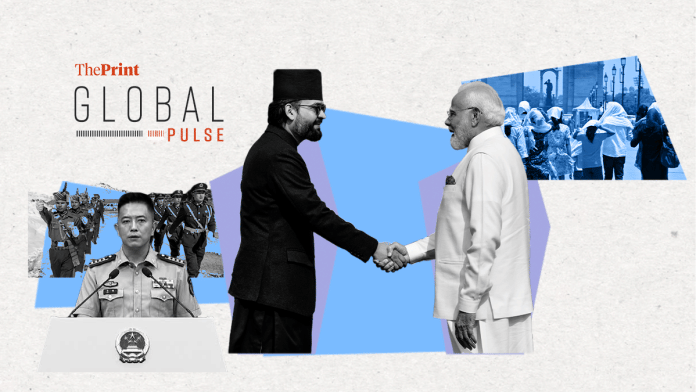
New Delhi: Delhi’s nights are getting hotter, and so are concerns over the India-China border. The New York Times reports on how rising heat is affecting Delhi’s urban poor, The Economist examines Nepal PM Balendra Shah’s visit to India, while Global Times looks at the latest Indo-China military talks.
Also Read: India’s ‘anti-AI trade’ has worked, but it could become a big winner of AI itself, says FT editorial
Nepal has got rid of its old political “uncles” and, as one Kathmandu wit puts it, is now “lumbered with a government of dude bros”. The Economist, in its latest report headlined “Nepal’s ex-rapper prime minister asks India for cash,” documents the challenges facing Prime Minister Balendra Shah’s new government and his visit to New Delhi.
The 36-year-old former rapper, known for his dark shades, diamond earrings and distinctive kalo topi, remains an enigma to Indian officials. “Mr Shah’s policies and beliefs remain elusive,” the magazine writes, adding that the “enormous challenge of running a poor, climate-ravaged country was what brought Mr Shah to Delhi”.
Nepal wants to “build back better” after devastating floods that killed more than 1,400 people and destroyed a tenth of its hydropower capacity. Shah sought $2 billion in loans and grants from New Delhi, with Prime Minister Narendra Modi pledging $1.6 billion. According to The Economist, “At a time when China seeks influence in Nepal, the package pulls it closer to India.”
But Shah’s politics and style of governance have raised concerns. His finance minister, Swarnim Wagle, says he “inherited a kleptocracy and an incestuous relationship between politicians and business”. The magazine describes Shah as “the same unserious provocateur” who once said he wanted to learn strategic planning from Hitler. His government has rounded up activists, critics and a former chief justice on “flimsy” pretexts. Shah considers due process an obstacle to reform and says: “We are on an expressway,” adding that he “will apply the brakes only when we reach the destination”.
Tanuja Pandey, a leader of the movement that brought him to power, says the government “is scared of the people’s voice”—a potential “dark irony”, the magazine notes, given that Shah rose to power on the back of that very movement.
The report also flags Shah’s growing “love” for Nepal’s army. He holds the defence portfolio and has appointed former military officials to senior diplomatic positions. The army has taken a prominent role in flood rescue and reconstruction, prompting a political analyst to warn that “under the guise of humanitarianism, you can extend your tentacles”.
Despite these concerns, Nepalis remain “desperate for change” and hold on to “dogged optimism”. “People think we will transform the country overnight,” complains ruling MP Sagar Dhakal. Against that backdrop, The Economist returns to the sentiment with which it began: “No one wants the uncles back.”
Also Read: Bengaluru’s success as deep-tech hub depends on Delhi, but the road is fraught, writes global media
In a report by Anupreeta Das headlined, “The Unbearable Heat of Delhi’s Summer Nights”, The New York Times looks at how millions in urban India’s informal settlements are learning to cope with rising nighttime temperatures. For Madhu Kamal Varma, the heat has turned her family’s one-room house into “an oven that would not cool down long after the sun had set”. She and her husband have been taking turns staying awake at night to guard their home while the other sleeps. “What can we do? We have to sleep,” her husband says.
The report looks at how urbanisation is intensifying the problem, and leading to what scientists call the creation of urban heat islands. Rajan Rawal, an architect and professor at CEPT University, explains that buildings and roads trap heat during the day and release it slowly. “Materials do trap heat, but they do not find an opportunity to lose heat in the nights,” he says. “And that’s why the nighttime temperature remains high.” Delhi’s ability to cool down at night has dropped by 9 percent, according to a Centre for Science and Environment (CSE) study, with the city’s core cooling 3.8 degrees Celsius less than surrounding areas.
Residents, NYT notes, have been leaving doors open at night and finding ways to cool themselves. Sudershan, an electrician and painter, says he wakes up between 2 am and 3 am because of the heat, while Noor Jehan, a mother of four, resorts to bathing several times a day and sprinkling talcum powder on herself and her children. Kathy Baughman, who runs the climate adaptation nonprofit HERA, says women bear a disproportionate burden of the heat, adding that “the nighttime temperature just throws a flame torch over all of that”.
The report also captures how residents see the cost of Delhi’s rapid expansion. Sunita Thakur recalls a time when there were fewer factories, workshops and cars: “But now, there’s more of an impact.” Her husband, Upendra, puts the contradiction bluntly: “Every house has an AC, where is the temperature going to go? Outside.” He adds: “Buildings should be built, dirt roads should be paved, but where is the heat generated going to go? Outside.”
Also Read: Gandhi dynasty’s past a bestseller, but political future of Congress remains uncertain—The Economist
Chinese state-run Global Times, in a piece by Li Yu, discusses Beijing’s description of the situation along the India-China border as “generally stable”, while reiterating China’s claim over Arunachal Pradesh.
China’s Defence Ministry spokesperson Chen Xi said that “China and India maintain communication through diplomatic and military channels, including general-level talks,” to safeguard peace along the border. He also reiterated Beijing’s claim over Arunachal Pradesh, saying: “The Zangnan region is China’s territory and China does not recognise the so-called ‘Arunachal Pradesh’ illegally set up by India.”
The remarks came a day after India confirmed a recent meeting of senior military commanders in the eastern sector. MEA spokesperson Randhir Jaiswal said “India and China engage regularly through diplomatic and military mechanisms,” with the interactions aimed at maintaining peace and preventing escalation along the border.
The Global Times quotes Qian Feng of Tsinghua University’s National Strategy Institute, who says that “maintaining stability through dialogue remains a shared understanding between the two sides”. He adds that existing military and diplomatic mechanisms act as a “pressure valve to ease tensions” and prevent local friction from escalating.
The two sides had agreed in August to strengthen border management, add two meeting points for general-level talks and establish two additional military hotlines. Reiterating Beijing’s position, Chinese Foreign Ministry spokesperson Guo Jiakun said China “strictly abides by the relevant agreements and common understandings” and conducts “normal border patrol and control activities”. He added: “We hope that India will work with China in the same direction” to maintain peace and stability along the border “with concrete actions”.
(Edited by Amrtansh Arora)
Also Read: Women in public life to Adani’s business empire— Global Media on India’s growth story