


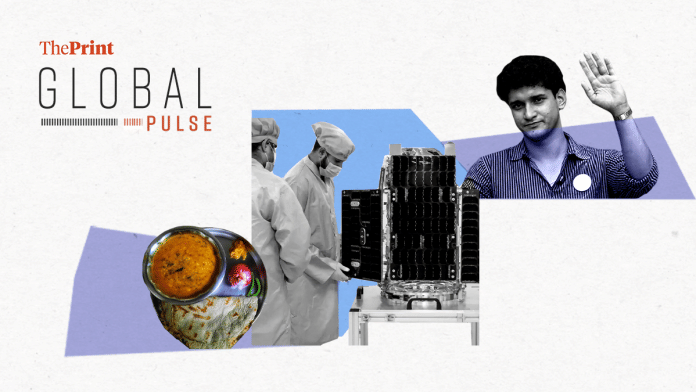
New Delhi: A rural thali in India is costlier at the moment than an urban platter, with food inflation hitting India’s villages harder than its cities.
Also, India is looking beyond its immediate realities, and dreaming of satellites, space technology and a global deep-tech future.
Meanwhile, Cockroach Janta Party activist Saurav Das being stopped from travelling abroad ahead of scheduled speaking engagements at leading universities in the UK has reignited debate over freedom of speech under the Modi government.
This week, international media looks at a country caught between the pressures of the present and how it’s fuelling the rocket of its ambitious future.
Also Read: Gandhi dynasty’s past a bestseller, but political future of Congress remains uncertain—The Economist
[/dropcap]B[/dropcap]engaluru has reinvented itself with every phase of India’s technology boom.
It first became the country’s IT and outsourcing hub, home to giants like Infosys and Wipro. The 2010s brought a wave of consumer-facing start-ups, such as Flipkart and Ola. Now, the city is betting big on “deep tech”, from satellites and defence systems, to semiconductors and artificial intelligence.
The Economist looks at this latest transformation through the journey of Awais Ahmed, who founded satellite start-up Pixxel at the age of 20. Eight years later, he has raised $200 million, secured contracts with the Indian Air Force and America’s spy-satellite agency, and put six satellites into orbit. His ambition is to build “the world’s most comprehensive Earth-observation company”.
“India’s first tech boom happened largely in spite of the government,” the article reads. “Despite bad schools and shoddy infrastructure”, IT companies found ways to train workers and tap into the expanding internet economy.
This time, however, “India’s notoriously bureaucratic government” has become closely involved in what it considers “strategic sectors”. Its support has come through a “mix of deregulation, procurement and state largesse”. The Prime Minister’s Office has also helped start-ups get “security clearance and win sensitive contracts”.
As the magazine puts it, “When it loosens its grip, things take off.” But the relationship between Delhi and Bengaluru will not only become more important, “but probably more fraught”.
There are hurdles. The government has launched several technology missions, but “little co-ordination exists among them”. Start-ups also face a shortage of growth capital and regulatory uncertainty. Bangalore’s own infrastructure poses another problem.
“Its urban governance is a disaster,” the magazine writes, warning that “interminable traffic jams, unreliable utilities and broken pavements may come to hinder the city’s rise as a global technology hub”.
Pixxel’s Ahmed admits to The Economist that “the infrastructure sucks”, but remains convinced that the city’s ambition and talent will matter more: “If an Indian wants to build something world-changing, this is where they’ll come.”
Also Read: Women in public life to Adani’s business empire— Global Media on India’s growth story
In India, the rising cost of food is putting another squeeze on Indian households. In a report for the BBC, India correspondent Soutik Biswas writes how food inflation, which climbed to 8.94 percent in October, is outpacing overall retail inflation of 6.09 percent.
The pressure is even greater in rural India, where food inflation touched 9.09 percent. “Adjustability for a poor country like India is significantly lower,” Rajeswari Sengupta, associate professor of economics at Indira Gandhi Institute of Development Research, is quoted as saying.
The strain is visible in the cost of a simple home-cooked meal. Crisil’s analysis finds that vegetarian thali became 12 percent more expensive in October than a year earlier, while the cost of non-vegetarian thali rose nine percent. Rice, pulses, edible oil and cooking gas have all become costlier.
“It’s no longer a few commodities that are driving this increase, it’s becoming a little more broad-based,” Pushan Sharma, Crisil’s director of intelligence tells BBC.
Biswas notes that families may cut down on onions when prices rise, but rice, pulses and cooking oil are much harder to do without. The poorest 20 percent of rural households faced inflation of 6.9 percent in October, compared with 6.5 percent among the richest 20 percent.
The reasons stretch from the farm to the marketplace. Nearly 60 percent of India’s farmland depends on rainfall, and this year’s southwest monsoon was 13 percent below normal and unevenly distributed. Weather disruptions, supply shortages and rising input costs have all added to the pressure. Weak storage, processing and transportation systems can turn seasonal shortages into price surges and leave excess produce to rot.
Sengupta warns that the impact can go beyond rising food bills: “Food inflation may begin with a supply shock, but its effects can spread.” As the cost of living rises, workers may demand higher wages, prompting businesses to raise prices to cover their increased labour costs. This could trigger what she calls the “familiar wage-price spiral that central banks try to prevent”.
Rajini Vaidyanathan and Jamie Whitehead report for the BBC that Saurav Das, one of the leaders of the Cockroach Janta Party (CJP), was stopped from boarding a flight to the UK, prompting him to say the Delhi government had “completely lost the plot”. He was meant to travel to Britain after being invited to speak about the movement at the Oxford Union, and universities including Cambridge and Edinburgh.
Immigration officials told him his passport had been “flagged” over “discrepancies” in his date of birth. Das claimed there was no mismatch in his documents, accusing the government of using “cheap tactics” to stop activists from travelling and speaking on issues that matter to young people.
He alleged that the government was “scared of the cockroach movement”.
“They’re scared of young people asking them questions because they have never had to deal with a generation that wants to ask questions so head on. So that jitters them,” he told the BBC. He said the incident had become “international news”, and showed Prime Minister Narendra Modi “in such poor light”, the report adds. He called the travel restriction “a way to harass, to target activists, young voices in India by the Modi government”.
BBC also recalls other instances of people being stopped from travelling abroad, including environmental and anti-dam activist Bhanu Tatak, who was prevented from boarding a flight to Dublin in September 2025, and journalist Rana Ayyub, who was stopped from flying to London in March 2022.
CJP founder Abhijeet Dipke took a swipe at the authorities, writing on X that Das might have been allowed to fly if he “had looted a bank or committed financial fraud”.
An Agence France-Presse report in The Guardian also looks at the wider questions raised by Das being stopped from travelling.
It points out that more than 100 overseas speakers were unable to attend a Congress-organised democracy summit earlier this month after being denied permission to enter India. Among them was Norwegian journalist Helle Lyng Svendsen, who had previously questioned PM Modi about press freedom when he visited Norway earlier this year.
“Critics say human rights and press freedoms have declined since Modi came to power in 2014,” the report reads.
(Edited by Mannat Chugh)
Also Read: Global media questions India’s investment appeal, climate record and Olympic aspiration