



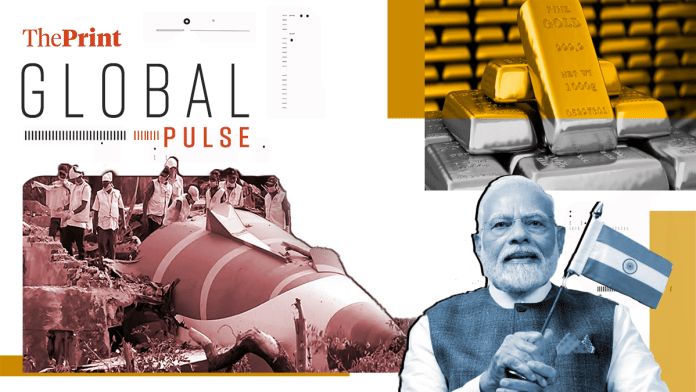

New Delhi: Global media has put the spotlight on the Air India crisis, and the pressure points building around India’s economy and foreign policy.
Nikhil Inamdar writes for the BBC that Air India is facing a wider crisis just weeks before India’s Aircraft Accident Investigation Bureau is expected to release its final report into the crash of flight AI-171 in Ahmedabad last year.
The London-bound flight crashed seconds after take-off on 12 June, 2025, killing 260 people. But Inamdar writes that the airline’s troubles now go beyond the investigation. A leadership vacuum, mounting losses, delayed aircraft deliveries, fuel shocks, route cuts and safety concerns have put Tata Group’s turnaround plan under strain.
Last month, Air India Chief Executive Officer Campbell Wilson resigned midterm as losses for the year ending March 2026 reportedly touched $2.4 billion, notes the report. Air India, which the Tata Group took over from the government in 2022, is now its biggest loss-making entity.
Jitendra Bhargava, a former executive director at Air India, told the BBC that the airline “needed a clear vision right now”. He said the Tatas had underestimated the problems inherited with the airline.
The report further pointed to “embarrassing operational lapses and safety violations in the past year”.
In March, an Air India flight from Delhi to Vancouver returned to the Indian capital after flying for nearly eight hours because it did not have regulatory approval to enter Canadian airspace. India’s aviation regulator also found “51 safety violations at Air India” in its annual audit last year.
The strain on Air India is part of a wider squeeze facing the Indian economy.
Krishn Kaushik and Chris Kay report for Financial Times that India has more than doubled import tariffs on gold and silver to protect the rupee and contain disruption from higher energy prices and the Iran war.
The import duty on both gold and silver has gone up from 6% to 15%. The decision comes days after Prime Minister Narendra Modi asked Indians to cut spending on fuel, foreign travel and gold, all of which add to the country’s import bill.
The report notes that the rupee has fallen 5% against the US dollar since the US and Israel began bombing Iran at the end of February this year. It is now trading below 95.5 to a dollar despite repeated interventions by the Reserve Bank of India. The central bank’s dollar reserves fell by $40 billion in the first month after the war, it adds.
India’s gold imports totalled $72 billion in the year to 31 March, while silver imports rose nearly 150% to $12 billion in the same period. The trade deficit widened to $120 billion from $95 billion the previous year, the report underlines.
Surendra Mehta of the India Bullion and Jewellers Association told FT that the duty hike could reduce gold demand by 10%. “If they have to stop the falling rupee overnight, this (duty hike) is the only measure,” he said.
Former National Security Adviser Shivshankar Menon places that volatility in a larger frame.
Writing in Foreign Policy, Menon says India is adjusting to a world where conflict is rising, institutions are weakening and great powers are showing open disregard for international norms.
There is still an international system, he says, because flights continue and phones work across borders. But “there is no longer a world order”.
For India, Menon argues, the challenge is to protect the conditions it needs for development, rather than enter every quarrel or try to mediate every crisis.
“Rather than getting involved in others’ quarrels or engage in mediation, the greatest contribution that India can make at this time is to continue to manage its own development and security well,” he states.
According to Menon, India should work with neighbours and partners to provide stability in the subcontinent, the Indian Ocean littoral, southeast Asia and west Asia. Strategic autonomy, he argues, should not mean neutrality. It should mean judging issues case by case and building coalitions where Indian interests are directly involved.
If Menon looks at India’s place in a disordered world, Satviki Sanjay in Bloomberg looks at the contest inside its consumer market. Sanjay writes that the market share war between Ambani’s Campa Cola, Coca-Cola and PepsiCo has created an unlikely winner: commercial refrigerators.
Reliance Consumer Products, Coca-Cola and PepsiCo’s India bottling network are installing glass-door coolers across kirana stores and small eateries as competition intensifies. The Rs 10 fizzy drink Campa has disrupted a market long dominated by the two American soda giants, says the report.
The push is helping refrigerator makers such as Blue Star, Voltas, Haier India and Western Refrigeration. The market for commercial fridges in India, including visi-coolers, is expected to grow from $2.8 billion in 2025 to $3.9 billion by 2034, according to IMARC Group.
For small retailers, these coolers are not just advertising space. In towns and villages where shops often lack the space and money for refrigeration, they have become basic retail infrastructure in the fight for India’s beverage market.
Tarini Unnikrishnan is an alum of ThePrint School of Journalism and an intern with ThePrint.
(Edited by Nida Fatima Siddiqui)
Also Read: IPL losing sheen? Global media looks at its ‘commercial run rate’ & seat-wise data from West Bengal