





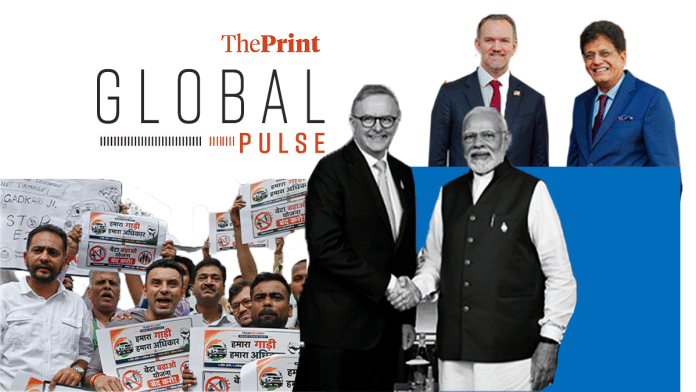


New Delhi: The leaders of two important pillars of the Quad grouping—India and Australia—are meeting in Australia, raising hopes the fading bloc would regain strength in an ever-changing world.
With Prime Minister Narendra Modi in Melbourne for the Annual Leaders’ Summit, Joseph Olbrycht-Palmer and Blair Jackson write on the news.com.au news portal the two countries aim to strengthen Quad partnership to counter China’s “growing military might”.
PM Modi and his Australian counterpart Anthony Albanese on Thursday agreed to deepen defence ties in pursuit of “an open, peaceful, stable and prosperous Indo-Pacific,” the report says.
The talks came just days after China fired a nuclear capable missile into the South Pacific.
Quad, a grouping of four countries — US, India, Japan, and Australia—was created to counterbalance China’s influence in the Indo-Pacific. But its influence has been fading.
The report notes that the outcomes from Albanese’s meeting with Modi mirrored the Joint Statement on Enhanced Defence and Security Co-operation agreed with Japanese Prime Minister Sanae Takaichi during her Australia visit in May. That statement focused on strengthening capability, deepening integration and bolstering interoperability,” the report notes.
“Ahead of the announcement, an Australian source unauthorized to speak publicly said (Japan’s) defence ties with both India and Australia had developed ‘naturally’ but that efforts had intensified over the past two years to, in part, show the Trump administration that the Quad can grow teeth,” it adds.
While Modi’s Australia visit remains in focus, global media also tracks the ups and downs of another important bilateral relationship: India-US.
Sumit Ganguly, a columnist at Foreign Policy and senior fellow at Stanford University’s Hoover Institution, writes about whether India-US ties have really improved over the last one year.
“U.S. Trade Representative Jamieson Greer concluded a trip to New Delhi in late June, meeting with Indian Commerce Minister Piyush Goyal as the two sides sought to finalize a trade deal. They had reached a tentative agreement in February—before a U.S. Supreme Court decision invalidated President Donald Trump’s sweeping tariffs that necessitated negotiations in the first place,” he writes.
Ties between the two countries came under strain after US President Donald Trump claimed last year that he stopped the war between India and Pakistan, referring to the three-day conflict in May 2025.
After a year of Trump announcing punitive tariffs against India, Washington and New Delhi were close to reaching a deal in February, when the US Supreme Court invalidated Trump’s tariffs globally. Now, US Ambassador to India Sergio Gor says that they are in the “last one percent” of signing the deal, the column notes.
“Whether U.S.-India relations are truly thawing remains uncertain. Ties are unsettled because the mutual trust that the two sides nurtured over decades is waning amid Trump’s second-term policy shifts. Among other issues, since Trump’s visit to China in May—where he met with President Xi Jinping—Indian policymakers have had doubts about New Delhi’s role as a possible counterweight to Beijing and its strategic significance to Washington.”
Ganguly also highlights that Trump’s “callous view” of the adverse effects of the US-Iran war on India has also hurt Delhi-Washington ties.
Archana Shukla of the BBC reports on the ongoing protests against ethanol blended petrol even as the Indian government pushes for the E20 fuel.
“The world’s largest two-wheeler market and third-largest car market, is trying to reduce its dependence on imported oil and cut carbon emissions. It began blending ethanol – made from crops such as sugarcane and maize – into petrol in the mid-2000s and has steadily increased the proportion ever since.”
Complaints have increased since the government moved to E20 petrol with drivers alleging malfunction in vehicles that are only built to handle E10 fuel, Shukla reports.
“Although unblended petrol is still available, it is often 40-50% more expensive than E20, depending on the state, and many motorists are unaware they can ask for it. Over the past few months, consumers have flooded social media with complaints of engine wear, lower fuel efficiency and reduced performance,” she adds.
In an attempt to allay the fears, the government has claimed that social media is being used to spread misinformation.
“In a statement last month, the government said the fuel was rolled out after extensive testing and does not damage engines. It has also issued statements on the benefits of E20 and to bust what it called the more colourful myths that have circulated on social media,” the report notes.
(Edited by Ajeet Tiwari)
Also Read: The Quad is fading. India must now confront the limits of strategic ambiguity