





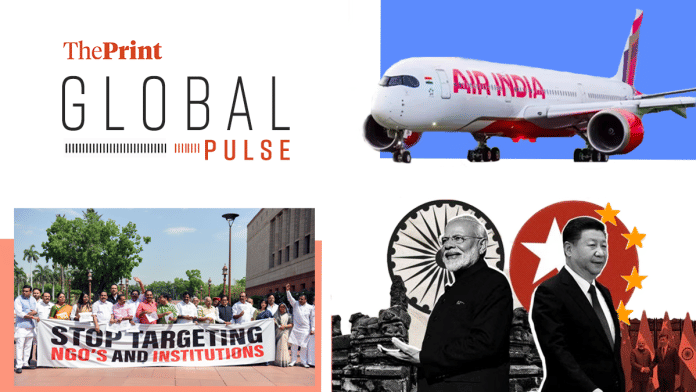


New Delhi: Global media reports on multiple challenges and policy choices that India is facing and will continue to face with time. The list includes Air India’s financial pressures and concerns over new rules on foreign-funded NGOs to questions about India’s dependence on China and its economic independence.
Another matter drawing attention is India’s deepening ties with Israel and what its long-term consequences could be, particularly amid continuing tensions and conflicts across West Asia.
In an article titled ‘Singapore Airlines loses almost $800mn on Air India bet — with more pain forecast’ published in the Financial Times (FT), journalist Owen Walker reports that Singapore Airlines “has booked operating losses of about S$1bn ($780mn) on Air India” in less than two years.
The deal was meant to be an entry point in India’s “surging demand”, but now analysts say that profits could take years to come. Jason Sum, an analyst at DBS bank, told FT that he did not expect Air India to become profitable over the next few years.”
Walker says the timing of the investment was “spectacularly badly timed”, as it came just before the Air India crash, “jet fuel crisis” and other disruptions. A Singapore Airlines executive called it “an annus horribilis for Air India”, saying the airline was attempting a transformation “the likes of which have probably never been seen in the airline industry” while also facing multiple other problems.
Sum added that he did not expect Air India to become profitable over the next few years and that any “meaningful earnings contributions” for Singapore Airlines is likely “several years away.”
Tata Sons chairperson N.Chandrasekaran has called these problems a “perfect storm”, while Singapore Airlines CEO Goh Choon Phong described this “a long game” with “no shortcut,” the article notes.
Beyond this, global media is also looking at how the government policy decisions can affect civil societies and minority organisations.
In an FT article titled ‘India plans to tighten rules on foreign-funded NGOs,’ journalists Michael Stott and Andres Schipani write that the government wants to give a new agency the powers to “confiscate foreign-funded land, buildings or other assets” which belongs to NGOs whose resignation is cancelled or not renewed.
The changes, according to the government, are needed to ensure “proper scrutiny of foreign-funded projects” and that foreign donations are “utilised and accounted for in accordance with Indian law.”
The article quotes Human Rights Watch’s Meenakshi Ganguly saying that the Modi government has “repeatedly used the FCRA and other laws to crush dissent” and believes it treats criticism as “unfounded, politically motivated, or inspired by unpatriotic individuals.”
The Foreign Contribution (Regulation) Act, or FCRA, governs how Indian individuals, associations, NGOs, trusts and companies may receive and use money, securities or articles sent to them from a source outside India
The authors write that Christian groups are scared that the government can take over their “schools, hospitals, places of worship and humanitarian projects.” Joseph D’Souza, a Protestant archbishop, tells FT that these proposed changes are “a plunder and theft of Christian institutions.”
The authors also quote Yamini Aiyar, who says the changes are “part of a larger questioning of the role of civil society” and that the government has “always been ideologically opposed to the idea of large amounts of foreign funding coming in.”
Yamini was earlier associated with the New Delhi-based think tank Centre for Policy Research (CPR) whose FCRA registration was cancelled by the Indian government in January 2024.
While this focuses on India’s domestic policy, there is another pressing issue which involves New Delhi and Beijing. In an article titled ‘India’s Strategy for Economic Security: Deny, Indigenize, and Diversify’, author Tanvi Madan writes that India’s approach to its economic security has majorly been influenced by its rivalry with China and that now its strategy rests on three pillars of “denial, indigenization, and diversification.”
She says that this approach was brought in because there were security concerns over China and that it aims to “identify and reduce or mitigate national vulnerabilities, particularly in critical sectors.”
India has taken certain steps like “restrictions on FDI”, “the exclusion of Chinese companies from India’s 5G network” and “import duties, customs procedures, or screening” which aims at reducing its dependence on China, Madan writes.
The Indian government is also quite interested in “enhancing domestic capacity” in sectors such as “solar power, electronics, pharmaceuticals, and rare earth magnets”, while also “creating new capacity” in areas like semiconductors, the article adds.
Madan writes that despite India trying to reduce its dependence on the neighbour, it still remains difficult as India’s trade deficit with China has doubled from “$54 billion in 2018-19” to “$112 billion in 2025-26”. The article adds “that dependency—and the lack of affordable alternate suppliers in the short term” is making it difficult for India to completely reduce its reliance on Chinese goods and expertise.
The foreign policy expert writes that India can “neither can go it alone nor walk a middle path between the United States and China,” and that India’s strategy will make its journey “trickier, perhaps slower”, while emphasising on “a wider range of partners.”
At the same time, India has its strategic ties getting stronger with Israel which has brought in global attention. In a Guardian newsletter titled ‘As conflict in the Middle East intensifies, India’s relationship with Israel deepens,’ journalist Niha Masih writes that the country is now a “significant contributor” to Israel’s weapons production and not “a major customer of Israeli weapons.”
Masih focuses on why has this growing relationship between India and Israel not triggered a backlash, especially amid the ongoing war in Gaza.
Indian journalist and foreign policy expert Stanly Johny says that there is a “clear ideological confluence between Hindutva and Zionism” and that in the Right-wing circles, Israel is now popularly being seen as a “bulwark against the expansion of Islam.”
The article mentions that Modi has a “personal rapport” with Netanyahu and that India had a “noticeably muted response” when Israel along with the US attacked Iran. Johny adds that the absence of any anger over India-Israel relationship indicates that the “foreign policy debates in India are being stripped of moral concern.”
Johny warns that this relationship might have some costs, too. The Iran war threatens “India’s energy security” and that New Delhi must “continue to stay engaged with Israel”, while also “restore balance to its approach to west Asia” and “forcefully defend its own interests.”
(Edited by Tony Rai)
Also Read: Why AI is a ‘threat’ to India’s IT industry and how exam leaks in India predate Modi