






New Delhi: When children’s author and former history teacher Saisudha Acharya wanted to discuss the Partition with her students, she found a vast corpus of literature to dip into: oral histories, material histories, short stories as well as Booker Prize-winning adult fiction.
But to her surprise, there were remarkably few novels through which her fourteen- and fifteen-year-old students could encounter the Partition of India from the perspective of protagonists their own age.
For an event that has generated a vast literary archive, including widely celebrated fiction by Saadat Hasan Manto, Bhisham Sahni, Khushwant Singh, Salman Rushdie and Geetanjali Shree, the corpus of mainstream Indian children’s literature, especially fiction, is strikingly scarce.
The challenge of complexity
Writing traumatic histories for young readers is always challenging. However, it gets particularly difficult to fictionalise a complex event like the Partition, which resists simple “victim versus villain” narratives because its causes and consequences encompass long-standing communal tensions, the politics of undivided India, British policies and administrative failures, retaliatory violence and the mass displacement of millions of people belonging to different religious groups.
Sohini Mitra, publisher of the children’s division at Penguin Random House India finds that fiction that captures this complexity for young readers, without diminishing the history, requires extraordinary sensitivity, nuance and objectivity that can be hard to come by.
“We have seen far fewer middle-grade submissions on this theme than one might expect,” she admits.
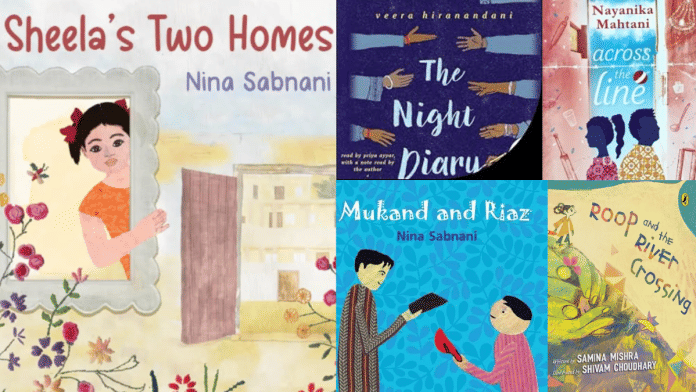
Among the only novels in her list is screenwriter and author Nayanika Mahtani’s Across the Line (2019). The story begins with Cyril Radcliffe, the British lawyer enlisted to draw the lines separating India and Pakistan, and his unease about the enormity of the task and the short deadline. It then follows brother and sister Toshi and Tarlok, who are separated during a riot in Rawalpindi shortly after Radcliffe’s borders are announced. While Toshi flees to India with their parents, Tarlok is left behind and adopted by a Muslim family. Thereafter, the novel shifts to contemporary India and Pakistan, where their grandchildren, Jai and Inaya, grow up with polarised notions of the other, until their paths serendipitously intersect.
“The challenge is to make the Partition emotionally immediate without simplifying its complexity or overwhelming younger readers with its brutality,” says Mahtani.
“You have to find hope alongside heartbreak, curiosity alongside grief. Perhaps that’s why there is relatively little widely celebrated fiction on this theme for younger audiences. Empathy, rather than history, becomes the gateway. If we can spark that emotional connection early, the conversations become meaningful,” she adds.
Also Read: What makes inheriting Partition different from remembering it
A question of format
A more common way through which Indian children’s publishing has approached the Partition is the picture book. In fact, one of the earliest and most-widely known children’s books on this theme is artist and animation-filmmaker Nina Sabnani’s Mukand and Riaz (2006). She followed it up with Sheela’s Two Homes, another picture book on the Partition, that was published last year. Others include Bharati Jagannathan and Prashant Soni’s One Day in August (2015) and Samina Mishra and Shivam Choudhary’s Roop and the River Crossing (2025).
Publisher Richa Jha, founder of Pickle Yolk Books, feels that the rich visual landscape of picture books diffuses some of the complexity that children’s fiction needs to capture almost exclusively through text.
“The pictures make room to say what might be difficult to put into words for children,” she says.
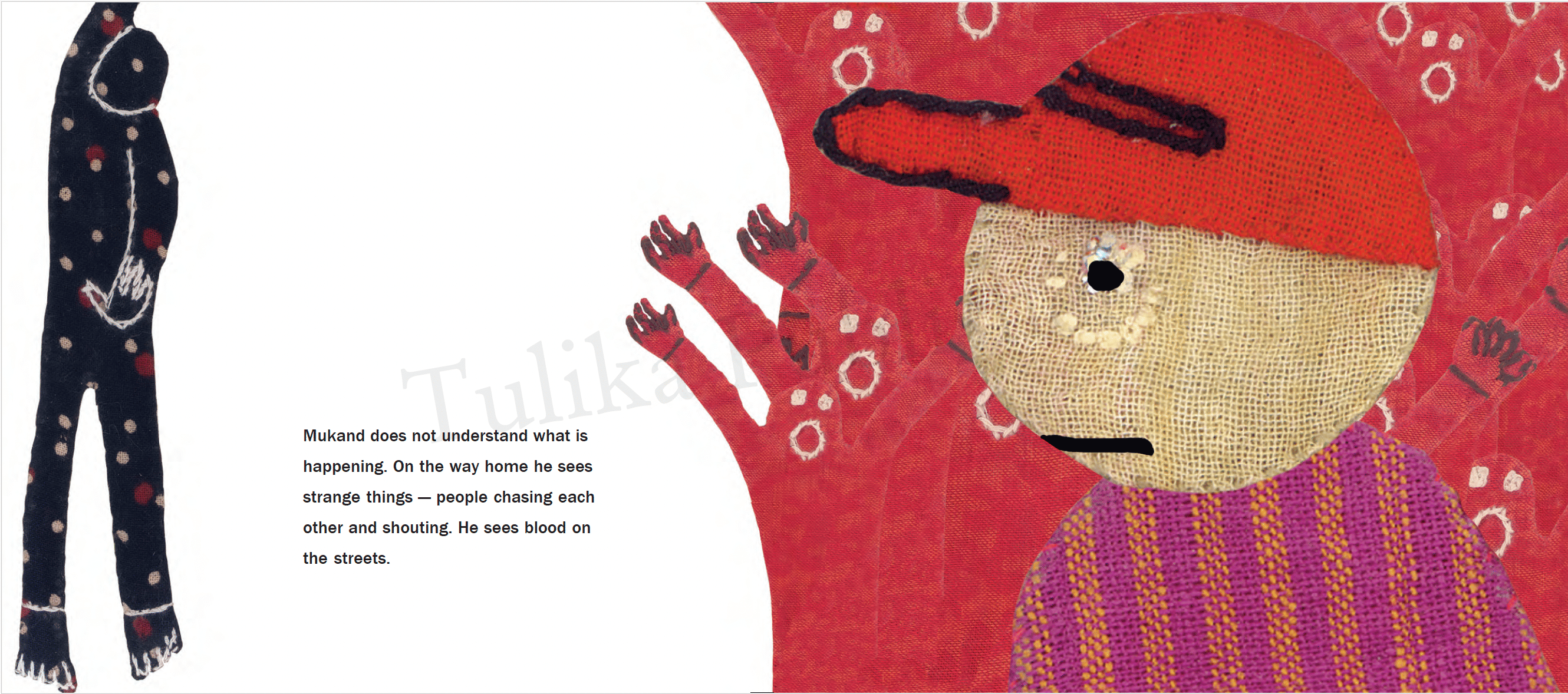
Mukand and Riaz, for example, uses illustrations created from appliqué work, an art commonly done by women of Sindh in Pakistan and Gujarat in India, to recount a tender story of two close friends who are separated forever during the Partition. The book is based on the memories of the author’s father. In one of the spreads, she narrates the violence he witnessed:
“Mukand does not understand what is happening. On the way home he sees strange things—people chasing each other and shouting. He sees blood on the streets.”
The accompanying illustration, though, is far more stark with the figure of a hanging man and a patch of deep red inlaid with Mukand’s worried face. The effect is startling, even though the words are restrained.
The challenge of dealing with enormous complexity, though, isn’t the only reason behind the paucity of Indian children’s fiction on the Partition, especially when one encounters the efflorescence in international children’s fiction on this theme. One of the best-known children’s novels on the Partition—Veera Hiranandani’s Newbery award-winning The Night Diary—was originally published in the US in 2018 by Kokila, an imprint of Penguin Random House.
An epistolary novel, it narrates the story of twelve-year-old twins Nisha and Amil, born to a Hindu father and a Muslim mother who died in childbirth. Due to the riots, the family decides to leave their home in Pakistan and embark on a perilous journey to India on foot. Told through Nisha’s diary entries, the novel movingly captures her struggle to comprehend her mixed identity, the loss of home and her need to belong.
It’s worth noting that a majority of international children’s books on this theme, such as Torn Apart: The Partition of India (2021) by Swapna Haddow, Lion of the Sky (2024) by Ritu Hemnani, and The Partition Project (2024) by Saadia Faruqi, came in the years following the thundering success of The Night Diary. Even Anita Desai’s The Peacock Garden, originally published in 1974, is being brought out as a “rediscovered classic” by NYRB Books in the US later this year. In May 2027, Two Hoots, an imprint of Pan Macmillan in the UK, will release A Handful of Home: The Partition of India in 100 Objects, a fully illustrated, children’s adaptation of the 2018 book Remnants of a Separation by author and oral historian Aanchal Malhotra.
In a conversation organised by Literature across Borders, a transnational literary exchange programme for young people’s books at Bath Spa University, Hiranandani spoke about the importance of the own voices initiative in international publishing. She felt that in a landscape dominated by white writers, it was a way of reclaiming history in the voices of those who have a personal connection to it.
However, she credited a lot of the extraordinary success of her book to her editor Namrata Tripathi at Kokila, “I had never worked with an editor like her. She really took on the book and tried to get it in as many hands as possible.’
Perhaps what Indian children’s fiction really needs is a breakout book on the Partition, such as The Night Diary, backed by a deeply committed editor. Many in the book industry believe this is just a matter of time.
Also Read: Partition wounds live on in the body, speech, humour of a 93-year-old
Publishing dilemmas
Publisher Urvashi Butalia, author of the widely-acclaimed non-fiction book The Other Side of Silence: Voices from the Partition of India (1998), says that while there is a huge body of literature on this theme for adults, “by and large in India, children’s (publishing) has, until recently, shied away from writing ‘difficult’ things.” But she is quick to add that the shying away was more by the old, traditional publishers rather than the adventurous indies who first emerged on the scene in the 1990s. The latter, Butalia believes, might possibly have been more interested in local histories from their corner of the country, rather than the Partition, accounting for the deficit in children’s publishing on this theme.
However, before passing judgement on the reluctance of traditional children’s publishers to engage with “difficult” topics like the Partition, it’s important to acknowledge that such publishing began in the 1950s as a government-supported, not-for-profit, multilingual pursuit tied closely to the agenda of literacy in a country where only a very small proportion of the population could read or write. Handling difficult topics for young readers was never its mandate.
Moreover, the market it catered to was not prepared for books that gave children agency within the complications of the adult world. In such an environment, nuanced fiction about a politically charged, violent and deeply traumatic event like the Partition was unlikely to be an obvious publishing priority. So, even though some Indian languages do feature a collection of children’s stories on the Partition, these have not been translated and made widely available. Not surprisingly, some of the most notable works appear in Bangla, which has a rich tradition of children’s writing and a proximity to this history.
Historian Anwesha Sengupta, who worked on a series of illustrated Bengali history books for children, shares two stories published close on the heels of the Partition by authors who lived through those turbulent times: Leela Majumdar’s Tepantorer Parer Bari (The House on the Edge of Tepantor), about a house “haunted” by refugee children, and Ramesh Chandra Sen’s Sada Ghoda (The White Horse), that deploys an animal’s innocent perspective to depict the mindlessness of communal riots. However, Sengupta is unaware of any recent fiction on this theme in Bengali.
Butalia says that following the Partition, there was an outpouring of literature by direct survivors and witnesses. This included books like Khushwant Singh’s Train to Pakistan published in 1956 and Bhisham Sahni’s Hindi novel Tamas published in 1974.
After that there was a long interlude, and it’s only recently that a flowering of fiction and non-fiction on this history has begun. Jha concurs, adding that perhaps the interlude was necessary for healing, but now a new generation of Indian writers, cosseted by distance, are finding their way back into this history.
Also Read: Effects of the Partition are not just limited to 1947. They can still be felt today
The Partition in Schools
Schools have long been the largest market for children’s books, so it’s important to understand where they stand on literature about the Partition.
Deeptha Vivekanand, Storytelling & Reading Lead at Chandigarh’s St Kabir Public School, says that when it comes to schools, a lot depends on what is being covered in classrooms, as this tends to influence what librarians or reading programmes recommend as supplementary reading resources drawn from children’s publishing.
Post-independence history, including the Partition, entered school textbooks in a significant way following the National Curriculum Framework, 2005, which emphasised the importance of raising contemporary issues in the classroom. This encouraged many schools to include supplementary reading on this theme for students. This year, for instance, Vivekanand has The Night Diary on her reading list for grade eight students.
However, a lot boils down to the choices made by individual librarians and reading programme curators.
“It’s not like Anne Frank’s The Diary of a Young Girl, which was recommended by the CBSE and read widely in schools across the country,” she says, referring to the famous memoir. Yet, for scores of students, the book became a compassionate and engaging gateway into the horrific history of the Holocaust through the eyes of a young Jewish girl.
In 2013, the CBSE had compiled a recommended reading list for schools, which included Mukand and Riaz. While it helped in popularising the book, the initiative eventually fizzled out.
Vivekanand also laments how supplementary reading lists are mostly used by English teachers and not by history teachers. So, even if she includes books on the Partition in her curation, they may not make their way into the history classroom because the teachers are often too pressed for time and ill-prepared to deviate from what’s prescribed in the syllabus.
Nevertheless, in a country where majoritarian politics is snipping the communal fabric and the history textbook has become a battleground, Vivekanand believes that the need for children’s stories on the Partition that balance various narratives and evoke emotions is greater than ever. Butalia echoes the sentiment.
“I was surprised to hear, years ago, that some bits from my book The Other Side of Silence: Voices from the Partition of India were included in the NCERT textbooks, but they are no longer there, I think. This is that same legacy, keeping difficult subjects away from young people—it’s tragic,” she adds.
The Power of Fiction
Children today have access to a wide variety of media to learn about the Partition, so one wonders just how large and consequential the gap this dearth of fiction has created.
Joanne Saldanha, library educator at a Montessori school in Chennai, says that while the richness of resources is undeniable, it’s not always easy to find children’s perspectives in them. For her, children’s fiction is possibly the only space where young readers can truly immerse themselves in this history.
Vivekanand seconds this: “Fiction allows children to see themselves in history. It gives them the agency to imagine the historical setting, the mood of the time and the role they can play in large national movements. It enables them to walk in the shoes of those who lived so many years ago and brings up feelings.”
It is precisely for this reason that Mahtani says that the protagonists in her book are not merely characters, but “an invitation for a new generation to step into (the) history (of the Partition) with empathy rather than distance.”
Ruminating on her personal experience, Malhotra adds, “Childhood is often where our understanding of empathy or difference first begins to take shape. Children… may not need every detail of that history’s violence, but they deserve to understand how ordinary lives were changed, how relationships endured or fractured, what is the other side. I wish, for instance, that when I was young, I had read something beyond the truncated, often flattened narrative in my history books. Maybe then I wouldn’t have waited so long to ask about Partition at home.”
It’s an experience that Saldanha fully appreciates, having witnessed it with her own students last year: “In 2025, my students from grade eight and nine read three books of fiction on the Partition—Across the Line, The Night Diary and Torn Apart: The Partition of India—as part of Literature across Borders. They had not yet been introduced to this history by the curriculum followed at our school and many of them didn’t look forward to what they assumed would be a dull history lesson. We began by discussing the facts of the history, looking at non-fiction books and online resources like the Museum of Material Memory before moving to the fiction. The reading experience was transformative. Some children came from families that had a lived history of the Partition and they found that their unconscious biases were profoundly challenged. What was most heart-warming was that such responses came organically through the reading of the stories and the discussions around them. The students produced art and wrote prose and poetry, which might not have been possible without the deluge of feelings produced by the fiction.”
In a poem, titled ‘Brothers’, a student from Saldanha’s reading group wrote:
‘Brothers’
I think, as people run past me.
I run too, far away.
The darkness comes, I can’t see.
‘Brothers’
My legs burn and my body sour.
What was the Partition?
A misuse, an abuse. The division of power.
Perhaps there is no better ode to the power of young people’s fiction to shape how children respond to a history they inherit but will never live through.
Meghaa Gupta is an author and editor working in Indian children’s publishing. She is also a co-founder of Literature across Borders with Dr Alexia Casale. Her most recent book is Uncoded: A Technological History of Independent India, that’s part of a series of history books on Independent India, published by the children’s imprint of Penguin Random House.