








On 23 March 2020, a day before a 21-day lockdown was announced to control the Covid-19 pandemic, I lost my 88-year-old paternal uncle in Kolkata. Given the restrictions on travel, none of us, including my father, his only surviving brother, could see him one last time or participate in his funeral rites.
Besides the personal pain, his death came as a blow, especially as I had begun interrogating the historical event that had changed the destinies of my father’s family and my own: the Sylhet Referendum of 1947. ‘Jethu’, as I fondly called him, was 15 during the referendum and 18 when his family decided to cross the border, while my father was still a toddler. His first-hand account of what had happened would have been invaluable for understanding this history.
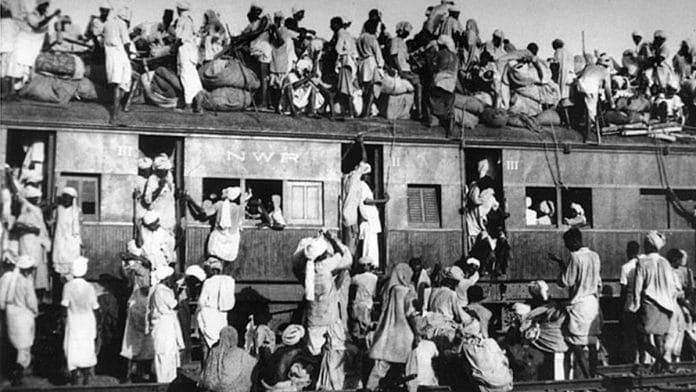
What remains not well known about India’s Partition is that, along with Punjab and Bengal, Assam was also partitioned. And this ‘forgotten partition’ led to the displacement of millions of people in subsequent decades.
History and memories
Soon after the referendum, my father’s family, who lived in Sylhet, found themselves on the ‘other’ side of the border and, within a few years, increasingly experienced hostility. Anticipating that things might take a turn for the worse, one day my grandfather declared that they would leave for India. My grandmother packed some puffed rice and jaggery for what was to become a 15-hour journey for the family of nine. The only valuable things they carried with them were 12 bell-metal plates and glasses, which my grandfather, in a fit of rage, is said to have thrown into the Dawki river after security guards at the border checkpoint objected to such ‘heavy’ things being transported by a refugee family.
What became of them as they moved from one refugee camp to another, and how they eventually rebuilt their lives in Shillong, is not entirely known to me. As children, during annual family gatherings in Shillong, we would gather around an angeethi to listen to Jethu’s fascinating stories about East Pakistan, which had by then become Bangladesh. He had an elephantine memory; an extraordinary ability to remember people, places, and things, and could conjure up images of mountains, rivers, forests, and entire villages. Jethu loved superlatives; his stories were always about the ‘biggest’ mountains, ‘longest’ rivers, and ‘fastest’ leopards. We would ask, “As tall as the ceiling?’, or “as tall as that pine tree in Ward’s Lake?” His response was invariably, “No, no, much bigger” or “much taller!”
With his death, the last window to the world my father had left behind was permanently closed.
His death also made me realise how much of Partition’s history survives not in archives alone, but in memories passed down within families, and how quickly those memories can disappear with each generation. We remember Partition as an event that happened to our grandparents, but its enduring legacy may lie in the memories, fears, and identities transmitted to people who never experienced it themselves.
Also read: Main Vaapas Aaunga is a masterclass in how memory works. Don’t look at it as a hit or flop
Inheriting history
What does it mean to inherit a history you never experienced?
I was born in Assam, decades after Partition. I did not cross a border, lose a home or experience the violence of 1947. And yet Partition was never entirely a historical event for me. It existed in fragments; in family stories, in places we spoke about with familiarity but could no longer easily visit, and in an awareness that our relationship with home had been shaped by an event that preceded my birth.
This may be one of Partition’s most remarkable legacies: it created generations who inherited something they never experienced.
And yet, unlike remembering, inheriting can mean receiving categories and emotional residues without necessarily knowing where they came from. Why do children and grandchildren sometimes carry stories of Partition more intensely than their parents? How do memories of lost homes become family identities? How do stories of displacement get transformed into stories of achievement, resilience or grievance? What happens when inherited memories encounter the different political identities of the present?
Perhaps this is where the distinction between remembering and inheriting becomes important. When history is passed down in fragments, through family stories, silences, memories of loss and belonging, we do not inherit the whole of the past. We inherit particular versions of it. The danger, therefore, may not lie in remembering Partition, but in remembering only one part of it. We can inherit the memory of what was lost without remembering why others lost their homes. We can remember our family’s displacement while forgetting what happened to another. We can remember our community’s suffering while remaining indifferent to someone else’s.
To remember Partition meaningfully on Partition Horrors Remembrance Day, then, we must do more than preserve the memories we have inherited. We must also make space for the memories we did not inherit.
Malini Bhattacharjee is a faculty member at Azim Premji University, Bengaluru campus. She tweets @MaliniBhattach6. Views are personal.
Disclaimer: The content and opinions expressed are that of the author, and are not necessarily endorsed by/do not necessarily reflect the views of Azim Premji University.
(Edited by Aamaan Alam Khan)