






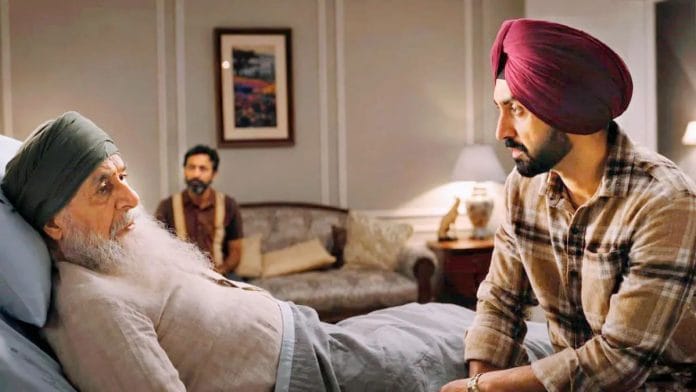


Main Vaapas Aaunga maybe struggling at the box office. But it will be inadequate to judge the latest Imtiaz Ali film through the hit-or-flop lens. It is more than just another Partition drama. It is a window into how memory works.
Many among the generation that crossed the bloodied India-Pakistan border are probably at the dementia stage of their lives now. As an oral historian, I noticed how Ali portrays fraying memory, unstructured remembering and the late surfacing of trauma. He has hand-crafted the fragility of the recurrent and intermittent hallucinatory images that haunt the male protagonist Keenu, played by Naseeruddin Shah, in his senior years—the swish and swaying laburnum trees; secret lovers’ meetings in Sargodha ruins; a missing earring; an unread poem; dancing masked Martians; and bicycling through the narrow lanes.
Memory is made of just a handful of unceasing flashes of images that come at him as he lies helplessly on his death bed. He mumbles some words again and again. For an untrained ear, it comes across as gibberish. That’s how it is for Keenu’s family members at first.
But this is how memory works. Many oral history sessions that I have conducted with senior citizens in the US and India taught me one thing: People don’t remember meta histories of big events as keenly. They hold on to intimate memories of their lives that are entangled in the larger incidents of a nation’s history. Ali captures that intensely.
I consider this film a masterclass in the discipline of memory studies.
Also read: Sindhis have been missing in India’s Partition story. Now, they finally get an exhibition
What endures
Main Vaapas Aaunga is a break from the formulaic retelling of Partition stories that has come to dominate our textbooks and scholarship. It isn’t a political history of Partition. It isn’t about victimhood. It isn’t just a yearning to return to the homeland of one’s childhood or about people caught in harrowing cycles of hate. It is more complex.
Imtiaz Ali’s central predicament in the movie isn’t about how to view Partition. It’s about what to do with memory itself.
The memory caught in the cyclical loop of a dementia patient—its relentless, repeated return in broken fragments. For an older person dealing with dementia, memory is neither linear, logical nor complete. It isn’t unadulterated either. Sometimes it’s even a James Joycean stream of consciousness. It is often repetitive. And this repetition is an act of fortifying one’s claim on a version of history.
Naseeruddin Shah’s character remembers his lover but also Martians, the moon, and the rocket landing. He remembers directions to his lover’s home and the neighbourhood church as if he is still cycling through those lanes. There is a fluid motion to his retelling.
Keenu doesn’t regard himself as a victim either. His memory of lost love, unfulfilled promises and hurried flight from Pakistan haunts him. But it is not a story of hate or barbarity, even though his teenage persona encounters bloody violence and killings. The movie doesn’t skip his own community’s acts of violence against Muslims. It also shows his grandmother beheading all the daughters to save them from rape and abduction.
In 2008, I interviewed Bir Bahadur Singh, a senior Sikh, for The Washington Post. He would go to the local Delhi gurudwara and talk about how he killed 26 women in his family. They raised their braided hair and offered their necks one by one to his sword, as the mobs approached.
“None of the women protested, nobody wept,” Singh told me.
These things happened and these memories amounted to an entire generation of Indians living with severe untreated PTSD.
At the nucleus of Keenu’s trauma is the inability to protect the women of his family, of the broken promise to his lover caused by his hasty escape from the Muslim mobs in the dead of the night.
I recently spoke to a BJP leader about Partition. She told me that when she was little, her maternal grandmother would suddenly wake up from sleep and keep uttering the same line: “I had to run away barefoot, I didn’t even get the time to wear my chappal.”
This was her grandmother’s most enduring memory from everything she had experienced during Partition. It’s strange how the mind holds on to some strains of memory more strongly than the others.
Also read: Inside Pakistan’s Main Vaapas Aaunga craze—global box office flop, emotional hit
An act of resistance
The movie is an ode to memory itself. It’s a psychological study, not a history lesson, not a love story. But there is no easy remembering here.
Neither for the old man who is remembering and recalling, nor for his grandson Nirvair (Diljit Dosanjh) who is listening and trying to find meaning. Together they try to construct an account of Keenu’s tangible past from his fluid, incoherent remembering. This meaning-making process is profoundly important for generational healing. Nirvair finds a way to process these inherited memories through comedy.
When I conducted oral history sessions, I had to often get past replica memories. Everybody remembers the meta events in the same way, as if it is practiced remembering. It is in the personal stories that the nuance comes through. That’s what the oral history discipline is about—unearthing buried layers of remembering and dis-remembering that occur over time. Memory is a process. And oral history is an understanding of how memory is constructed and how the residual, late resurfacing of memories among senior citizens is often a product of a muddle of images and circular stories.
Questions like ‘why remember’, ‘who remembers’ and ‘what to remember’ surge in all studies of the past. And it is especially relevant in Partition studies. The answers to many of these questions not only shape the contours of collective memory-making projects, but also determine how democracy is staged and enacted in India.
In many ways, memory is a well-rehearsed ritual when one is dealing with big transformative episodes of history. Many episodes of collective memories around trauma, conflict, and pain have a script-like quality, because the events have already been recalled and rehearsed many times. The practiced remembering moves along a set template. That is why individual stories can subvert the takeover of their memory by larger meta-narratives.
Keenu’s remembering is an act of resistance against family members who want none of his past trauma.
Rama Lakshmi, a museologist and oral historian, is ThePrint’s Opinion and Ground Reports Editor. After working with the Smithsonian Institution and the Missouri History Museum, she set up the ‘Remember Bhopal Museum’ commemorating the Bhopal gas tragedy. She did her graduate program in museum studies and African American civil rights movement at University of Missouri, St Louis. Views are personal.
(Edited by Theres Sudeep)
Imtiaz Ali showing Hindu and Sikh retaliatory violence without adequately establishing the provocation, the trigger, the sequence of events is a form of false equivalence. It’s the classic whataboutery move dressed as balance.
Genuine historical honesty would require showing what came first — Direct Action Day, the League’s deliberate instigation, the systematic targeting.
The sequence matters because reaction without showing the provocation that caused it is manipulation not balance.
Proportionality matters too — who organized it, who had political backing, who had state support.
Showing Hindu and Sikh violence without that context creates a false picture. It implies spontaneous communal savagery rather than communities defending themselves under extreme provocation after suffering enormous losses.
Real honesty about Partition requires showing the full sequence. Instead Ali made a selective morality tale dressed as history.
And the question worth asking Imtiaz Ali directly is simple:
Why does your courage always seem to flow in one direction?
A memory studies scholar who doesn’t interrogate the historical accuracy of what’s being remembered has left the most important question unasked. By her own framework…memory is shaped by what gets included and excluded …the real question is what Imtiaz Ali deliberately excluded.
She’s admired the architecture without checking the foundation