



New Delhi: Hyderabad-based space technology company TakeMe2Space launched its MOI-1a satellite on Friday morning aboard SpaceX’s Transporter-18 mission, 10 months after its first launch attempt on an ISRO PSLV mission failed.
The MOI-1a mission is a step towards building an orbital data centre in space. It will allow customers to collect Earth observation data and process it in space, instead of sending large volumes of data to the ground.
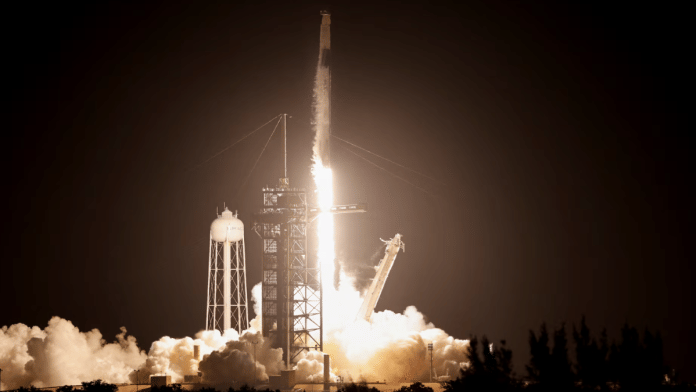
MOI-1a was one of 130 payloads launched aboard SpaceX’s reusable Falcon 9 rocket from California’s Vandenberg Space Force Base. The Transporter-18 mission was a rideshare launch, meaning multiple customers shared the same rocket.
Other Indian payloads on the mission included Dhruva Space’s LEAP-2 mission and SatLeo Labs’ TAPAS-1 satellite.
On 12 January, TakeMe2Space launched its MOI-1 satellite aboard ISRO’s PSLV-C62 mission. However, the mission failed following a problem with the rocket’s third stage. TakeMe2Space, Dhruva Space and several international companies lost satellites in the mission.
In May, TakeMe2Space announced that it would re-attempt the launch aboard a SpaceX rideshare mission in October, with the MOI-1a satellite.
“Any space startup is burning cash whether or not they launch. Accessing space-based services as quickly as possible is important for business,” Anand Rajagopalan, executive vice-president (business strategy) at TakeMe2Space, told ThePrint.
“As soon as C62 failed, we started looking for the earliest launch slot. There was one on SpaceX, and we took it,” he added.
What does MOI-1a do?
TakeMe2Space’s MOI-1a satellite is equipped with AI computing capabilities to not only collect satellite imagery but also process it in space.
It is the first of five planned satellites that will together form a constellation for Earth observation and data processing in space. This is the beginning of what TakeMe2Space calls an “orbital data centre”, where satellites will carry out both observation and computing tasks.
The MOI-1a satellite already has 23 customers. The 14-kg satellite carries 117 TOPS of onboard computing, 2 TB of storage and a nine-band multispectral imager.
Its applications include agriculture monitoring, mining and supply-chain intelligence. The satellite also marks a step towards TakeMe2Space’s commercial operations.
Also Read: Launching a rocket to space now costs 95% less than it did 65 years ago—and could get cheaper
What are the other Indian payloads?
Dhruva Space’s LEAP-2, or Launching Expeditions for Aspiring Payloads, is a platform designed to carry smaller payloads on a single satellite.
This is Dhruva Space’s second mission with SpaceX, following its August 2025 mission.
Ahmedabad-based SatLeo Labs launched its TAPAS-1 satellite aboard the LEAP-2 platform. It is India’s first commercial CubeSat thermal payload.
TAPAS stands for Thermal Access Platform for Analytics & Solutions. It uses thermal infrared sensing technology to study and observe the Earth, rather than relying on radar or optical imaging.
Thermal sensing measures changes in temperature and heat radiation. It can provide information that other forms of imaging may not capture.
TAPAS-1 will demonstrate its thermal sensing, data capture, and processing capabilities aboard the SpaceX mission. Its potential applications include agriculture, urban heat mapping, climate monitoring, and disaster management.
The mission marks India’s first foray into dedicated commercial thermal, or long-wave infrared (LWIR), Earth observation.
Edited by Maryam Hassan