





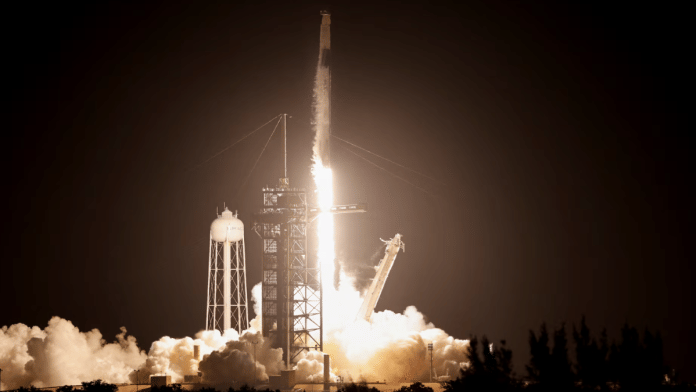


New Delhi: Space launches have become 95 per cent cheaper since 1960, with the cost of putting 1 kg of payload into orbit dropping from $87,000 to $3,800 over 65 years, a new study by University of Cambridge economists has found.
Published on 14 July in PNAS Nexus, the study has built the world’s most comprehensive database of over 4,400 rocket launches since the first Sputnik launch in 1957.
The authors analysed rocket launches across 16 space-faring regions to understand how quickly costs have fallen as the industry has gained experience. They also compared this with trends in steamship freight and modern solar photovoltaic technology.
They found that rocket technology has been one of the fastest-improving technologies in the world, with a steeper ‘learning curve’ than steamships during the Industrial Revolution and modern solar photovoltaic technology. This has been reflected in falling costs.
The study predicted that, according to calculations, the cost of rocket launches is only expected to go down in the future decades.
“Our central scenario suggests costs per kilogram might more than halve between now and 2030, and drop further by four-fifths by 2040,” said the paper. “To put this into perspective, SpaceX alone could achieve this with 80 flights of its new super-heavy reusable rocket Starship,” it added.
While Elon Musk’s SpaceX and its reusable rockets are among the main factors behind the reduction in launch costs, the study also pointed to advances in manufacturing, including 3D printing, automation, and the use of lighter materials. But the main reason, according to the study, is that as space companies launched more, they gained more experience, and their production costs lowered.
Also Read: China’s reusable rocket didn’t land on its legs. It was caught in a net
Wright’s Law in action
The study used Wright’s Law to assess the learning curve of the global rocket launch industry. Developed by aeronautical engineer Theodore Wright in 1936, the law says that the more you build something, the better and cheaper it becomes. This holds true for the rocket industry.
“Our data show how the experience curve of space launchers follows Wright’s Law very closely, especially since the turn of the century,” said the study.
However, the authors also wanted to understand how exactly more production led to falling costs — did each individual rocket become cheaper, or did the industry begin to use cheaper rockets over time? Their research found that it was a bit of both.
In the early years of the rocket industry, launches were driven by Cold War-era motivations, meaning countries cared less about cost efficiency than developing indigenous rocket capabilities. From the 1960s to the mid-1990s, reductions in launch costs largely happened through “reallocation”: countries built many experimental rocket designs and eventually picked the most efficient ones, bringing down average costs.
After 1995, around the time the first private companies entered the space sector, there was also a technological shift in the launch industry. The study said the industry matured in the 1990s and 2000s, focusing on building a few successful designs and refining manufacturing.
“Since the end of the Cold War, the learning rate (in the rocket industry) accelerated to 8%. Taken together, this is prima facie evidence that state-led competition during the Cold War did not foster cost efficiency improvements,” said the study.
Also Read: A new imaging technique lets scientists sneak a peek into invisible cell activity
A rocketing sector — and a word of caution
The study compared the rocket industry’s technology improvement and growth with those of solar photovoltaic technology and 19th-century steamship freight. Both sectors also follow Wright’s Law, with increased production leading to lower costs.
The researchers discovered that space has an edge over solar PV, even though both industries took off around the same time. While solar PV costs have fallen by 99 per cent since the 1970s, that is largely attributed to the huge increase in production. Millions of solar panels have been installed since then, helping drive down costs.
The space industry, meanwhile, has produced relatively fewer rockets and operated at a much smaller scale over the same period, yet managed to reduce costs by 95 per cent. According to the study, this means the sector has had a steeper learning curve.
Using Wright’s Law, the study projected that launch costs could fall to around $1,600 per kg by 2030 and $300 per kg by 2040.
However, given the role played by the future Starship rocket in these projections, the study also cautioned against overdependence on SpaceX for further reductions in launch costs.
“The fact that the United States and the whole world have become so reliant on a single company for cheap space access makes the task of projecting the size of the space economy particularly challenging,” said the study.
(Edited by Asavari Singh)