





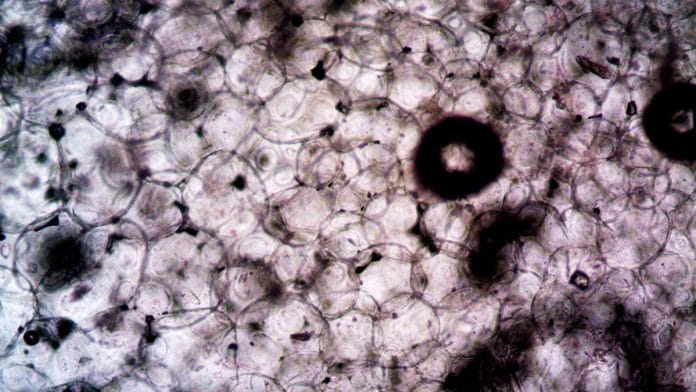


New Delhi: Cells are like crowded cities where the chaos of molecular interactions has long remained invisible to scientists. Now, researchers at the University of Illinois Chicago have developed a new imaging method that lets them peek into activities of previously hidden enzymes.
The study, published in the Proceedings of the National Academy of Sciences (PNAS) in May, describes the imaging method, termed Fluctuation Increase Negated by Intra-Chain Interaction or FINICI, which observes biosensor signals, or the result of interactions between enzymes and other substances in the cell. FINICI turns these biosensor signals into readable images, allowing scientists to study how cellular enzymes react in real time.
“Cell signaling determines how drugs work. Drug molecules directly interact with molecules in your cells, and visualizing these details is a significant step that helps to understand and improve how they work,” said Gary Mo, a co-author of the study and associate professor of pharmacology and regenerative medicine and biomedical engineering at UIC, in a university statement.
Also read: Want to buy a dinosaur? T. Rex ‘Gus’ sold for $50.1 million, some for $19 too
Peeking into a cell
Until now, researchers had relied on biosensors to understand chemical messages within a cell. These biosensors would either glow or go dark when they sensed activity in the cell. Since much of this cellular activity happens at a nano-scale, scientists could not understand whether the cell had gone dark due to a lack of activity or because of an ongoing interaction.
FINICI managed to reinterpret the dimming and glowing of biosensors. Using their new imaging technique, researchers looked deeper into the activity of three molecules — the Src kinase, Syk kinase, and cGMP.
The study found that the Src kinase, a protein linked to cancer, led to activity in tiny hotspots on the cell membrane, often in the cholesterol-rich areas. Researchers also saw that cGMP, an enzyme responsible for regulating muscle relaxation, blood vessel dilation, first sent signals in small clusters in the cell before propagating it through the cell.
According to the researchers, it is important to study not just when an enzyme is active, but where it is active. This is particularly helpful when it comes to drug research because it allows researchers to see where drugs react with cells, and why some drugs succeed and others fail. Using insights from FINICI, researchers may even be able to better design drugs to target particular enzymes.