





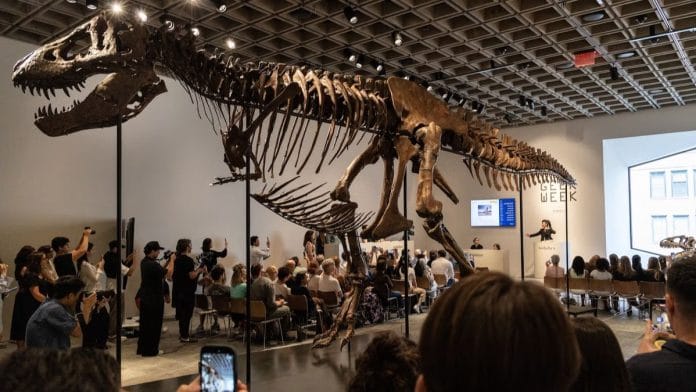


New Delhi: A 67-million-year old Tyrannosaurus rex called Gus sold for $50.1 million at an auction in New York on 14 July. While the auctioneer, Sotheby’s, expected the fossil to sell for about $20 to $30 million, a 10-minute long bidding battle involving seven interested parties raised the stakes until an anonymous caller finally bagged the deal.
The last time someone brought out the big bucks for a fossil was when Citadel founder Kenneth Griffin bought a 150-million-year-old Stegosaurus for $44.6 million in 2024.
Gus’s remains date back to the final years of non-avian dinosaurs before they went extinct. Hanging at the auction, his bones were remnants of a majestic 11.6 metre long and 3.8 metre tall T. Rex, one of the largest and most complete specimens ever found.
“Gus has an exceptionally preserved skull, with approximately 82% of the bones represented, including all six dentitions. Judging from the overall size and degree of bone development it can be determined that Gus’ skeleton belonged to a very large, robust, adult individual,” Sotheby’s wrote about Gus.
While Gus is far too expensive for most people to afford, Fossilera, a website for legally selling dinosaur parts, offers fossils even for the lay public starting at a price of $19 dollars and going up to $29,500 for a T. Rex tooth.
Also read: Harappan dead can tell many stories. Only a few are studying their cemeteries
Fossils for sale
Gus gets his name from a ranch owner called Gary “Gus” Licking in South Dakota’s Hell Creek Formation. He was excavated in 2021 at the cattle ranch which soon turned into one of the world’s richest Late Cretaceous fossil sites. Researchers spent nearly five years excavating an area of 7,000 square feet before finally documenting, restoring, and rebuilding the fossil. What they found were about 183 fossilized bones which make up nearly 61 per cent of the creature’s bone count. Such high levels of preservation are extremely rare for a T. Rex.
Over the past few decades, fossil sales have picked up, especially since 2020 when a T. Rex called Stan sold for $31.8 million to the Abu Dhabi Department of Culture and Tourism. However, with a rise in demand, the price of such fossils has also risen. Compared to Gus, Sue, another T. Rex, had sold for $8.4 million in 1997.
Several collectors have begun looking at dinosaur fossils as another form of “art” or a “collectible”. This emerging fossil market also encouraged commercial fossil hunters to launch expensive excavations that museums or researchers just cannot afford. While some paleontologists argue that this private market helps fund discoveries, others are worried that important fossils may disappear into private collections where they are no longer easily accessible to researchers who want to study them.