





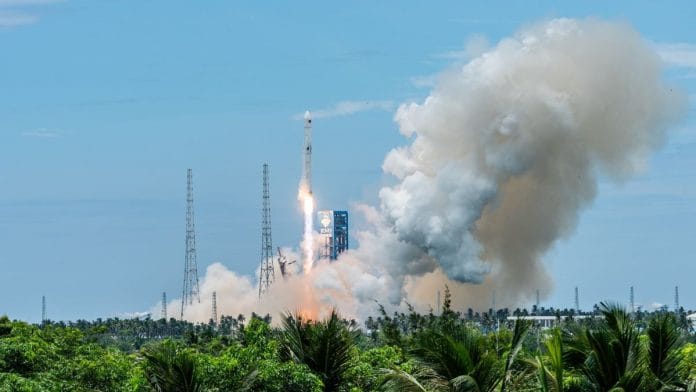


New Delhi: China successfully recovered its first reusable rocket Long March-10B using its new net-based recovery system on Friday, marking a milestone in the country’s development of reusable rocket launch technology, reported a state news media outlet.
The rocket lifted off from the Hainan International Commercial Aerospace Launch Centre in south China’s Hainan Province. Six minutes after the rocket sent a satellite into orbit, its first-stage booster returned to Earth and was captured by a specially designed sea vessel using a net recovery system.
This is the first time a carrier rocket has been caught using the net system, and it is also the first time ever that China has recovered a rocket booster. This puts the Chinese Aerospace Science and Technology Corporation (CASC) in the same league as American companies such as Elon Musk’s SpaceX and Jeff Bezos’s Blue Origin that have so far been the only two to recover and reuse an orbital booster.
“Engineers will continue refining the rocket’s reusable technologies and aim to conduct the first reflight by the end of the year,” the CASC said in a state media report.
Also read: China is leading a rooftop solar boom in the Philippines
What is the Long March 10-B
The Long March 10-B is a two-stage rocket launch vehicle where the first booster is powered by seven liquid oxygen-kerosene engines, and the second one uses an oxygen-methane engine. This allows the rocket to remain stable as its booster returns to earth.
The rocket has the capacity to deliver 16 tonnes of payload to low-Earth orbit, allowing it to deploy larger satellite constellations or be a part of commercial launch missions, while reducing costs due to its reusable technology.
However, what was particularly remarkable about the launch was its recovery system. While SpaceX’s Falcon 9 and Blue Origin’s New Glenn, return their respective first-stage boosters to Earth using landing legs on drone ships at sea or land pads, the CASC has taken a different approach.
As the booster falls back to earth, a hook mechanism on it makes contact with tensioned cables aboard the recovery vessel, called the Linghangzhe. First the booster slows down until it is eventually captured in the recovery net.
This new form of recovery shifts the complexity of the reusable technology onto the recovery vessel instead of the rocket itself, allowing it to either carry more payload or more fuel. If the rocket itself is built with landing legs, as is the case with Falcon 9, the design adds weight and complexity to the rocket.
However, whether such technology is scalable, and whether China can repeat this experiment and see the same results, is yet to be seen.
China is also in the process of building other partially reusable rockets like the Long March 12A and the Zhuque-3, both being built by Landscape, a private aerospace company. While both these rockets tested out their reusability in December 2025, they could not stick the landing back into Earth.