





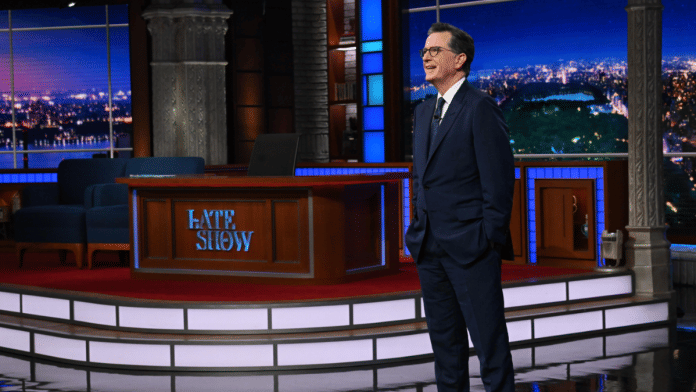


New Delhi: For 11 years, Stephen Colbert walked onto the stage of The Late Show each night carrying one promise: that no matter how absurd the news cycle became, there would still be room to laugh at it.
On 21 May, he did it one last time.
The final episode of The Late Show with Stephen Colbert aired Thursday, following CBS’s decision to cancel the programme—a move the network insisted was financial, not political, despite the timing (a merger with Paramount) raising eyebrows. When the cancellation was first announced, several prominent television and film personalities protested against the decision, with many others standing in solidarity with Colbert, who won his first Emmy for best talk show in 2025.
By the time Colbert returned for his farewell episode, the show had turned into a conversation about what remains of American network television, political satire, and appointment-viewing culture in the streaming age.
But Colbert did not turn the finale into a funeral.
He opened the show almost defiantly, insisting viewers were getting a “normal episode”. That was the joke, and the point. The easiest way to mourn “late night”, he obliquely suggested, was to keep doing late night.
Surprisingly or unsurprisingly, there was no mention of United States President Donald Trump, someone Colbert had routinely targeted and bore the brunt of it.
Colbert takes the Questionert
Throughout the finale week, the mood around the show had swung between celebration and nostalgia. Colbert danced in blue overalls with David Byrne to ‘Burning Down the House’ (1983).
The who’s who of Hollywood from Billy Crystal to Josh Brolin took turns asking Colbert the famous “Colbert Questionert”, the host’s oddball rapid-fire questionnaire that became one of the show’s signature segments.
Colbert recalled two rare moments when guests correctly guessed the “number he was thinking of”—one by Ethan Hawke and another by Meryl Streep.
“Ethan Hawke just looked at me straight and said, ‘I know what it is, it’s three,” Colbert said.
The finale began with the monologue, as it had for 33 years at The Late Show. Political jokes and absurd comedy bits followed.
Astrophysicist Neil deGrasse Tyson appeared to explain a fictional “interdimensional wormhole” supposedly caused by Colbert’s cancellation, warning that all of late-night television could collapse next. Before Tyson could finish, Colbert shoved him into the imaginary void.
It was vintage Colbert—playful, self-aware, and bitter underneath.
Fellow late-night hosts Jimmy Kimmel, Jimmy Fallon, Seth Meyers, John Oliver and Jon Stewart also appeared on the show to joke about the “collapse” of late-night television.
Also Read: Harrison Ford to graduating students—‘world my generation left you is a real mess’
One last big reveal
As the show progressed, actors Bryan Cranston, Paul Rudd, Ryan Reynolds and comedian Tig Notaro popped up from the audience pretending to be surprise guests. And they were all vying to be Colbert’s final guest. This big reveal, though, was saved for later.
After teasing viewers with fake-outs and interruptions, Colbert finally introduced the guest of his final show—Beatles legend Sir Paul McCartney.
The Beatles first performed for American television audiences in 1964 at the Ed Sullivan Theater. Decades later, the theatre became home to David Letterman and eventually, Colbert.
McCartney spoke about returning to the venue, recalling how America once felt to him like “the land of the free” and the centre of the music that shaped his youth.
The evening ended with McCartney performing ‘Hello, Goodbye’ (1967) joined by Colbert, bandleader Jon Batiste and staff members crowding the stage together. In the final moments, McCartney and Colbert walked backstage and switched off the theatre lights.
The genre that once dominated post-11 pm American television now survives in fragments—scattered across YouTube clips, podcasts, streaming platforms and social media feeds.
Colbert delivered no dramatic, tearjerker monologue. Just thanked the audience for doing the show with him.
(Edited by Insha Jalil Waziri)