



Geraftaar, a 1985 film starring three of the biggest superstars of Indian cinema — Amitabh Bachchan, Rajinikanth, and Kamal Haasan — was built around family, friendship, and Hindu-Muslim unity.
On paper, it is a quintessential Bollywood masala film, bringing together everything that defined mainstream Hindi cinema of the period — action, romance, comedy, family drama, revenge, and songs.
The coming together of these three superstars was itself an unusual feat at the time. Recalling how Amitabh Bachchan came on board for the film, director Prayag Raaj said that after working with him on Coolie (1983), he requested just a guest appearance from the actor.
“He told me, ‘I will give you 10 days.’ In those days, 10 days of Amitabh Bachchan almost meant an entire film,” Raaj said.
The film begins with a typical Bollywood family setting before taking a dramatic turn. Kapil Kumar Khanna, an honest police officer, and his wife Durga, played by Nirupa Roy, have two sons: Karan, played by Amitabh Bachchan, and Kishen, played by Kamal Haasan.
While on duty, Kapil arrests Vidyanath, played by Kader Khan, and Ranjit, played by Ranjeet, for selling drugs. However, they kill Kapil and frame Karan for his father’s murder. Durga also believes their story and, in anger, tells Karan to leave. He runs toward the ocean and is presumed dead.
This separation becomes the foundation of the film. Karan is saved by the family of Hussain (Rajinikanth), and the two grow up together, eventually becoming police officers.
Kishen, meanwhile, grows up in a completely different environment and becomes a struggling actor and stuntman.
The film’s central idea — two brothers separated by tragedy, growing up in completely different circumstances and eventually meeting without knowing their relationship — was already familiar in Bollywood. Amar Akbar Anthony (1977) had three brothers separated as children and raised in different religious households before reuniting as adults. Suhaag (1979) similarly revolved around separated brothers who grow up in contrasting circumstances before finding each other.
At the heart of Geraftaar is the idea that relationships can survive even when people are separated by circumstances. The same idea extends to Karan and Hussain. Their friendship is presented as something that goes beyond religion.
This Hindu-Muslim friendship is not treated as a separate social message inserted into the story; it is part of the film’s emotional world. Hussain becomes family to Karan after his own family rejects him. When Hussain is killed after uncovering the criminal syndicate, his death becomes personal for Karan and pushes the story further into revenge.
The film therefore moves between two kinds of justice. There is the institutional justice represented by Karan as a police officer, and there is the personal justice he seeks after losing his father and Hussain.
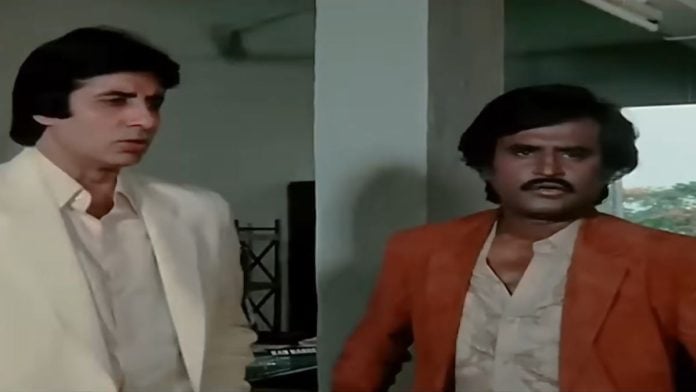
What makes the film more watchable, apart from the coordination of these three superstars, is the dialogues written by Kader Khan. In one scene, Amitabh Bachchan and Rajinikanth are shown together for the first time while stopping a jewellery shop robbery. Amitabh, wearing a white coat, warns the police team after the thief threatens them, saying that if they enter the shop, they will be killed.
“A person’s life is in the hands of God, but bullets change their direction when they see Karan’s chest. Hold on to your guns and get ready to welcome me,” Karan says.
Also read: Aghaat brought working-class politics into Bollywood—from labour unrest to union rivalry
A time capsule
This film featured songs that remain part of old-is-gold Bollywood playlists, including ‘Dhoop Mein Nikla Na Karo, Roop Ki Rani’, sung by Kishore Kumar and Asha Bhosle and composed by Bappi Lahiri, and ‘Aana Jaana Laga Rahega’.
The latter becomes integral to the story. After a series of incidents, Karan and Kishen end up in jail. Hussain’s death prompts Karan to kill corrupt police commissioner Vijay Sinha. Meanwhile, Kishen is wrongly jailed for harassing Lucy (Rabia Amin). There, he sings the childhood song he once shared with Karan. Hearing the familiar tune, Karan follows the voice and discovers his long-lost brother, turning the song into a crucial link between their childhood and reunion.
Once Karan discovers Kishen, the film shifts from the mystery of their separation to how the brothers confront the problems in each other’s worlds. Karan helps Kishen escape and, while trying to prove his brother’s innocence, finds himself drawn into the same criminal syndicate that destroyed his family years earlier.
Durga eventually learns that Karan is alive and realises that the person who had been protecting Kishen was, in fact, her older son. The brothers then decide to turn the tables on Vidyanath and Ranjit. They eventually discover that Vijay, whom they believed was dead, has survived. In the final battle, the gang members are killed, and Karan, Kishen, and Durga are finally reunited as a family after years of separation.
Ultimately, Geraftaar works as a time capsule of the kind of Hindi cinema that could bring three major stars into one story and give each of them space to create their own larger-than-life moments.
(Edited by Aamaan Alam Khan)