



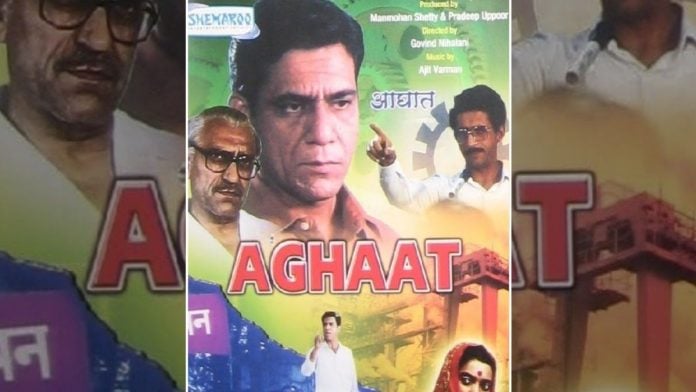
In 1985, filmmakers blended family drama, romance and action to capture audiences. As working-class issues slowly disappeared from mainstream Bollywood films, Govind Nihalani’s Aghaat kept political drama alive by blending it with elements of commercial cinema.
The film starts with a Labour Day celebration at Shivalik Engineering, organised by the union of Madhav Verma, played by Om Puri. The celebration is disrupted by workers of another union—run by Rustom Patel, played by Naseeruddin Shah. The workers start shouting slogans supporting their union, and chaos erupts with Verma aggressively trying to stop Patel’s union at the site, believing that his union can represent the workers better.
With the film, Nihalani depicts his idea and reason for the decline of unions in India, but at the same time, he is not framing Verma’s union as good or Patel’s union as bad. It shows that even within the unions, disagreements are increasing and no one has the solution.
Manmohan Shetty and Pradeep Uppoor produced the film under Neo Films Association. Along with Om Puri, Naseeruddin Shah and Bharath Gopy, the cast includes Amrish Puri, Deepa Sahi, Rohini Hattangadi, Sadashiv Amrapurkar, K K Raina and others.
Then Nihalani puts both the unions to the test. Chotelal, played by Pankaj Kapur, loses his legs in an accident at the factory and is hospitalised, but his family now needs compensation for both hospital bills and the future, which will offer them more struggle than it already was.
The accident becomes the main plot of the film, as Krishnan Raju, played by Bharath Gopy, who works for Patel’s union, takes advantage of the situation. He pressures Chotelal and his brothers to join his union, promising higher compensation. What should have been a collective fight for an injured worker becomes an opportunity for one union to strengthen its position against the other.
Also read: Maya Darpan was Kumar Shahani’s portrait of a changing India
Fight within unions
The film was written by Vijay Tendulkar, who also worked on the screenplay and dialogues alongside Vasant Dev. Instead of limiting the story to the personal rivalry between two union leaders, Aghaat explores how workers’ collective strength is weakened when their representatives are divided.
Shivalik Engineering’s management sees the rivalry between the unions as an opportunity to advance its own interests, while the workers face the possibility of losing their jobs. The film, therefore, connects the decline of unions to a broader struggle over employment, industrial change and management control.
Nihalani does not make the conflict a battle between good and bad. Verma’s principles are tested as the rivalry grows, while Patel’s union attracts workers through promises of better pay and compensation.
The film’s music was composed by Vanraj Bhatia, with lyrics by Vasant Dev. Its ‘Garm Lahu Ki Dhaara’ was sung by Shailendra Singh and Suresh Wadkar. The song is part of the film’s political and social setting rather than a conventional romantic or commercial soundtrack.
At last, after Chotelal dies on his hospital bed, the fight between the two unions reaches a violent climax. Rustom Patel arrives in a white car to hold a meeting at the factory gate and tries to bring more workers into his union. Verma, who has always supported peaceful protests and workers’ unity, now finds it difficult to fight Patel’s methods.
What follows is a violent clash between workers outside the factory gates. Verma’s union is forced to use the same violence it once opposed. In the end, Nihalani shows how workers become divided and fight among themselves, while the management remains safe
Nearly four decades after its release, Aghaat received a 4K restoration by the NFDC–National Film Archive of India. The restored film was screened in 2023 at the Jio MAMI Mumbai Film Festival as part of a retrospective celebrating Bharath Gopy.
(Edited by Saptak Datta)