



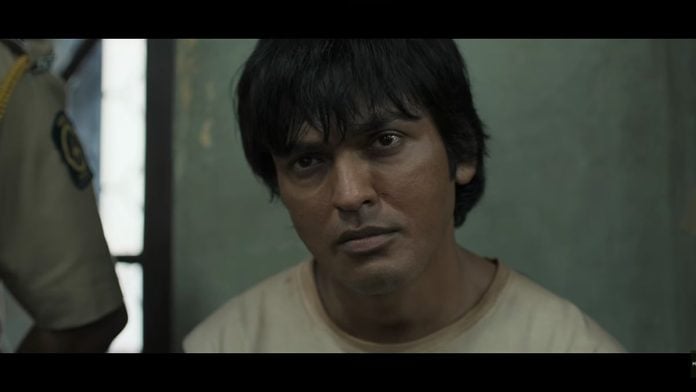
Mumbai: Lalit Prabhakar, who played Ajmal Kasab in the movie Prahaar: The Untold Story of Ujjwal Nikam, remembers 26 November 2008 all too well. He was rehearsing with his theatre group in Kalyan, far from South Mumbai, when the terror attacks began. As news of the shootings spread, he was feeling anger, shock and helplessness.
“I’d read somewhere that people living in Maharashtra feel very safe because we’ve never seen war here. War happens at the borders,” he told ThePrint. “I felt so much anger. And helplessness. What could we do?”
He never imagined then that nearly 18 years later, he would play the lone surviving terrorist from those attacks.
Released on 16 October, Avinash Arun’s Prahaar also stars Rajkummar Rao as special public prosecutor Ujjwal Nikam, who led the prosecution against Kasab in the 26/11 trial and had earlier successfully represented the State in the 1993 Mumbai blasts case.
A role he almost missed
This is the first time that 39-year-old actor Prabhakar is getting recognition beyond Marathi cinema. He was promoting his Marathi film Aarpar in September 2025 when the casting team approached him for Prahaar. The audition dates kept clashing with existing commitments, and he was reluctant to send a self-test.
“Self-tests scare me a lot. I said, ‘No, I’ll come. I’ll find the time,’” he recalled.
He eventually auditioned in person with two scenes, one in which Kasab claimed to be 17 years old and another involving a confession. He was selected that same night, just a few weeks before filming began.
Prabhakar hadn’t read the entire screenplay, but he had admired Arun’s earlier work, which includes Killa, Three of Us and Paatal Lok. Meeting the director reassured him about how the film would handle such a sensitive subject.
“I hadn’t really thought about all that when I said yes. But when I met him, I felt that we wouldn’t do anything wrong with this subject.”
Two confessions, two truths
To understand Kasab in court, Prabhakar read accounts of his interrogation, including those by investigating officer Ramesh Mahale.
“I was trying to think about his psychology. A man who had killed so many people, who was ready to die. How would he look at people? How would he see them? He had no fear,” he said. “When he first came to court, he was more than happy that people had come to see him.”
“He was very smart. He was observing everything, absorbing everything. He was learning very quickly what was happening around him.” Prabhakar tried to unravel Kasab’s personality by speaking to the investigating officer and by reading Kasab and I, written by Mahale.
Kasab had even claimed in court to be a fan of Amitabh Bachchan, the only commonality Prabhakar could find with him.
In the film’s first confession scene, Kasab admits taking part in the attack but denies deliberately killing anyone. He claims that any bullet that hit people was accidental and that he had tried to stop the violence. In the final confession, he admits his actions.
Arun told Prabhakar that the second confession had to feel truer than the first, but left it to the actor to work out how to achieve that distinction. With no visual cue revealing the first account as false, Prabhakar had to make it believable.
“All of that also has to feel true. But it cannot feel as true as the final confession. That was quite tricky for me to perform.”
Prabhakar had to work out which emotions Kasab was genuinely experiencing and which he was performing for the court. He approached the confession by considering what Kasab was telling himself, what he wanted his listeners to believe, and where feelings of betrayal, sadness and anger entered the performance.
For the final confession, Prabhakar drew on an audio recording he had been sent of a man involved in Kasab’s indoctrination. He studied the man’s Pakistani lehja, diction and rhythm, and decided to use that manner of speaking for the end of the confession. Arun approved the approach.
“The people who had brainwashed him, the way they had spoken to him, I thought he should end his confession in that same way,” he said. “I felt it was a very good approach.
Also read: Meet Clayface, DC’s shape-shifting monster making his big-screen debut
How theatre helped Prabhakar play Kasab
At 39, Prabhakar was nearly twice Kasab’s age at the time of the attacks. To imagine the world through the eyes of a 21-year-old, he drew on something he had enjoyed since childhood: pretending to be other people.
“When I was young, I felt I could become anything. If I saw a conductor, I’d think I could become a conductor. If I saw a shopkeeper, I’d think I could become a shopkeeper,” he said.
For Kasab, Prabhakar applied that attention to characterisation even to the way he walked. He lowered his shoulders, bent his knees slightly and altered the distance between his feet to make himself appear shorter.
For him, acting still retains something of that childhood excitement.
“You give me a scene, you give me clothes, you give me dialogues, you give me a character. Then you keep adding things about that character. I just love it.”
A computer science graduate, Prabhakar began pursuing theatre alongside his studies at Birla College in Kalyan, training under director Ravindra Lakhe. What began as an interest gradually became a serious pursuit, helped by a Ministry of Culture scholarship that provided him with a monthly stipend. His television career progressed from small parts to supporting roles before he became a household name playing Aditya Desai in Julun Yeti Reshimgathi in 2013. He made his Marathi film debut with Chi Va Chi Sau Ka in 2017.
“Joining that theatre group in college was one of the biggest milestones of my life,” he said.
“One thing Lakhe sir taught us was that whatever character you play, their laughing and crying must be different,” he recalled. “I’ve seen actors play different characters, but when they laugh or cry, they do it in the same way. That shouldn’t happen.”
Even ordinary gestures mattered.
“We watch so many films, we read so much. All of that influences how we talk, how we move,” he explained. “But somebody who hasn’t watched those films or read those books, who doesn’t know what will look good, how will he react? How would he even hold a tomato?”
But Prabhakar is less solemn about the experience of playing Kasab.
“I don’t think it affected me,” he said. “But you’d have to ask the people around me. They were a little scared when I came home from shooting or met my friends. They weren’t sure whether they should talk to me or not.”
Prabhakar also chuckled as he recalled filming the scene in which Kasab is taken to the gallows.
“When they were taking me to be hanged, I was listening to Oscar Isaac’s ‘Hang Me, Oh Hang Me’,” he said.
The actor is now preparing to play Marathi poet and activist Namdeo Dhasal in the biographical film Dhasal, directed by Varun Rana. Dhasal co-founded the Dalit Panthers in Maharashtra in 1972. His poetry confronted caste oppression and the lives of marginalised communities. When the part came Prabhakar’s way, he had no hesitation.
“A poet has that delicacy, that sensitivity. And on top of that, this man was a radical activist, out on the streets. What a deadly combination. You find very few people like that. To have a subject like this come my way, to be able to perform it, I’m just happy. Blessed,” he said.
Prabhakar was already back on a film set in Jaipur when he spoke to ThePrint, with little time to take stock of the response to Prahaar.
For someone who speaks so earnestly about discipline and dedication, he is quick to point out how much he still falls short of his own expectations.
“I’m very harsh on myself,” he said. “I look at what people have done at my age, the films they’ve made, the performances they’ve given. And I think, what am I doing? Am I wasting time?”
For now, he said the best way to respond to the appreciation coming his way after Prahaar is to keep working.
“I don’t know how to reciprocate it. I can say thank you to people, but I only know how to reciprocate through good work.”
(Edited by Ratan Priya)