








Malihabad/Lucknow: The soles of Madhvendra Deo Singh’s shoes wore out completely. For six months, he went back and forth between government offices and his home several times to obtain environmental clearances. By the time Maeve Meadery — Uttar Pradesh’s first fruit winery — opened its doors in the mango orchards of Mal, on the outskirts of Lucknow, Singh had acquired 36 licences over two years of bureaucratic exhaustion. Mango wines are the new rage. Next up, mango-chilli wine.
“It drained me out,” he said, swirling a wine glass slowly in his hands, “I made at least 25 rounds just for the environmental clearances.”
The winery sits inside Madhav Udyan, the family’s sprawling estate, after which the Malihabad mango belt had once been named. The belt produces some of India’s most celebrated mangoes and holds a Geographical Indication certification that prevents anyone outside the region from selling fruit under its name.
“Malihabad is what the Napa Valley is for grapes,” Singh said.
A tour and tasting programme is in advanced preparation, with tie-ups being discussed with tourism companies.
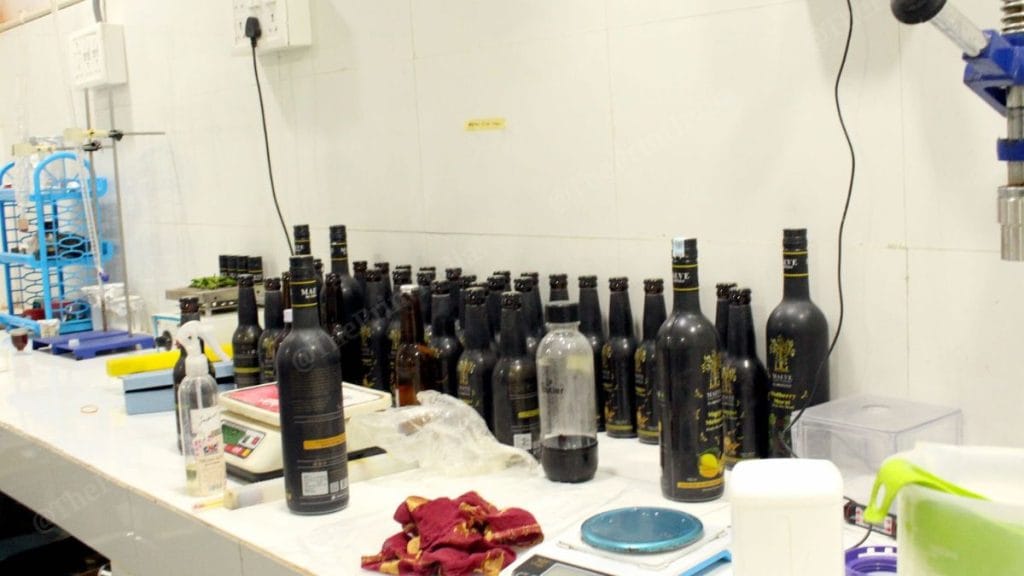
The winery building is functional, and the production is carried out on the ground floor, where large fermentation vats and a cold storage room full of fruit stand alongside sacks of malt and hops imported from Belgium. It also holds a lab where Singh’s winemaster experiments with new flavours. A tasting room is ready and waiting.
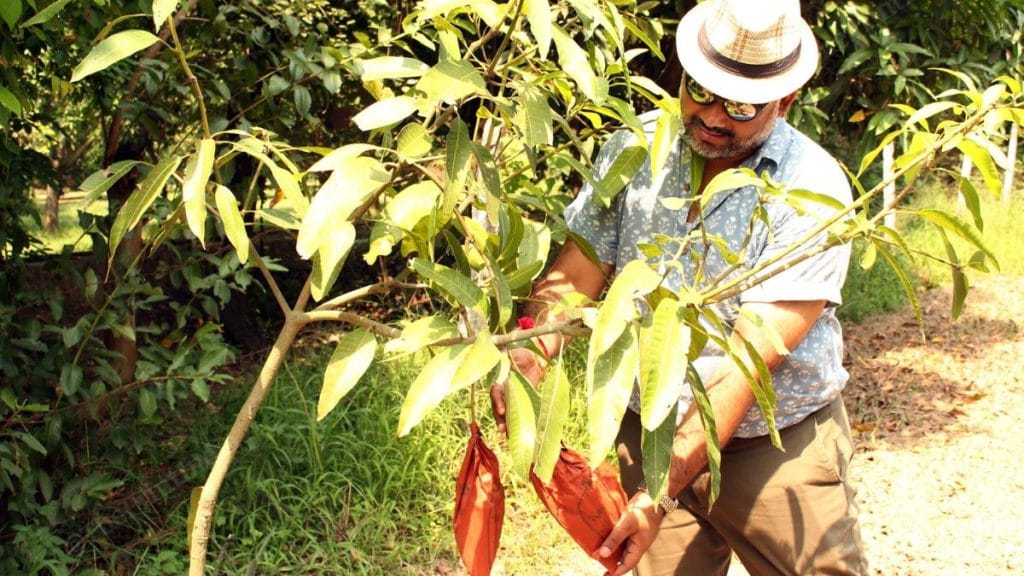
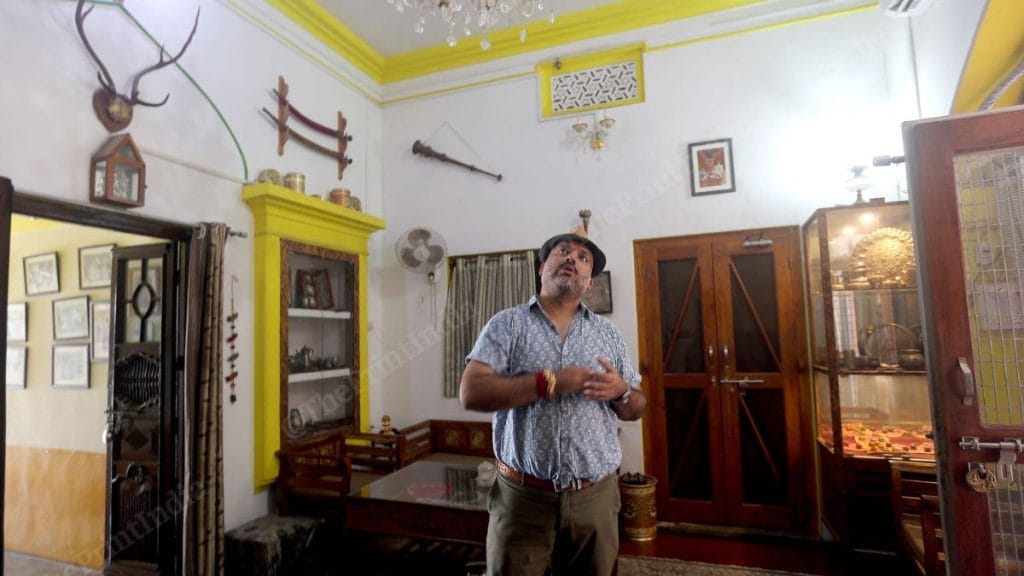
The second floor houses his office. Outside, generations of mango trees stretch into the afternoon haze, surrounding Singh’s farmhouse, a white building with a historical charm, built by his ancestors.
Singh is not simply a winemaker. He belongs to the lineage of warrior-farmers whose roots trace back to Jodhpur.
“We are the Rathors from Jodhpur,” he said, gesturing broadly. “They (his ancestors) were on their way to visit Nilsar when they decided to place their camp here. They used bamboo stumps to build those camps, and later they saw that shoots had started sprouting out of that bamboo—which meant that the soil was fertile, and was also an auspicious sign.”
After that, they conquered 55 villages, and then his family became farmers, Singh said, adding, “We also promoted mangoes in the area, teaching people how to grow them. We were not rajas or maharajas. We were warriors who used to go on call. We have never used the prefix raja for ourselves — but people do.”
A 200-year-old business
On a wooden table in the tasting area, Singh is slicing mangoes. He holds the knife with practised precision, making two deliberate cuts. His father taught him the method, and his father was not forgiving about sloppiness.
“If the seed is not cut like this, my father used to scold me a lot,” he said, peeling back the flesh with a clean stroke. “First cut we make to analyse the depth of the seed. And the second cut we make to slice the thing out of the mango.”
The smoothness of the cut, he insists, matters. Not as an aesthetic preference, but as a marker of understanding. It denotes how well you know the fruit.
He is equally firm about how mangoes are eaten and judged. Someone once told his father that a mango was not sweet enough. Singh recalls this with the quiet exasperation of a man who has heard the complaint too many times.
“Mango is always eaten for taste, not for sweetness,” he said. “That’s why it’s the king of food.”
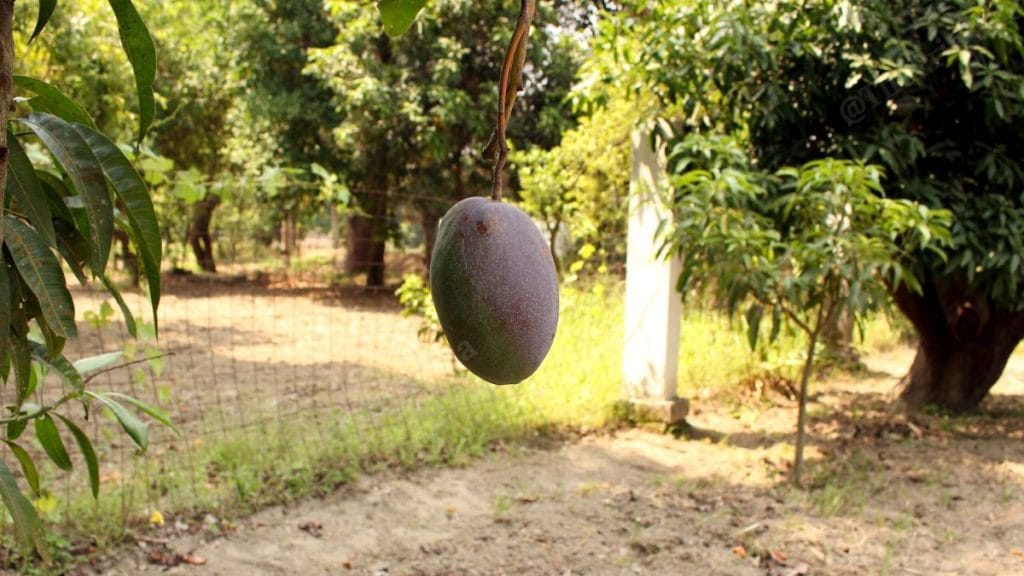
His family began commercial cultivation of mangoes in Malihabad roughly 150 to 200 years ago. They were among the first to plant orchards here, and they trained other farmers in cultivation. The Gangetic plains soil, he says, is uniquely suited to the fruit. Today, Malihabad’s GI certification is its proof: no one can sell mangoes under the name unless they were grown here. Singh draws the comparison without irony.
He picks up a mango of uncertain variety, turns it over, and admits — with some amusement — that even he cannot identify it.
“Yesterday, my brother and I were sitting and discussing. Now, neither knows whether it belongs to the Gulaab Khas variety nor anything else. No one knows the name of it,” Singh said.
This, he explains, is precisely what makes the mango unlike any other fruit. You cannot simply plant a seed and get the same mango back.
“If you plant this seed, a mango tree is not going to grow out of it,” he said. “You don’t get the same mango out of the seed of a mango. You have to do grafting — then you get the same. That’s why we have 60 varieties. Mangoes are like humans. If you plant an apple, it’s the same apple. If you plant an orange, it’s the same. But not mangoes.”
And the seed itself, he argues, is the most overlooked part.
“The fibrous stuff that generally comes off the mango’s seed is considered to be extremely healthy. It has modules — when you take the juice out of those modules, it’s considered to be the most anti-cancerous. That is why it’s said that the seed of the mango should be cleaned while eating,” Singh said.
Also read: After Japan, now Nepal has also banned Indian mangoes
Bottled dreams
The antiques at Singh’s house span generations. Khadau chappals, his grandfather wore. A walking stick. Paan-dans were passed down through the family. At his office, Singh keeps a set of coasters he once stole as a child from his father’s table — a small act of sentiment that now carries more weight than he expected.
His father had built the biggest fruit processing unit in northern India. Then it shut down. Singh was a child when it happened, but the memory keeps coming back to haunt him.
“It’s actually a recreation of his dream,” he said. “He was very passionate about mango farming. That is why all my sisters and I have our names starting with the letter M.”
Singh did his post-graduation in agri-business, then moved to Mumbai to work in food processing, dispatching orders for Reliance Fresh during the early days of modern retail in India.
He now works with a winemaster named Vishal, a native of Kannauj, UP, who had trained at Sula Vineyards on the Bengaluru-Mysore highway.
“I interviewed multiple people, and I really liked his energy and passion,” Singh said. “I asked him if he could experiment, and he was willing to do so. He is more of an innovator — he is the one who developed a mango chilli flavoured wine, which we will be launching soon.”
For three years before the winery’s construction, Singh had employed a winemaster without commercial production — simply to test whether he could create a product that was good enough.
“Without work, for three years, I kept him here to discover if I will ever be able to make a product that can compete with big giants,” he said. “Finally, when I was sure, I started setting up this path.”
Also read: Japan says no to Indian mangoes after 20 yrs. Raises questions about monopoly, say exporters
‘Want to maintain our standards’
The machines for the winery came from Chennai. The multi-flower honey reared on the farm comes from hives on the property. The mangoes are mostly from Singh’s own orchards, partly purchased from neighbouring farmers: generally, the fruit that has fallen from the tree and is dented so it cannot be used for sale, but is fully ripe. He pays Rs 400 to Rs 600 for one crate. One bottle of wine requires four to five mangoes.
The current range of wine includes mango, banana, mulberry, and traditional mint. A mango-chilli and a beetroot-jamun mixed-fruit variant is coming. Singh is also thinking about a paan-flavoured product. A beer base with honey is priced at Rs 180; without honey, Rs 140. The wine bottles sell at Rs 1,200.
All of it, he is careful to note, is alkaline — with a pH above 4, compared to the below 4 pH of most wines and beers.
“White wine’s pH is generally 3.3, red wine is 3.6,” he said. “All our products are above 4 pH. Our alkalinity is way better than any other alcoholic beverage. This is what we want to maintain.”
He pours a small measure, swirls it, and holds the glass out.
“Most of you must be used to smelling artificial flavours and strawberry ice cream in your alcohol,” he said. “But this is the actual natural aroma of fruits. It’s very slight, doesn’t smell too overpowering. And you might be able to smell the honey, because in this, we do not use any sugar.”
He pauses. “Even the alcohol in this is natural. This is not spirit added. This is natural alcohol,” Singh said.
What Singh makes, technically, is mead — fermented honey — blended with fruit wines. He argues that mead is not a foreign drink at all, but deeply woven into Indian and pan-Asian history.
“The grape wine that we drink is us following Western culture,” he said. “But our wines are according to our own culture. It is in sync with our system. This was invented to decrease inflammation in the human body in medieval times. It improves your skin, it improves your gut, and it is called the drink of immortality. It is the somras.”
He said that the term ‘honeymoon’ came from this.
“Because in a Scandinavian country, a couple was given this drink so that they could grow their family. So for a whole month, the couple was given free mead,” he added.
Also read: India’s ‘mango diplomacy’ reaches Seattle. Kesar frenzy empties shelves in hours
‘Mango is a mix of many things’
The winery was inaugurated in the middle of last year’s mango season. It has not been a year, and Singh already has two shops in Lucknow and one recently opened in Lakhimpur, after obtaining special government permissions when regular alcohol shops declined to carry the stock. Singh now has clearance to open two shops in each of UP’s 75 districts.
On 15 June, the Hindustan Times reported that UP’s first vineyard tour was scheduled to launch, which was inaugurated by the state’s excise minister, with Saturday slots available for Rs. 500 per head. Mango-eating competitions, straw-weaving demonstrations, and nature walks are planned alongside the tasting.

The excise policy changes that enabled the winery were themselves significant. Two more wineries are reportedly in the pipeline in UP — one in Saharanpur, one in Muzaffarnagar.
Singh, for now, is focused on the product.
“Mango is aroma therapy, taste therapy, nutrition therapy,” he said, lifting a freshly cut slice. “Mango is just not mango. Mango is a mix of many things. That’s why it is an intricate part of the culture.”
He sets the slice down, wipes the knife clean, before reaching for his next target.
(Edited by Saptak Datta)