





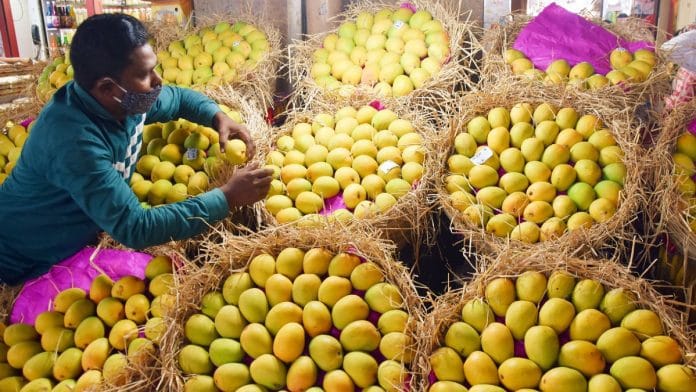

New Delhi: While Indian mangoes are being celebrated globally, Japan has stopped importing the fruit from India this season after an inspection team found irregularities in production at the country’s facilities.
Tonnes of Kesar, Alphonso, Langra and Banganapalli are exported to Japan every year since 2006, but this year a ban has been slapped after two decades. Previously, Japan banned Indian mangoes in 1986 over reported fruit fly infestations. That ban was lifted after 20 years.
Every year, before the mango season, Japan sends inspectors to oversee the vapour heat treatment (VHT), a non-chemical quarantine process that keeps mangoes free of pests in hot and humid air.
This year too, a team of quarantine officers from Japan, who were on inspection in Rehmanpur, Uttar Pradesh, in March, found deficiencies in fumigation and related disinfection measures at Indian treatment facilities, prompting the country to impose a ban on mango imports.
Yokohama Plant Protection Association, a public-interest organisation in Japan that supports quarantine plans, notified that mango shipments carrying inspection certificates issued by India on or after 25 March this year are not accepted anymore, reported ET.
The association further stated that mangoes would only be accepted after operational standards are improved.
“There is a completely new treatment system to increase the quality of Indian mangoes. If only Japanese-made systems are approved, then it raises questions about monopoly and diplomacy rather than technical compliance”, said Akram Baig, exporter based out of Uttar Pradesh.
Exporters also claimed that Japan wants to have a monopoly in treatment and quality control.
Unhappy mango exporters
Japan, a country known for its quality of products, whether it is mangoes or fish. Considering the country’s strict rules, the Indian government opened several VHT plants in India, starting with the Tirupati VHT plant in 2007.
Since then, India has been exporting mangoes after careful treatment.
But while Japan is not among the most “important” buyers, exporters are unhappy with the development.
Speaking to ThePrint, Baig, who had exported around 2.5 tonnes of mangoes to Japan in 2025, said that although the “Japanese market is not that big”, it is still very relevant, given that this year the domestic market is also facing “trouble and we are losing money”.
“How can every facility’s mangoes be rejected?” questioned Baig, who owns an agricultural trading and export company called Dr Nature.
“It almost seems as though the inspection team arrived with the intention of failing these facilities regardless of their actual performance”, he added.
Also read: Mumbai to Mexico—world’s birth rates are in freefall. And no, feminism didn’t cause it
Top 5 mango exporters
Last year, nearly two million dollars’ worth of mangoes were exported to Japan, especially from Gujarat’s Kesar.
India’s top five mango exporters are the US, UAE, UK, the Netherlands and Saudi Arabia, with Malaysia also testing the waters.
The Indian government has not publicly commented on the ban. However, the president of the Mango Grower Association of India, S Insram Ali, told ThePrint that the Centre is already in talks with the Japanese government.
“We were promised some solution”, he said.
But with the season coming to an end, the ban is unlikely to be lifted soon.
(Edited by Saptak Datta)
The section titled “Top 5 mango exporters” is wrong. It should be importers. Countries who buy from us, are called importers. We become the exporter then.
Even in the body of that section, which talks about the top 5 countries that import mangoes from India, this error continues.
This news piece is not cohesive.