



New Delhi: The world’s strongest coral bleaching events in the past three decades have all been associated with the El Nino phenomena, but a new study has found that human-led climate change is the biggest contributor to these events.
Published in the Oceanography journal on 21 July and led by an international group of researchers from Climate Central, the study showed how the ocean heat that led to massive coral bleaching in the world was linked to anthropogenic reasons, not a weather phenomenon like El Nino.
“Our study shows that without climate change, coral bleaching would be a rare and isolated event, and global mass coral bleaching simply would not occur,” said Andrew Pershing, Chief Program Officer at Climate Central and lead author of the study.
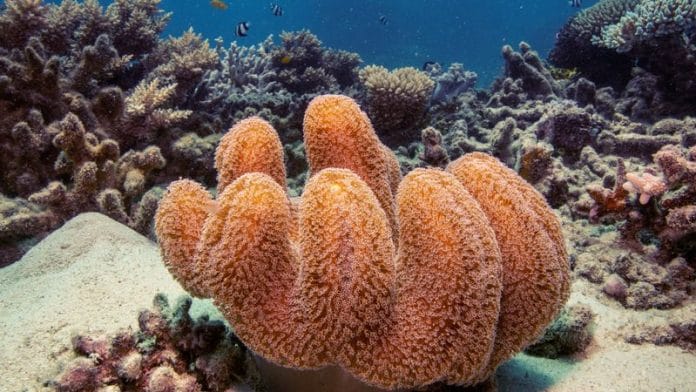
Coral bleaching events occur when coral reefs lose their colour due to external stressors, mainly rising ocean temperatures. This is because corals expel the algae that contribute to the colours we see. The Great Barrier Reef in Australia, the Red Sea Coral reefs, Maldives Atoll reefs, and the Andaman and Nicobar Island reefs are some of the famous global coral reefs. Bleaching does not just impact coral reefs’ colour, but also their energy, since the algae help produce energy through photosynthesis.
Also read: NGT orders DDA and Delhi flood department to end Yamuna floodplain deadlock
Rising risk
The study by Climate Central looked at the main global bleaching events — 1998, 2010, 2014-17, and 2018-2025 — and how they coincided with El Nino events. El Nino is a weather phenomenon in which sea-surface temperatures rise higher than normal, and it is a part of a global phenomenon that leads to rainfall and other climate changes too.
Since the coral bleaching events coincided with El Nino years, the study explained how it was difficult to isolate the impact of climate change on them.
However, the authors of the study used a multi-model extreme event attribution method, to understand how climate change, and especially anthropogenic greenhouse gas emissions, impacts coral bleaching. They also compared it to the coral bleaching risk model that was developed by the US-based National Ocean and Atmospheric Administration (NOAA).
They found that in the 2018-2025 coral bleaching event, which was the last such event, the majority of the risk was because of human-caused climate change.
“Of the 71 regions where coral bleaching was observed, only one region would have had a moderate risk of bleaching in a world without climate change,” said the study.
Moreover, the study also found that this was the case with other global coral bleaching events since 1998; El Nino was never the only contributing factor to the bleaching event. This analysis by the scientists was also extended to the current El Nino that is underway in the world.
Researchers found that while El Nino conditions would contribute to certain, low-level coral bleaching in 2026-2027, there is a much bigger risk from climate change. Coral reefs in regions like the Caribbean, the Central and South American coasts, and the coasts of eastern Asia are especially vulnerable this year to bleaching, found the study.
“Millions of people and entire countries rely on healthy coral reefs for livelihoods and food security,” said Pershing. “Without immediate emissions reduction, coral reefs as we know them will disappear.”
(Edited by Aamaan Alam Khan)