





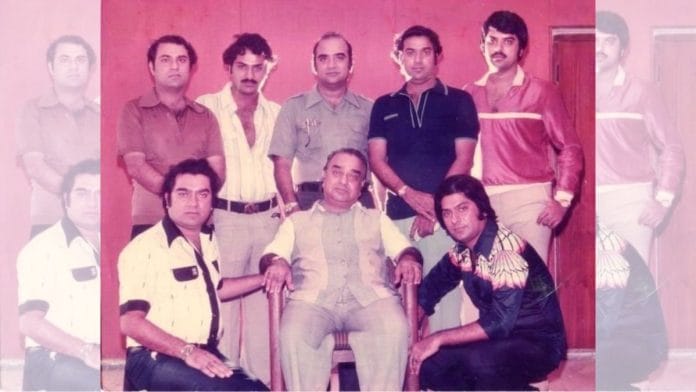


New Delhi: Dismissed as ‘C-grade’ filmmakers, the Ramsay brothers turned budget horror films into box-office phenomena in the 1970s and 1980s. Now, Deepak Ramsay, son of filmmaker Tulsi Ramsay, opened up on the persistent ridicule the family faced despite consistent financial success in the Hindi film industry with cult films like Purana Mandir, Veerana, and Purani Haveli.
“Our movies were made on a shoestring budget. It was experimental cinema at that time. You were gathering new artists, introducing creatures, taking the team to Mahabaleshwar, and then making the entire film there, it was like a family trip for them,” said Deepak on a Hindi Rush podcast.
While big studios worked with lavish budgets, giant crews and expensive productions, the Ramsays operated on minimal resources, often shooting entire films in locations like Mahabaleshwar with smaller teams and newcomers.
“Filmmakers would work with hundreds of people, have vanity vans, huge budgets and massive expenses, and despite all that, the films wouldn’t always work. Meanwhile, the Ramsays’ low-budget films would consistently make money. Many distributors earned so much from our movies that they eventually became established distributors,” he said.
Also read: Why Vashu Bhagnani’s Pooja Entertainment is suing Tips Music? A battle for the beats
Prithviraj Kapoor inspired the Ramsays
FU Ramsay, the patriarch of the Ramsay family, got the idea of exploring the horror genre in Hindi cinema because of Prithviraj Kapoor.
Ramsay came to Mumbai and started an electronics business. However, financial struggles pushed him toward film production, but most of them failed at the box office. In 1970, he took a major risk by backing Ek Nanhi Munni Ladki Thi, starring Mumtaz, Shatrughan Sinha and Prithviraj Kapoor.
This film too flopped commercially, but he observed that during the night-time heist sequence, when Prithviraj Kapoor’s character appeared in heavy prosthetic makeup, the audience screamed. That’s how they got the idea of making a full-fledged horror film.
The Ramsay brothers’ debuted with Do Gaz Zameen Ke Neeche in 1972. The film was made with less than Rs 5 lakh. Deepak revealed that because the film made 7 times the return on their initial investment, they stuck with similar concepts. During that phase, they made 50 films, all in the horror, supernatural, and murder mystery genres.
While the Ramsay Brothers did not initially receive much recognition from the film industry in the 1970s, things changed after the success of Purana Mandir. It was then that even Bollywood’s big shots, including the Kapoor clan, began taking notice of them.
Also read: Vijay allocates film portfolio to comedian Rajmohan. Why Tamil film industry is divided
Amicable relations with the Kapoors
The Ramsays were among the few filmmakers bold enough to release their films alongside movies of superstars such as Amitabh Bachchan, Rajesh Khanna and Dharmendra.
At the time, clashing with an Amitabh Bachchan film was considered a guaranteed disaster, but the Ramsays trusted the audience pull of their horror cinema.
Addressing comparisons with Bollywood’s influential Kapoor family, Deepak said the two families operated in completely different cinematic spaces and shared “an amicable relationship.”
“Raj Kapoor’s style of filmmaking and genre were completely different, so there’s no comparison between Kapoor and Ramsay films. We have been working since the time of Prithviraj Kapoor. But in no way were the Ramsays lesser filmmakers. The entire family functioned like a film factory. They would complete a film from start to finish and ensure that it became a hit,” he said.
Also read: Ram Charan thanks Salman and Aamir for Peddi. Here’s why
Veerana’s many cuts
Deepak said that since the films were going to get an ‘A’ certificate because of the gory content, they pushed further with semi-nudity and intimate scenes.
He then said that some of their films had an “inherent requirement” for sensuality. Veerana (released in 1988), one of their biggest hits, was one of those films.
“Veerana had an inherent requirement for sensuality. A ravishing woman or a ‘chudial’ (witch) who is wandering the streets at night and is looking for a companion,” he said. The Central Board of Film Certification (CBFC) wanted multiple cuts.
It was ultimately released after they went to the tribunal.
“They gave an ‘A plus’ certificate, made a lot of cuts and then the film was released. It was a nightmare, as far as the censors were concerned,” he said.
(Edited by Theres Sudeep)